

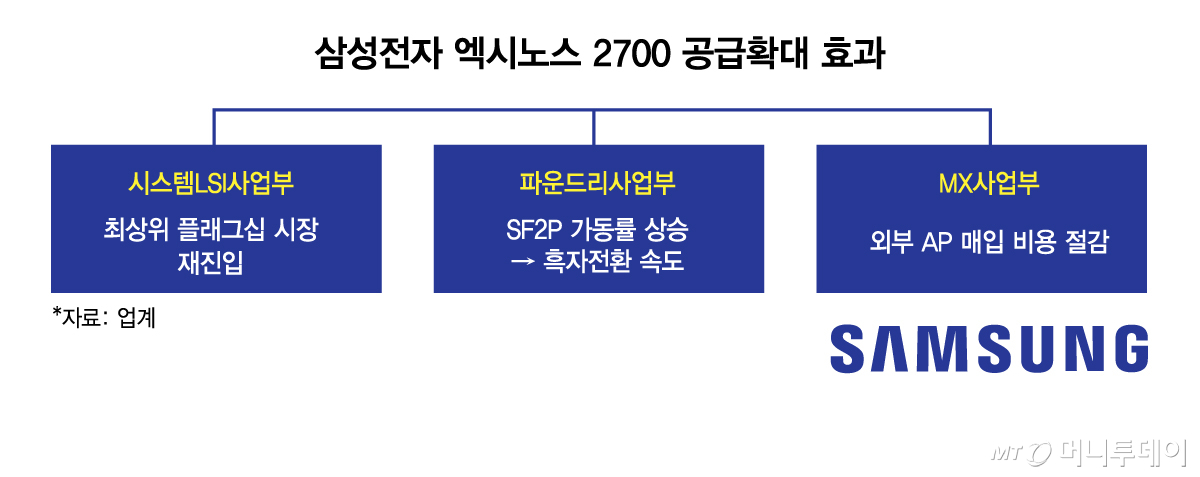
Samsung Electronics' decision to once again apply its own mobile application processor (AP), 'Exynos', in the Galaxy S27 flagship (ultra) model is a strategic move to reduce reliance on external APs and enhance the competitiveness of non-memory semiconductor businesses, including system LSI (semiconductors) and foundry (semiconductor contract manufacturing).
The background for this decision lies in the stabilized performance of 'Exynos' produced by Samsung's System LSI business unit. Internally, it is already being evaluated that Exynos' performance has reached a level sufficient to expand the scope of its application as an internal AP. In fact, the next-generation 'Exynos 2700' is scheduled to be manufactured based on SF2P, Samsung Foundry's second-generation 2nm process. According to recent internal evaluations, it recorded superior performance across key indicators including CPU (central processing unit) and GPU (graphics processing unit) capabilities, as well as AI (artificial intelligence) computation and power efficiency, compared to Qualcomm's next-generation Snapdragon. The previous model Exynos 2600, which was included in the Galaxy S26 series, also received more positive market evaluations than expected, boosting confidence in the performance of the next generation and its expanded application.
Cost burdens in the smartphone business are also increasing the value of utilizing internal APs. According to Samsung Electronics' semi-annual report, the DX (Device Experience) division recorded an operating loss of 818.8 billion won in the second quarter this year, with the MX (Mobile Experience) business unit accounting for approximately 700 billion won of that loss. With profitability deteriorating due to rising prices of major components including memory semiconductors, mobile APs also involve significant costs. Samsung Electronics' purchases of mobile APs from external semiconductor companies such as Qualcomm and MediaTek in the first half of this year reached 7.4383 trillion won. This figure represents 17.9% of the total raw material procurement costs for the entire DX division during the same period.
In a situation where the burden of purchasing external APs has increased, expanding the application of internal APs can serve as a card to lower manufacturing costs and enhance negotiation leverage with Qualcomm. This change is also an opportunity for the System LSI business unit. As system LSI re-enters the flagship market, which Qualcomm has virtually monopolized, it can significantly expand its position within the global AP market. Although the System LSI business unit achieved record-high sales in the first half of this year, an annual deficit is expected. Expanding the supply scope of Exynos 2700 will lead to increased AP sales, contributing to improved profitability for the business unit.
The Foundry business unit can also secure benefits beyond simply securing order volumes. Securing internal volume through Galaxy flagship models is expected to help improve production efficiency in the SF2P process. Samsung Electronics previously stated during its second-quarter earnings announcement conference call last July that it could soon turn the foundry business profitable based on yield improvements and increased utilization rates. Once mass production of Exynos 2700 begins from the fourth quarter this year, advanced process utilization rates could surge, which is expected to positively contribute to accelerating the timing of the Foundry business unit's turnaround to profitability.
An industry insider stated, "Since APs account for a large portion of smartphone costs, increasing the share of internal APs itself is a means for Samsung Electronics to defend profitability." They further predicted, "If Exynos becomes established even in flagship models, performance improvement effects will appear across the entire System LSI and Foundry businesses."

 in INDUSTRY
