

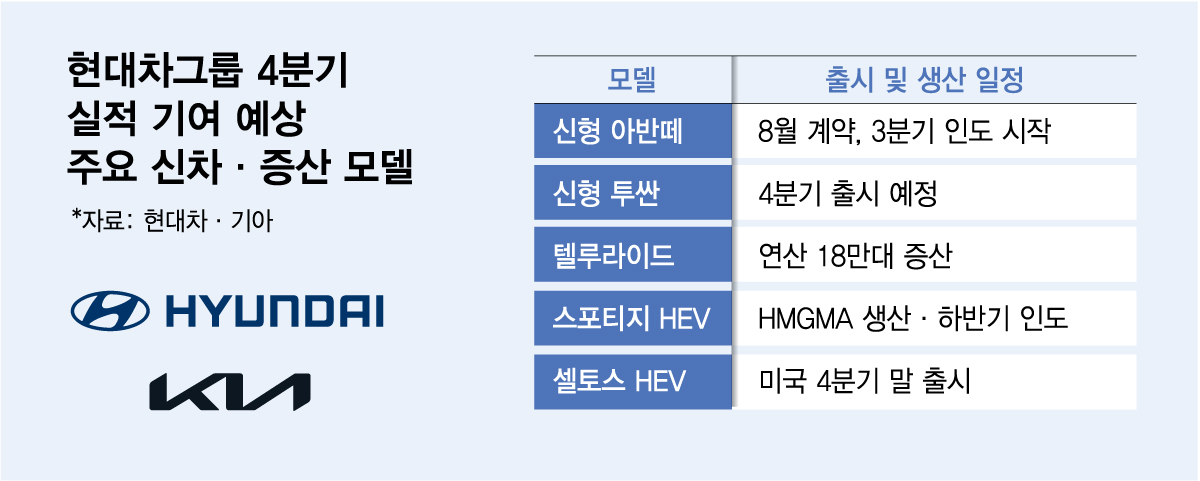
Hyundai Motor Group aims to rebound in the fourth quarter, overcoming production disruptions from last quarter's strike and the burden of U.S. tariffs. Hyundai will focus on recovering lost production volumes due to the strike, while Kia will prioritize increasing supply of high-margin hybrid electric vehicles (HEVs) in the United States.
According to industry sources on the 8th, Hyundai has set a goal to recover more than 90% of the approximately 50,000 units lost during this year's wage negotiations by the end of the year. Kia plans to further boost its global HEV sales volume, currently at around 55,000 units per month.
Hyundai experienced a total of 60 hours of strikes during this year's wage negotiations. On the 21st of last month, an eight-hour full-scale strike, the first since 2016 after a decade, halted production lines at Ulsan, Asan, and Jeonju plants. The automotive industry estimates cumulative production losses at approximately 55,200 units, with corresponding revenue losses exceeding 230 billion won.
Hyundai has begun expanding production this month. By adjusting production volumes and model allocations, it plans to recover more than 90% of the lost output by year-end. Based on industry estimates of the production disruption scale, a simple calculation shows that approximately 50,000 units must be recovered within the year.
The effects of increased production are expected to begin in mid-month and fully take off next month. In the automotive industry, the fourth quarter is a period when promotional campaigns for meeting year-end sales targets coincide with new model deliveries. For Hyundai, expectations for recovery are high as both the base effect from third-quarter production disruptions and expanded deliveries of key new models occur simultaneously.
The eighth-generation Avante, whose contracts began last month, recorded 11,094 units on its first day, setting a record high. Once customer deliveries commence, the fourth quarter will effectively become the first quarter with complete sales performance applied. The launch of the all-new Tucson is also scheduled for the fourth quarter. Since both models are representative global volume (popular) models for Hyundai, normalizing production is expected to lead to actual sales recovery. High demand for upper trims and HEV models in the early stages of new car launches is also a factor improving average selling prices and profitability.
Kia aims to increase sales volumes by leveraging HEVs. It plans to maintain its current electric vehicle (EV) sales flow, currently at around 40,000 units per month, through the second half of the year while additionally expanding HEV sales volume to around 55,000 units per month.
High-margin SUVs produced and sold in the United States are also expected to drive Kia's performance improvement. Kia has confirmed a plan to increase the annual production capacity of the Telluride from 120,000 units to 180,000 units, a 50% increase. This follows the production volume expansion plan announced in April for an additional 180,000 units annually.
Sportage HEVs manufactured at Hyundai Motor Group MetaPlant America (HMGMA) will begin deliveries to local customers from the second half of the year. Since both the Telluride and Sportage HEV are produced in the United States, expanded sales will reflect reduced burdens from import tariffs. Additionally, Kia will introduce the Seltos HEV to the U.S. market by the end of the fourth quarter this year.
Kia's HEV sales are showing a steep upward trend. Global sales volume for the second quarter reached 178,000 units, a 61% increase compared to the same period last year. U.S. sales volume reached 66,000 units, a 151.6% increase. Meanwhile, Kia's U.S. sales volume last month totaled 83,793 units, setting a new all-time monthly record.

 in INDUSTRY
