

Amid a more than 50% surge in the global DRAM market this second quarter driven by AI (artificial intelligence), Samsung Electronics solidified its top position by leveraging its supply capacity for general-purpose products, widening the gap with SK Hynix, which holds a higher proportion of HBM (high-bandwidth memory).
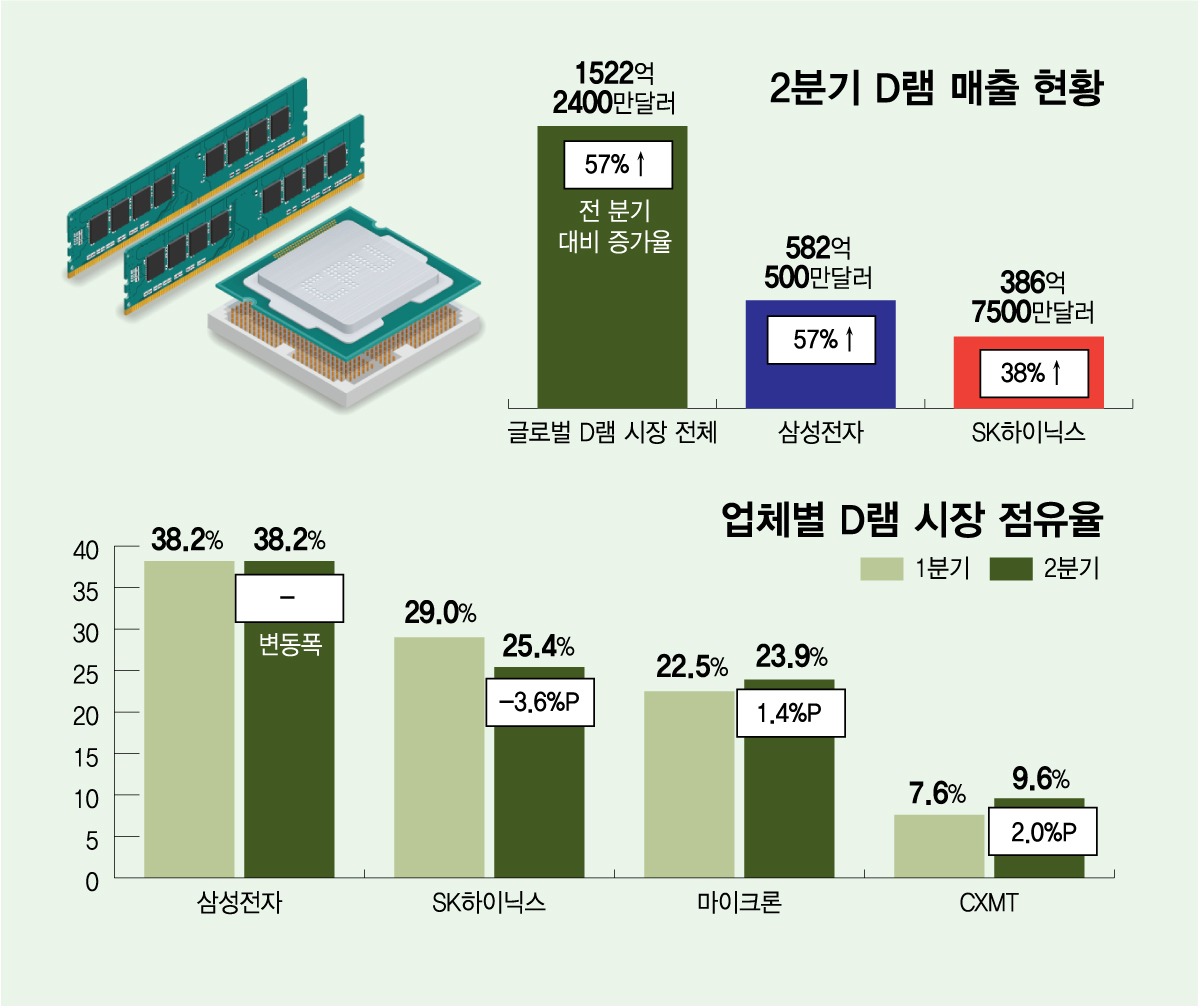
According to Counterpoint Research, a global market research firm, global DRAM market revenue reached $152.224 billion (approximately 204.68 trillion won) in the second quarter, up 57% from the previous quarter. This growth was fueled by rising demand for CPUs (central processing units) for AI servers and a sharp increase in general-purpose DRAM prices. As AI memory competition led by HBM spread to shortages and price hikes in general-purpose DRAM, product mix and supply capacity became key factors determining each company's performance.
During the same period, Samsung Electronics' DRAM revenue rose 57% to $58.205 billion (approximately 78.297 trillion won). Growing at the same pace as the market, it maintained a market share of 38.2%, identical to the previous quarter. Even as the market expanded by more than half in just one quarter, Samsung fully secured growth commensurate with its existing market share.
The competitiveness of general-purpose DRAM supported this outcome. Analysts note that demand for general-purpose DRAM centered on AI server CPUs exceeded supply, and Samsung Electronics secured sufficient supply volumes while reflecting price increases in revenue, thereby benefiting from the trend.
In contrast, SK Hynix's DRAM revenue increased only 38% to $38.675 billion (approximately 52.019 trillion won). Although absolute revenue grew, it fell short of the market growth rate by 19 percentage points (P). Its market share also dropped from 29% to 25.4%, a decline of 3.6 percentage points. This was influenced by SK Hynix's high proportion of HBM sales. Unlike the sharp rise in general-purpose DRAM prices, HBM faced weak average selling prices (ASP) due to price declines in HBM3E (fifth generation) and delays in launching HBM4 (sixth generation).
SK Hynix also faced disadvantages from having signed long-term agreements (LTAs) with competitors earlier than rivals. Contracts locked in at prices below current market rates before the price surge limited its ability to reflect sharp price increases in revenue.
Consequently, the market share gap between Samsung Electronics and SK Hynix widened from 9.2 percentage points in the first quarter to 12.8 percentage points in the second quarter. Compared to a year ago, the leadership race has completely reversed. In the second quarter last year, SK Hynix led with 39.2% market share against Samsung Electronics' 33%, ahead by 6.2 percentage points; however, this year's second quarter saw the opposite trend.
The decline in SK Hynix's market share was largely captured by U.S.-based Micron and China-based CXMT (Changxin Memory Technologies). In the second quarter, Micron's market share rose from 22.5% to 23.9%, while CXMT's increased from 7.6% to 9.6%. Combined, their gains totaled 3.4 percentage points, nearly matching SK Hynix's decline of 3.6 percentage points.
Future competition will likely be shaped by price trends in general-purpose DRAM and HBM. With the strong trend in general-purpose DRAM prices continuing, Samsung Electronics is expected to maintain its current advantage due to its competitiveness. However, if HBM prices recover and SK Hynix renews its existing LTAs at higher contracted rates, the growth rate gap between the two companies could narrow again. An industry insider stated, "With additional price increases in general-purpose DRAM expected in the third quarter, Samsung's performance is likely to grow further."

 in INDUSTRY
