

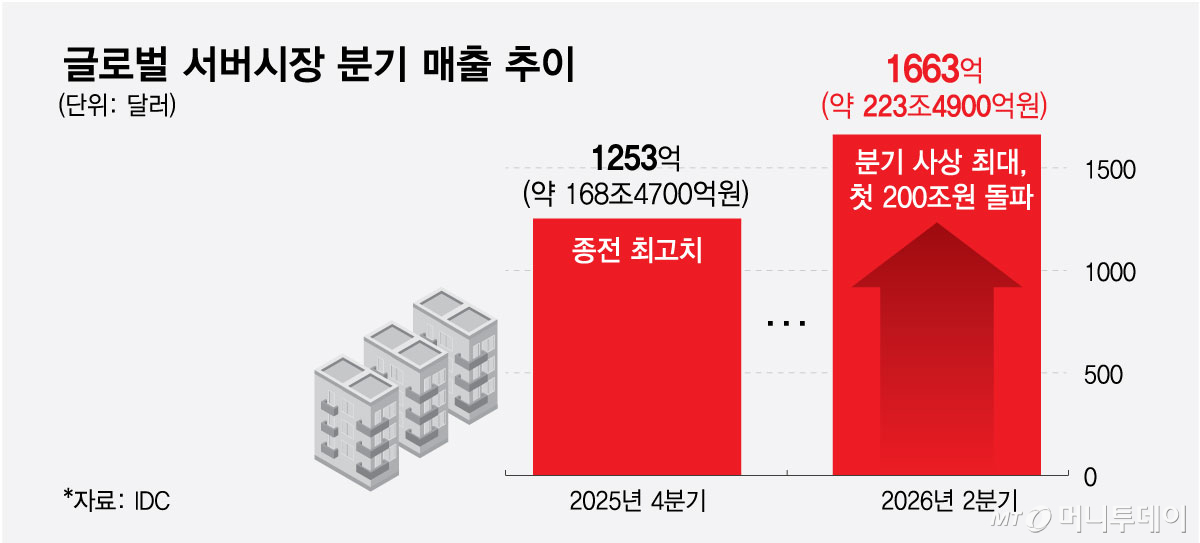
Driven by expanded investment in AI (artificial intelligence) infrastructure, global server market sales have surpassed 200 trillion won on a quarterly basis for the first time. With increased adoption of high-performance components for AI computation, the average selling price (ASP) of servers has also risen sharply.
As demand spreads across memory semiconductors as a whole — from HBM (high-bandwidth memory) to DDR5 (double data rate 5) and eSSD (enterprise solid-state drive) — favorable market conditions are expected to continue for domestic memory companies including Samsung Electronics and SK Hynix.
According to market research firm IDC on Monday, global server market sales in the second quarter of this year reached $166.3 billion (223.49 trillion won), marking a record high on a quarterly basis. This is the first time a single quarter's sales have exceeded 200 trillion won. The figure represents a 32.7% increase compared to the previous record of $125.3 billion (168.47 trillion won) set in the fourth quarter of last year.
Investments in AI infrastructure by hyperscalers (large-scale data center operators) and CSPs (major cloud service providers) have driven market growth. In particular, while global server shipments increased by 15.4% year-on-year in the second quarter of this year, sales grew by as much as 52%. This indicates that not only were more servers sold, but the ASP per server also rose significantly.
GPU (graphics processing unit) acceleration servers are a prime example. The ASP of GPU-accelerated servers rose 43.6% year-on-year to $170,200 (approximately 229 million won). Sales of other servers equipped with ASICs (application-specific integrated circuits) and similar components also surged by 237.6% during the same period. Analysts suggest that as AI infrastructure investments centered on NVIDIA GPUs diversify into proprietary AI accelerators developed by big tech companies, server specifications are becoming more advanced at a faster pace.
As the "value" of servers rises, Samsung Electronics and SK Hynix are expected to continue their growth trajectory. AI servers require not only HBM but also high-value, high-capacity memory such as DDR5 for data processing and eSSD for storing large-scale data. This context aligns with remarks made by Colette Kress, NVIDIA's CFO (chief financial officer), during a recent earnings announcement conference call for the second quarter of fiscal 2027: "Today's memory shortages are largely caused by AI deployment itself."
In fact, rising memory prices are a key factor driving up server ASPs. IDC stated, "Server suppliers cite rising DRAM and NAND flash prices along with increased component allocation as primary reasons for price hikes." This is also why global big tech companies are entering into long-term supply agreements (LTAs) with memory manufacturers. Samsung Electronics has already signed LTAs with major global tech firms and has now entered negotiations with five additional large customers. Typically, these contracts follow a "rolling" structure lasting five years, with the contract period extended by one year annually. SK Hynix has also secured LTAs with over ten customers, including key clients.
With expanded AI infrastructure investment and strong memory prices, earnings estimates for both companies are rising. According to financial information provider FNGuide, the combined operating profit consensus estimate (average analyst forecast) for Samsung Electronics and SK Hynix this year stands at 656.5054 trillion won—more than seven times their combined operating profit of 90.8074 trillion won last year.
An industry official stated, "AI servers have higher memory capacity and product specifications compared to conventional servers, creating a structure where growth in the server market directly translates into expanded demand for high-value memory." The official added, "As long as AI investment continues, demand for server memory—including not only HBM but also DDR5 and eSSD—will remain robust."

 in INDUSTRY
