

Although SK Hynix management and labor reached an agreement on the performance-based pay distribution method following two rounds of voting, controversy over the 'N% of operating profit' bonus persists. With record-breaking profits swelling the bonus pool to hundreds of millions of won per employee, the focus has shifted from the total payout amount to how treasury stock and other instruments can be used for distribution, making this a new focal point of the N% performance bonus debate. Opinions also diverge on how companies should allocate profits generated between employee compensation, shareholder returns, and future investments.
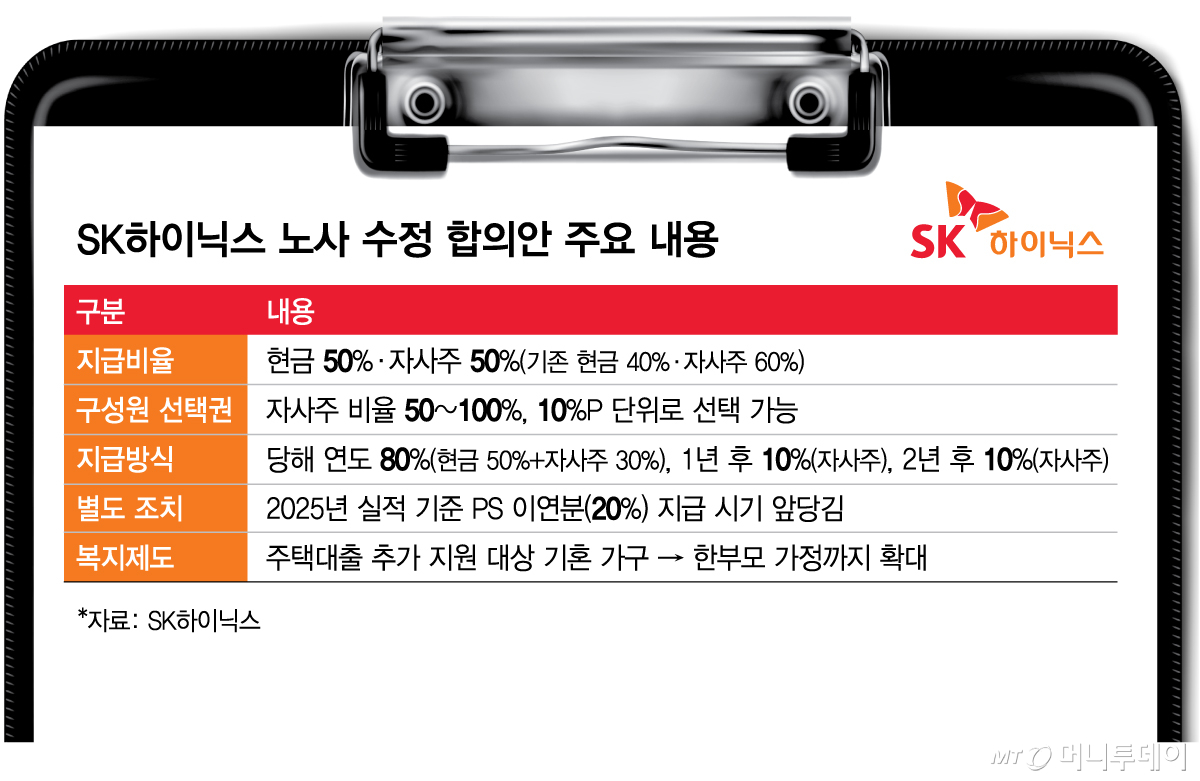
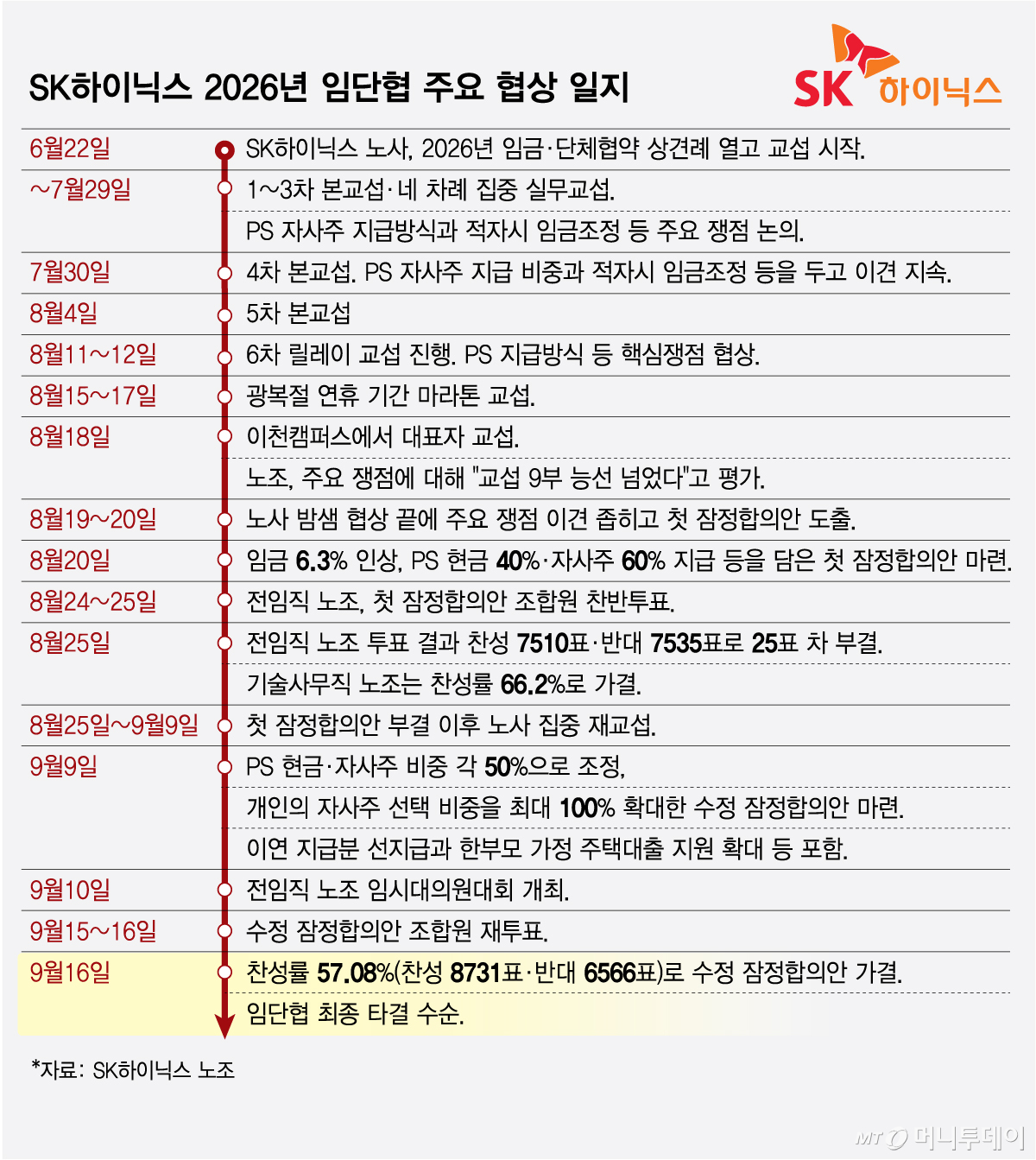
On the 16th, SK Hynix Labor Union announced that its revised agreement proposal, which sets the cash-to-treasury stock ratio for the profit-sharing (PS) payout at 50% each, was ultimately approved with 57.08% support in the '2026 Wage and Collective Bargaining Agreement Re-negotiation Proposal' vote held over two days starting on the 15th. The number of affirmative votes totaled 8,731, exceeding Ban (CEO) by 2,165 votes.
During this year's bargaining process, the most significant point of disagreement between labor and management was the payment method for PS. While both sides agreed to maintain the existing framework that utilizes 10% of operating profit as the funding source without a cap, a proposal emerged to pay part of the PS—previously paid entirely in cash—in treasury stock. Although labor and management broadly agreed on using treasury stock for payment, they faced difficulties negotiating the respective proportions of cash versus treasury stock.
Resistance from employees over the payment method had already intensified before the first tentative agreement was reached. The newly formed unified union launched last month demanded full cash payment for PS. Subsequently, a first tentative agreement drafted by management and the existing union proposed paying 40% in cash and 60% in treasury stock, but this was rejected in a yes/no vote by production workers on the 25th of last month by a narrow margin of just 25 votes.
Following this, labor and management conducted re-negotiations for about two weeks and found common ground by increasing the cash payment proportion to 50% and expanding stock option eligibility. Notably, during the runoff vote process, the union also made concerted efforts to persuade employees. They held approximately 60 explanation sessions targeting all employees to clarify the rationale and benefits of the policy changes. The revised proposal passed with a support rate more than 7 percentage points (p) higher than in the first vote.
An SK Hynix official stated, "We are grateful to the union and employees for their cooperation through this difficult process," adding, "Moving forward, we will face upcoming challenges together as a company and workforce, working collaboratively to overcome them."
Controversy over 'N% of operating profit' performance bonus payment method
At the heart of the conflict over the performance bonus payment method lies the unprecedented scale of bonuses, which have swelled to record levels. In the securities industry, forecasts suggest SK Hynix's operating profit this year could reach approximately 250 trillion won. If 10% of operating profit is allocated as the PS funding source, the total pool would amount to roughly 25 trillion won. While amounts vary by rank and salary, the average pre-tax PS per employee is estimated to reach about 700 million won.
As performance bonuses have grown into the hundreds of millions of won range, the debate has shifted from "how much should be paid" to "how should it be paid." Last year, SK Hynix management and labor agreed to maintain the '10% of operating profit' performance bonus system for a decade. Revisiting this agreement after just one year placed burdens on both sides. Additionally, the method of paying entirely in cash has remained a contentious issue.
Around the same period, Samsung Electronics' Semiconductor (DS·Device Solutions) division, which also introduced an N% performance bonus system, opted for treasury stock as its payment instrument. Indeed, Samsung Electronics management and labor agreed during this year's negotiations to pay the DS division's special management performance bonus entirely in post-tax treasury stock. Thus, SK Hynix and Samsung Electronics, both initially planning to pay all bonuses in cash, have taken divergent paths.
Paying bonuses via treasury stock is interpreted as an effort to link employee compensation with corporate valuation while also considering other stakeholders such as shareholders. Cash payments lead to immediate outflows from the company's liquidity, whereas treasury stock payments result in variable actual compensation value for employees depending on future stock price movements. Furthermore, the company's share buybacks required to fund performance bonuses can have a positive impact on stock prices.
Controversy surrounding the N% performance bonus extends beyond payment methods. In a structure where higher operating profits automatically increase the bonus funding pool, another key issue arises: how to allocate resources between employee compensation and other uses such as R&D (research and development), capital investment, and shareholder returns. This is particularly critical in the semiconductor industry, where large-scale upfront investments determine competitiveness; it remains vital to decide how to divide windfall profits during boom periods between current performance rewards and securing future competitive advantages.
The agreement also addresses the challenge of how to share burdens when financial performance deteriorates during downturns. In this agreement, SK Hynix management and labor explicitly stipulated that up to 3% of wages can be deferred in case of losses. A company official explained, "This declaration signifies that both sides will jointly take responsibility not only for bonuses during profitable periods but also during loss-making periods, working together to overcome crises."
Institutional controversies surrounding the N% operating profit-linked performance bonus system itself continue. The Ministry of Employment and Labor recently issued implementation guidelines stating that management performance bonuses tied to a fixed percentage of corporate profits are difficult to classify under the Trade Union Act as mandatory bargaining subjects or as grounds for mediation or labor disputes. This is because operating profits serve diverse purposes beyond bonus distribution—including capital investment, R&D (research and development), and dividends—so mandating a specific portion be allocated exclusively to bonuses could infringe upon management's decision-making authority and shareholders' rights.
An industry official remarked, "The union likely could not ignore the social controversies sparked by the 'N% performance bonus' system," adding, "While it is regrettable that the proportion of treasury stock payments has decreased, concluding wage negotiations without resorting to strikes or other labor disputes is a positive outcome."

 in INDUSTRY

