

Daewon Pharmaceutical has signaled its entry into the domestic potassium-competitive acid blocker (P-CAB) market by pushing forward with an application for product approval of its new drug for gastroesophageal reflux disease (GERD), ‘Padoprazan,’ within this year. As existing products such as HK InnoN’s ‘Kaycap’ and Daewoong Pharmaceutical’s ‘Pezuclo’ seek to expand the market, the competitive landscape is expected to become significantly more diversified with the addition of the new drug.
According to industry sources on the 1st, Daewon Pharmaceutical recently confirmed that Padoprazan (DW4421) met its primary efficacy endpoint and demonstrated non-inferiority compared to existing treatments in a domestic Phase 3 clinical trial. The company plans to apply for product approval from the Ministry of Food and Drug Safety within this year after completing detailed analysis.
The trial was conducted at 22 medical institutions in South Korea, enrolling 328 patients with erosive gastroesophageal reflux disease. When Padoprazan at doses of 20mg and 40mg was compared with esomeprazole 40mg, an existing proton pump inhibitor (PPI), both doses met the pre-specified non-inferiority criteria. No statistically significant difference was observed in the incidence of adverse drug reactions, and no serious adverse events were reported.
Unlike existing PPIs, P-CABs are a class of drugs that suppress acid secretion by competitively acting on potassium ions. Compared to PPIs, P-CABs exhibit faster onset of action and have fewer restrictions on administration relative to meals. They have also emerged as a next-generation mechanism for treating reflux esophagitis, leveraging their relatively long-lasting acid suppression effects.
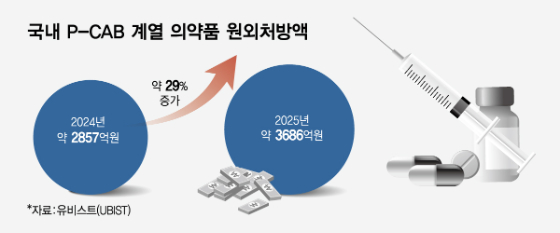
The domestic market has grown rapidly since the launch of Kaycap in 2019. According to pharmaceutical market research firm UBIST, out-of-hospital prescription spending on P-CAB drugs in South Korea reached 368.6 billion won last year, an increase of approximately 29% from the previous year. This year is also expected to comfortably surpass 400 billion won, continuing its growth trend.
Currently, HK InnoN’s Kaycap leads the market, having recorded prescription spending of approximately 220 billion won last year. Launched in South Korea in 2019, Kaycap has established itself as a representative product in the P-CAB market through rapid growth. In the third quarter of this year as well, it recorded out-of-hospital prescription spending of 65.4 billion won, a 16.5% increase from the same period last year, marking its highest quarterly performance to date.
HK InnoN is expanding its business in overseas markets based on its domestic prescription performance. In China, it has secured royalty (regular technical fee) revenue from local sales, while in the United States, it is proceeding with approval procedures through a local partner. The decision regarding approval by the U.S. Food and Drug Administration (FDA) is expected to be confirmed in early next year. Additionally, the company is pursuing partnerships for entry into the European market.
Daewoong Pharmaceutical’s Pezuclo, launched in 2022, is also expanding its domestic prescription base overseas. Launched in South Korea in 2022, Pezuclo is the second domestically produced P-CAB new drug to enter the market after Kaycap, with prescription spending projected to exceed 100 billion won this year. Since the launch of Pezuclo, Daewoong Pharmaceutical has pursued overseas product approvals and local launches alongside expanding domestic prescriptions. It is currently proceeding with global commercialization by increasing sales regions through cooperation with overseas partners.
OncoTherapeutics’ ‘Zaqubo’ also joined the competition with its launch in the fourth quarter of 2024. Since its launch, Zaqubo has recorded prescription spending of over 50 billion won in the first half of this year, chasing existing products. Furthermore, Takeda Pharmaceutical’s ‘Bontenti’ from Japan entered the domestic reimbursement market starting this month, further diversifying the competitive landscape of the P-CAB market.
Daewon Pharmaceutical is a late entrant that must compete with products already established in the market. Although it secured non-inferiority compared to existing PPIs in its Phase 3 trial, this serves as efficacy evidence for approval and does not prove superior therapeutic effects compared to existing P-CAB products. Therefore, future approved indications, drug pricing, prescription convenience, and sales networks are cited as factors that will determine market establishment.
Overseas commercialization is also a significant challenge. Since Kaycap and Pezuclo have expanded their business scope through overseas approvals and local sales after their domestic launches, Daewon Pharmaceutical must secure additional growth opportunities abroad, not just enter the domestic market, to overcome the limitations of being a late entrant. As Daewon Pharmaceutical has not yet launched the product domestically, it plans to first focus on establishing its position in the domestic market and expanding indications.
A Daewon Pharmaceutical official stated, “We will strive to provide new treatment options for patients with gastroesophageal reflux disease by proceeding with detailed analysis and product approval procedures without any issues.” The official added, “We are currently conducting a Phase 3 trial for non-erosive gastroesophageal reflux disease (NERD) and preparing clinical trials to obtain additional indications.”

 in THEBIO
