

While Samsung Electronics and SK Hynix have concentrated their production capacity on high-bandwidth memory (HBM) and server-grade DRAM, China's Changxin Memory Technologies (CXMT) has begun expanding its mobile DRAM output. By enhancing productivity through its fifth-generation DRAM process, Yangsan, and broadening its customer base to include mobile device makers, CXMT is emerging as a new variable in the DRAM market, which has long been dominated by Samsung Electronics and SK Hynix.
According to the semiconductor industry on the 21st, CXMT unveiled news of its fifth-generation DRAM technology platform, Yangsan, at the "2026 World Manufacturing Conference" held in Hefei, China, the previous day. The company reduced the critical structure spacing down to 11.95 nanometers (nm) and has entered mass production for two new 24Gb (gigabit) LPDDR (low-power DRAM) 5X products applying the new platform.
CXMT's supply expansion comes at a time when domestic companies are concentrating on HBM and server-grade DRAM. Market research firm TrendForce analyzed that major memory semiconductor (hereinafter "memory") companies are focusing on AI-specific DRAM, leading to persistent mobile DRAM supply shortages and high prices. The market segment left vacant by existing players has become an opportunity for CXMT to expand its market share.
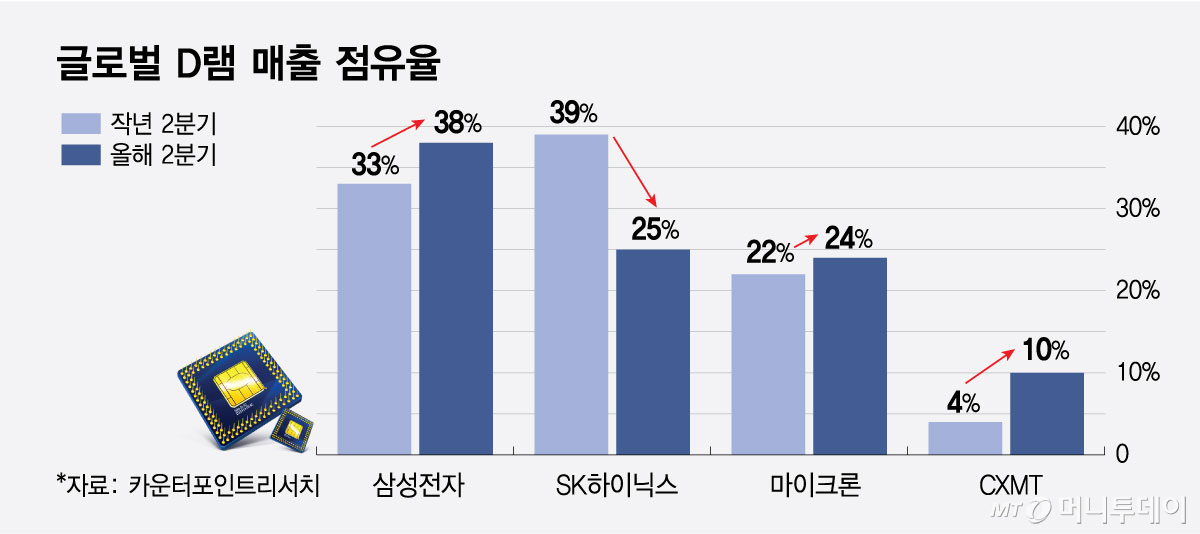
CXMT's rising market share is becoming evident. According to Counterpoint Research, CXMT's global DRAM sales market share reached 10% in the second quarter of this year. This marks the first time its quarterly share has entered double digits, placing it fourth behind Samsung Electronics, SK Hynix, and Micron. Recently, CXMT has also been expanding its mobile DRAM customer base by supplying LPDDR6 to Xiaomi's flagship smartphones.
This fifth-generation Yangsan process is expected to serve as a foundation for accelerating the volume offensive. According to CXMT, applying the new process increases the total number of dies (chip count) producible per wafer (the thin circular substrate used to manufacture semiconductor chips) by more than 50% compared to the previous generation, thereby improving cost competitiveness.
However, the impact on the market will likely depend on "Yangsan yield rates." Even if the number of chips per wafer increases, without sufficient initial yields, it will be difficult to translate into actual supply increases and cost reductions.
If CXMT stabilizes its yields, it could pose a threat to Samsung Electronics and SK Hynix as well. While these two companies prioritize production capacity for high-margin HBM and server-grade DRAM, CXMT can expand both volume and customer base in the mobile and general-purpose DRAM segments. In particular, if CXMT leverages China's smartphone supply chain to secure Yangsan experience and cost competitiveness, it could directly affect the market share and pricing structure of the DRAM market, which has long been led by the three major memory companies.
CXMT's expansion is not limited to DRAM. Despite U.S. restrictions on advanced semiconductor equipment, CXMT is securing its production base by jointly developing core manufacturing processes with Chinese equipment manufacturers. The company is also moving forward with entry into NAND flash memory. Amid a semiconductor upcycle driven by high memory prices, CXMT is simultaneously expanding both production volume and product portfolio to strengthen its position in the global memory market.
A semiconductor industry official stated, "An increase in chips per wafer does not immediately guarantee cost competitiveness; ultimately, Yangsan yield rates are the key factor." The official added, "While domestic companies focus on HBM and server-grade DRAM, it is important to monitor long-term whether Chinese firms can accumulate customers and Yangsan experience in the mobile and general-purpose markets."

 in INDUSTRY
