

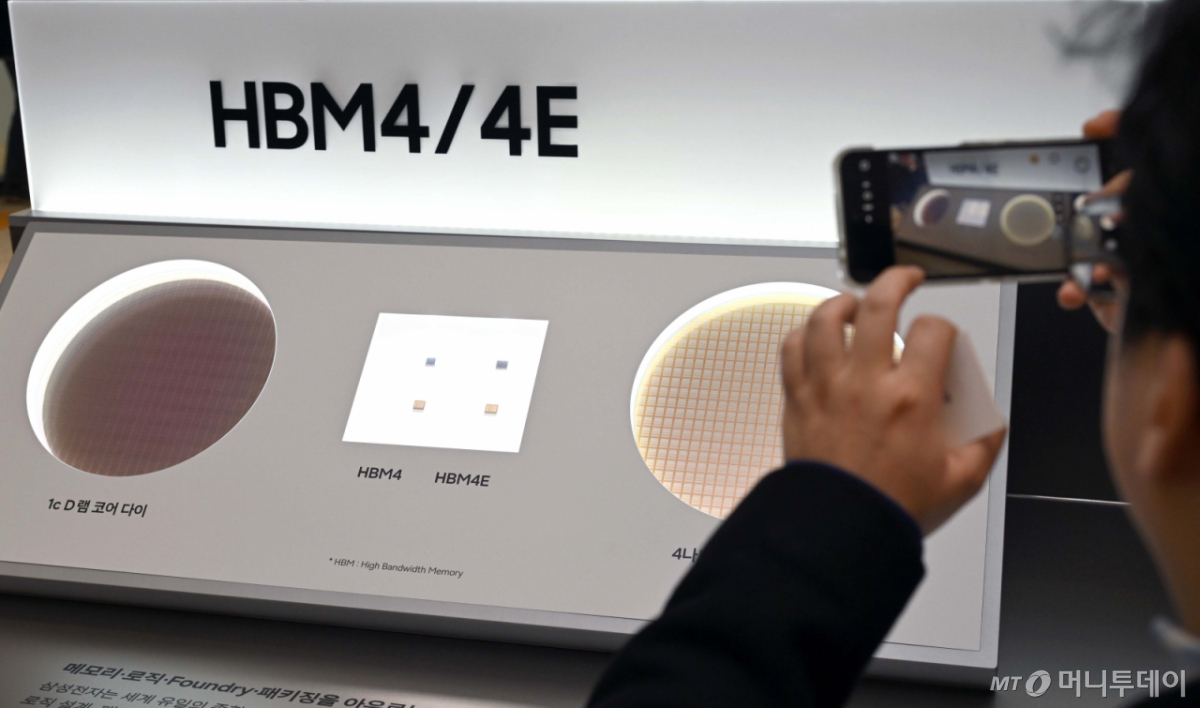
Samsung Electronics is expected to once again set a record for its highest quarterly performance this year, driven by expanded sales of HBM4 (sixth-generation high-bandwidth memory). Non-memory businesses, including foundry services, are also projected to significantly reduce losses. However, some analysts warn that actual results may fall short of market expectations due to slowing DRAM price increases and the strengthening won.
According to financial information provider FNGuide on the 23rd, Samsung Electronics' consensus estimate for operating profit in the third quarter of this year stands at 111.8175 trillion won. If realized, this would surpass the previous record of 89.4924 trillion won set in the prior quarter, marking four consecutive quarters of record-breaking performance since the fourth quarter of last year. Samsung Electronics is scheduled to announce preliminary earnings for the third quarter early next month.
This quarter's performance is expected to be driven by expanded HBM4 sales, as revenues from HBM4 for Nvidia's next-generation AI platform 'Vera Rubin' begin to fully reflect. Kim Jae-jun, Executive Vice President of Samsung Electronics' Memory Business Division, previously announced during the second-quarter earnings conference call that "HBM4 sales in the third quarter will expand more than three times compared to the previous quarter." Discussions on HBM supply for next year have already been finalized.
DRAM supply and demand continue to tighten as demand consistently exceeds supply. As the production share of HBM4 expands, the capacity available for general-purpose DRAM shrinks accordingly. According to KB Securities, Samsung Electronics' overall DRAM production capacity is projected to shift from 27% HBM in last year to 33% this year and 40% in 2027, while general-purpose DRAM will decline from 73% to 65% and then to 57% over the same period.
Notably, as of this month, the lead time for Samsung Electronics' high-capacity general-purpose DRAM for servers, DDR5 (Double Data Rate 5), has reportedly extended to up to 52 weeks. This means customers may wait a full year from placing an order to receiving the actual product. Kim Dong-won, Head of Research at KB Securities, stated, "Compared to the normal market lead time of six weeks, this is more than eight times longer," and added, "The shortage of general-purpose DRAM supply is expected to become structurally prolonged beyond a temporary phenomenon."
Expanded HBM4 sales are also improving foundry utilization rates. Samsung Electronics' HBM4 chips utilize base dies manufactured using the company's proprietary 4-nanometer (nm) process (1 nm = one-billionth of a meter). It is reported that more than half of the current 4nm production capacity has been allocated to HBM4 base die manufacturing. The next-generation HBM4E will also apply 4nm base dies, so related demand is expected to continue.
However, the slowdown in general-purpose DRAM price increases remains a variable. According to market research firm TrendForce, contract prices for general-purpose DRAM in the third quarter of this year are projected to rise by 13% to 18% compared to the previous quarter. While double-digit growth is expected, the pace has slowed compared to the previous quarter's increase of approximately 53% to 58%. The expansion of long-term agreements (LTAs) also limits price increases. LTAs enhance medium- to long-term supply visibility but may prevent selling prices from immediately reflecting market fluctuations during the contract period.
The strengthening won could also limit the extent of performance growth. Since a significant portion of Samsung Electronics' revenue is generated in dollars, a decline in the won-dollar exchange rate would reduce reported earnings when converted to won. In its annual report last year, Samsung Electronics estimated that a 5% drop in the won-dollar exchange rate would decrease pre-tax profit by approximately 435.1 billion won. The won-dollar exchange rate surged to as high as 1,561.5 won during trading on June 5 but has remained fluctuating around the 1,300-won level since late last month.
An industry official stated, "While LTAs may limit short-term price increases, the situation where demand exceeds supply is expected to persist," and added, "If the won continues to strengthen, the positive impact on performance from improving memory market conditions could be partially offset."

 in INDUSTRY

