

Micron projected that the global memory market's supply shortage will continue through 2028. This is because the expansion of memory production capacity is failing to keep pace with demand. In particular, as a significant price increase and increased supply volume for HBM (High Bandwidth Memory) are expected next year, the benefits for Samsung Electronics and SK Hynix are also anticipated to grow.
According to electronics industry sources on the 1st, Sanjay Mehrotra, CEO of Micron, stated during the company's earnings announcement for the fourth quarter (June–August) of fiscal year 2026 held that day, "Memory and storage supply will be much tighter next year and in 2028 compared to this year," adding, "HBM shipment volumes are expected to grow at a faster pace than conventional DRAM through 2028."
Micron's revenue and operating profit for the previous quarter were $54.229 billion (73.82 trillion won) and $43.751 billion (59.5538 trillion won), respectively, marking all-time high results. These figures exceeded market expectations, with revenue up 379.3% and operating profit up 1,097.3% compared to the same period last year. The operating profit margin reached 80.7%.
Behind the record-high performance is the explosion in data center demand driven by the spread of AI (artificial intelligence) infrastructure and rising average selling prices (ASP) for memory. Micron's Data Center Core business segment recorded revenue of $18 billion in the previous quarter, a 56% increase from the prior quarter. During the same period, ASPs for DRAM and NAND rose by the high teens and 30%, respectively.
A point drawing market attention is that the memory shortage will persist even as new fab (factory) construction is completed sequentially starting in the second half of 2027. Micron estimated that volumes under long-term supply contracts account for more than 35% of projected revenue through 2030. There are also cases where contracts have been extended through 2031.
CEO Mehrotra emphasized, "Even after cleanrooms are completed and the first wafers are shipped, production expansion will occur gradually," adding, "Despite plans to secure cleanrooms, it is currently difficult to gauge when (DRAM) supply and demand will regain balance."
Furthermore, rising prices and increased production volumes for HBM are anticipated. Micron explained that it has completed contracts for most of its HBM supply volume for next year and that prices have risen "significantly." Market research firm TrendForce also recently projected that HBM selling prices next year will increase by 121% compared to this year.
These trends in the memory industry are positive for Samsung Electronics and SK Hynix as well. Domestic securities firms forecast that the operating profits of Samsung Electronics and SK Hynix in the third quarter of this year will average 108.68 trillion won and 77.22 trillion won, respectively. This would be their highest-ever performance.
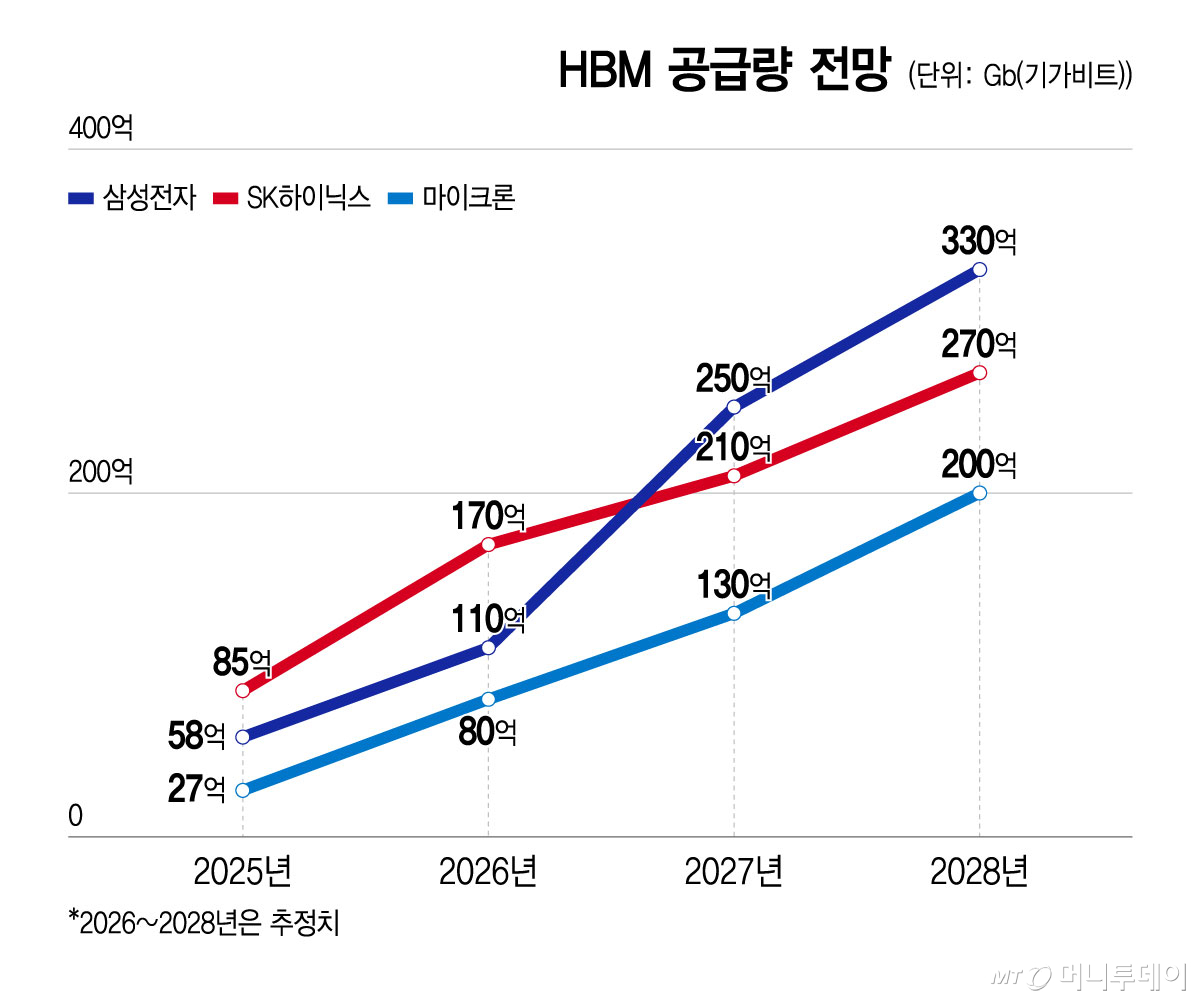
A strength for Samsung Electronics and SK Hynix is that they possess HBM production capabilities ahead of Micron. Global investment bank Citi projected that SK Hynix's HBM supply volume this year will reach 17 billion Gb (gigabits), more than double that of Micron.
In particular, Samsung Electronics is expected to take the top spot in the industry with an HBM supply volume reaching 25 billion Gb next year. This level is 4 billion Gb and 12 billion Gb higher than SK Hynix and Micron, respectively. Samsung Electronics has been strengthening its presence in the market by delivering HBM4E (7th-generation HBM) samples to customers for the first time in the industry last May.
Kim Rok-ho, a researcher at Hana Securities, stated, "It is necessary to pay attention to the increase in Samsung Electronics' HBM revenue next year," adding, "While price increases for conventional DRAM are limited due to long-term supply contracts and other factors, a significant increase in HBM revenue is expected to contribute to performance."

 in INDUSTRY
