

Although the price of chicken, a key raw material for fried chicken, has dropped significantly, menu prices at major fried chicken franchise chains remain unchanged. The industry stated that other cost burdens, such as labor costs, persist, and that headquarters had partially absorbed rising ingredient costs when meat prices were high. Rather than lowering official prices, they said they will continue to work to reduce the financial burden on consumers through discount coupons and promotions.
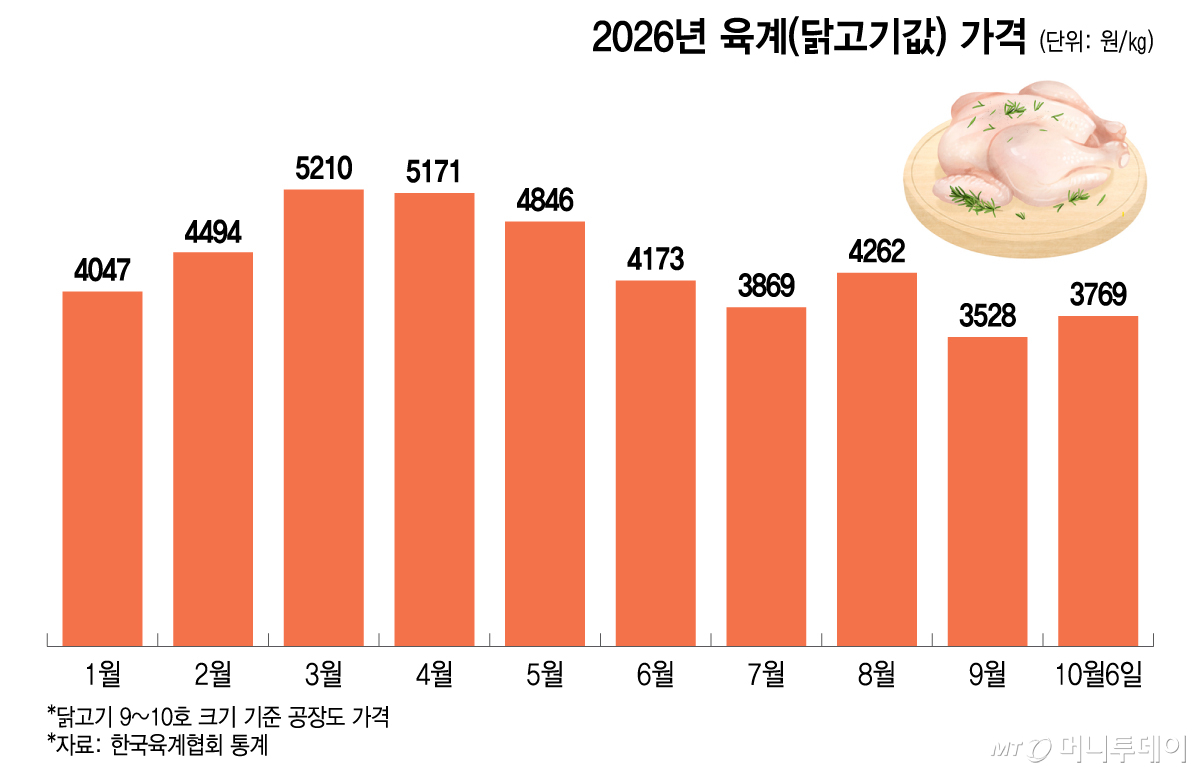
According to the Korea Broiler Association on the 7th, the market price of chilled chicken (No. 9–10), primarily used for fried chicken, was 3,769 won per kilogram as of the 6th, down 29.0% from the March peak of 5,308 won. Prices had fallen to 3,308 won per kilogram last month before recently rebounding slightly. Despite the decline in broiler prices, recommended prices for major menu items have remained unchanged. BBQ’s “Golden Olive Chicken” and Kyochon Chicken’s “Honey Combo” are each priced at 23,000 won, while bhc’s “Buringcle” is 21,000 won. Actual selling prices may vary depending on the franchisee and ordering channel.
The industry explains that there are differences in the actual purchase prices borne by headquarters. Due to long-term supply contracts, it takes time for market price fluctuations to be reflected in purchase prices, and costs also arise during processing, brining, packaging, and logistics. Franchisees bear the costs of cooking oil, labor, and rent, as well as delivery platform fees and delivery-related expenses. The industry also emphasized that when chicken prices surged sharply at the beginning of this year, headquarters took on a portion of the costs by reflecting franchisee feedback, thereby suppressing increases in selling prices. In fact, bhc and Kyochon last adjusted their prices in December 2023 and April, respectively, while BBQ made its final price adjustment in June 2024, after which all three companies have maintained the recommended prices for their signature menu items.
The industry also explained that it has consistently held discount campaigns to reduce the financial burden on consumers. This is because adjusting the depth and conditions of discounts for each campaign is easier than lowering the standard price. If the standard price is reduced, resistance to a subsequent price increase becomes significant when raw material costs rise, whereas discounts can be adjusted in terms of duration and scale depending on production costs and demand conditions. Discounts through company-owned apps are also utilized as a means to reduce reliance on delivery platforms and secure direct customers. A source in the chicken industry stated, "It is not the case that if chicken prices fall, the overall cost structure decreases by the same margin," adding, "Competition for market share among companies is fierce, and it is routine for them to compete over ideas. While cutthroat competition may exist, there is no reason to collude on pricing."

 in INDUSTRY
