

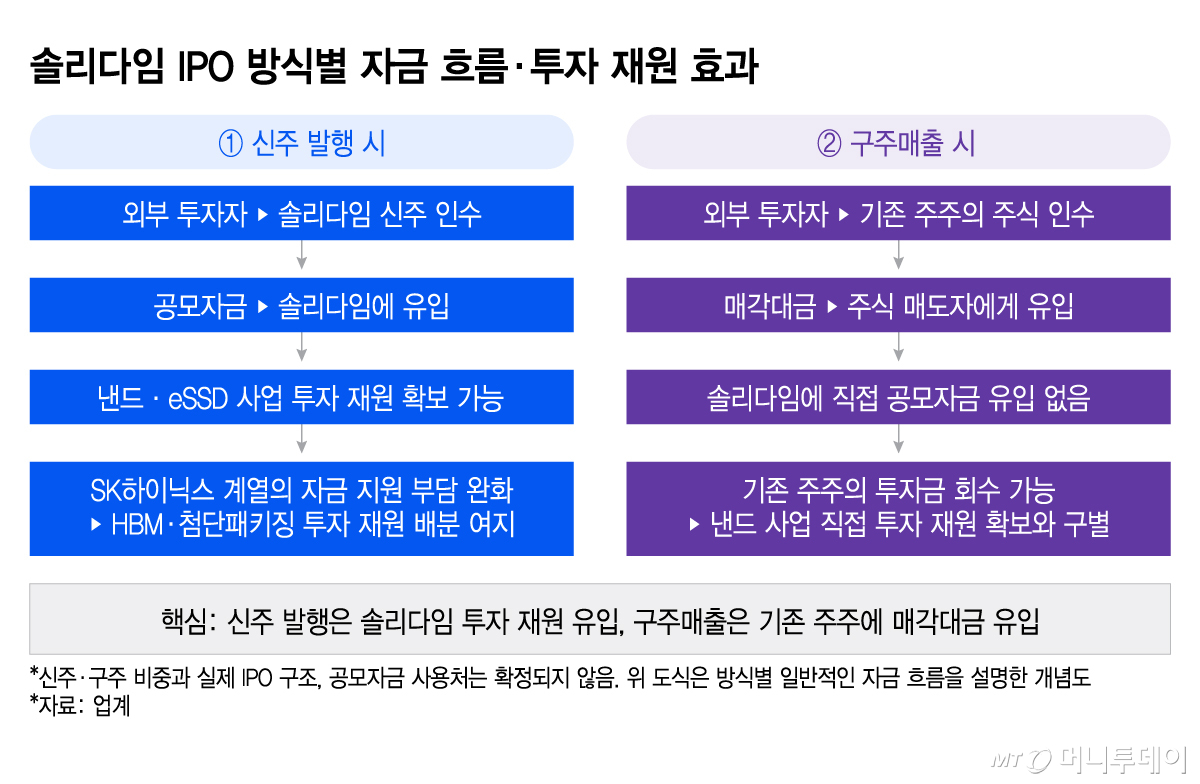
The possibility has been raised that Solidigm, SK Hynix's grand-subsidiary for NAND flash (hereinafter referred to as NAND), is pushing for a listing on the U.S. stock market. With large-scale investments simultaneously underway in HBM (High Bandwidth Memory), advanced packaging, and NAND, analysts say that raising external capital through Solidigm could serve as a means to disperse SK Hynix's financial burden and expand its investment capacity.
According to semiconductor industry sources on the 11th, if Solidigm secures external capital through an initial public offering (IPO), SK Hynix would be able to raise investment funds for its NAND business at the grand-subsidiary level, thereby broadening its room to allocate internal cash to other businesses such as HBM and advanced packaging. Given that large-scale investments in multiple businesses are proceeding simultaneously despite the semiconductor boom, the need to diversify funding channels is growing.
SK Hynix expects its capital expenditure for this year to reach the high 40 trillion won range. This represents an increase of at least 15 trillion won compared to last year's capital investment (30.173 trillion won). The company is accelerating the expansion of production facilities in the Gyeonggi Yongin semiconductor cluster while moving up the Yangsan schedule for the Cheongju M15X duplicate facility, and is also pushing forward with mid-to-long-term investments such as the advanced packaging plant P&T7 and the new NAND production base M17. Furthermore, as it pursues the construction of a Honam region semiconductor cluster, the scope of investment targets is expected to expand further. SK Group Chairman Chey Tae-won visited the Gwangju military airbase site on the 9th and emphasized, "Semiconductor demand is increasing faster than expected. Although we have moved up the overall construction schedule for the Yongin semiconductor cluster by 12 years, this may still be insufficient," adding, "We will construct it at the fastest possible speed."
The fact that investment targets span multiple businesses also highlights the importance of capital raising. HBM requires not only advanced DRAM production lines but also packaging equipment for stacking and connecting multiple chips. For NAND as well, securing production capacity to meet growing demand for eSSDs (enterprise solid-state drives) for AI data centers is a challenge. While enormous funds must be invested first in factory construction and equipment introduction, it takes considerable time before revenue is generated from new facilities.
Recently, SK Hynix has continued its high-flying performance driven by the semiconductor boom. According to financial information provider FnGuide, the projected operating profit for the third quarter of this year reaches 77.2214 trillion won. However, even with strong results, if funds spent on capital investment increase rapidly, the cash remaining in the company may decrease. As SK Hynix President Kwak No-jung previously presented a goal of "achieving 100 trillion won in net cash" to ensure financial soundness at the regular shareholders' meeting, the need for SK Hynix to efficiently secure investment funds by business rather than relying solely on its own cash generation has also grown.
The effect of alleviating the financial burden through Solidigm's IPO is expected to depend on the scale of new share issuance and the use of the raised funds. If Solidigm issues new shares to attract external capital independently, it can reduce the burden of additional funding support at the SK Hynix group level. Unlike the sale of existing shares held by current shareholders, new share issuance allows the raised funds to flow directly into Solidigm, making it advantageous for securing investment funds for the NAND business. On the other hand, if the proportion of new shares is low or the raised funds are not directly invested in expanding NAND production capacity, the effect of reducing the financial burden will be diminished. SK Hynix stated that it is considering various measures to strengthen Solidigm's competitiveness, but nothing has been specifically finalized.
An industry official said, "In a situation where SK Hynix continues large-scale investments in HBM and advanced packaging, there is no need to cover the funding for the NAND business with internal funds," adding, "If Solidigm can secure investment funds externally, SK Hynix will be able to allocate investment funds by business more flexibly."

 in INDUSTRY
