

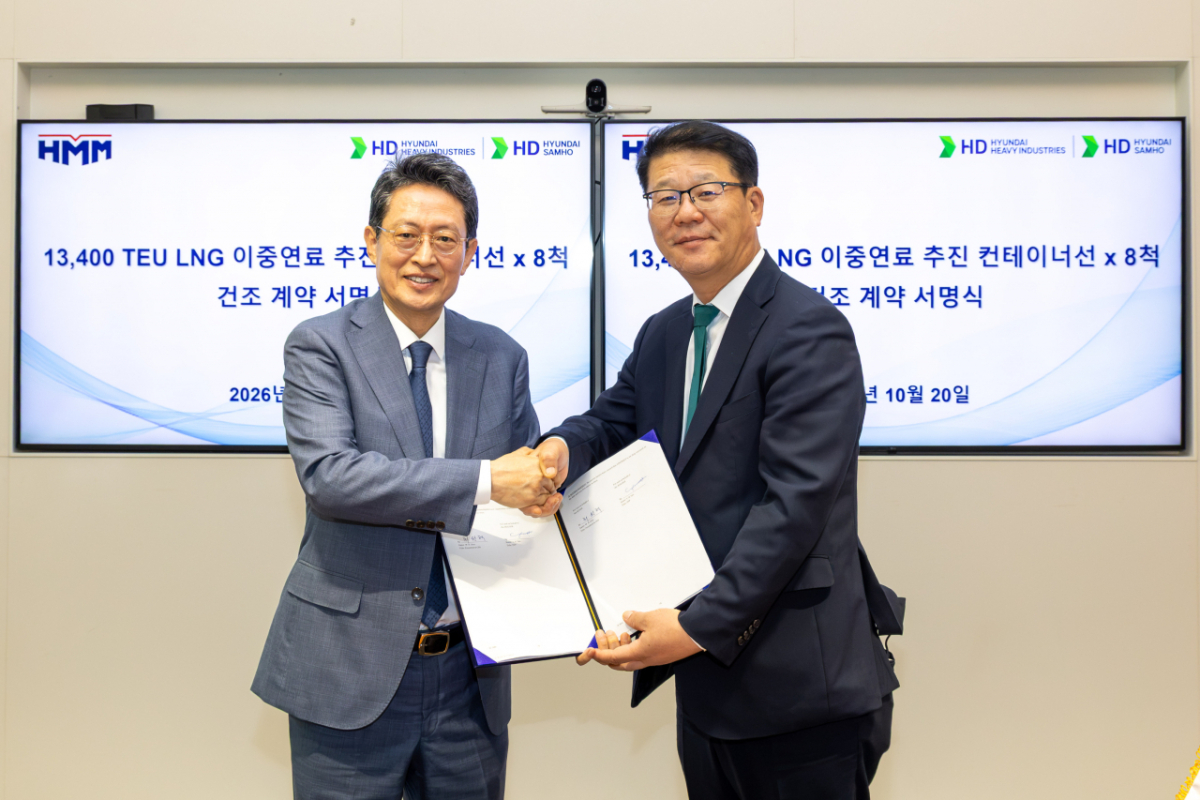
HMM is moving to secure eight container ships and four feeder vessels, which serve short haul routes, in preparation for a shipping boom, bringing its total investments this year to more than 6 trillion won.
HMM signed a contract with HD Hyundai to order eight 13,000-TEU-class container ships (one TEU equals one 20-foot container) on Tuesday. Six of these vessels will be built at Gwangju HD Hyundai Samho in South Jeolla Province, and two at Ulsan HD Hyundai Heavy Industries, with sequential deliveries scheduled to begin in 2029.
All eight vessels ordered this time are LNG (Liquefied Natural Gas) dual-fuel low-carbon ships. LNG fuel can reduce greenhouse gas emissions by more than 23% compared to conventional marine fuel, and when linked with treatment devices, it can cut nitrogen oxide and sulfur oxide emissions by over 80% and 99%, respectively.
In addition, HMM plans to bring in four feeder vessels from overseas shipbuilders via a resale method: three 2,800-TEU-class container ships and one 1,700-TEU-class vessel. Resale involves taking over the contract for a ship under construction, offering the advantage of securing the required fleet early on.
The company plans to deploy these newly ordered 13,000-TEU-class vessels on the FIM (Far East–India–Mediterranean) route to enhance operational efficiency on key ocean routes. The feeder vessels deployed in the branch network aim to strengthen the competitiveness of the 'Hub & Spoke' network by organically linking with hub ports.
Including this contract, HMM’s total investment this year in fleet expansion, logistics infrastructure, and securing future technologies exceeds 6 trillion won. Since President Choi Won-hyuk took office in March 2025, the cumulative investment scale has reached 12 trillion won.
HMM’s large-scale investment is a preemptive measure that comprehensively considers the shipbuilding period, which typically takes more than two to three years, and the cycles of global shipping market conditions. It is not merely an expansion of the fleet, but an effort to secure a competitive fleet in preparation for the shipping boom that will arrive in the future.
The investment is also based on the '2030 Medium- and Long-Term Strategy,' which aims to invest a total of 29 trillion won to expand the fleet to 166 container ships (with a capacity of 1.47 million TEU) and 110 bulk carriers (13.52 million DWT, deadweight tons) by 2030.
Examining the medium- and long-term strategy by sector, in the container division, HMM is securing feeder vessels alongside large ships to pursue a 'Hub & Spoke' strategy. As a result, the number of feeder vessels has increased 3.5 times from 12 in March last year to 42 this year, based on operating and ordered ships. These vessels are being deployed to build branch networks in regions with high growth potential, such as Africa and India.
In the bulk division, HMM has focused on structural improvements, such as diversifying ship types, and fleet expansion based on long-term contracts since the second half of last year. The bulk fleet has grown from 44 vessels in March last year to 60 this year, diversifying beyond the traditional focus on dry bulk carriers and tankers to include gas carriers, car carriers, and multi-purpose ships.
An HMM official said, "Investments in the shipping industry, such as in vessels and ports, have the characteristic of being conducted over several years with a long-term perspective, looking toward the future," adding, "We plan to continuously pursue medium- and long-term investments to secure the capabilities necessary to compete with global shipping companies."

 in INDUSTRY
