

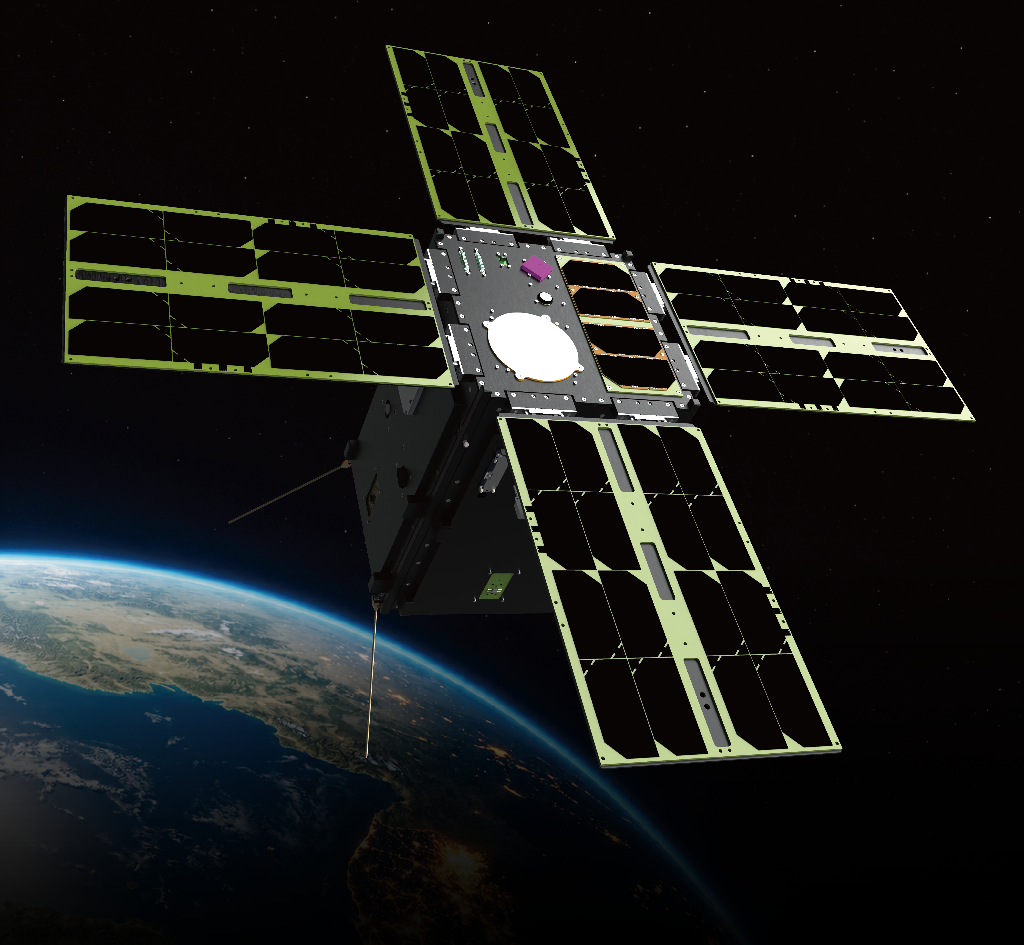
KAI (Korea Aerospace Industries) announced on the 21st that it carried out a demonstration mission of "artificial intelligence (AI)-based autonomous operation technology," which allows satellites to independently diagnose their status and respond, in space orbit on the 20th.
The BEE-1012 CubeSat, which entered space through the fifth launch of the Nuri rocket on the 7th of this month, is equipped with an AI module developed in-house by KAI. This demonstration is a follow-up project to the "Memorandum of Understanding for Cooperation on CubeSat AI Demonstration" signed between KAI and SpaceLintech in March last year, with participation from Yonsei University and Funjin, among others.
In this mission, KAI verified its "AI Onboard Processing" technology, which enables the onboard AI module to independently analyze abnormal conditions and derive response measures based on data collected in the space environment. The demonstration was conducted by having the ground station send a virtual fault signal, after which the AI module analyzed the cause and scope of the fault and generated a technical report containing countermeasures, which it then transmitted back to the ground station.
Conventional satellites must transmit relevant data to the ground station when an abnormality occurs and wait for analysis results. With the application of an AI module, satellites can independently analyze abnormal conditions in orbit and prepare response measures. According to the company, this reduces the amount of data exchanged with the ground station, lowering communication costs while enhancing the satellite's autonomous operation capabilities.
KAI developed an AI module trained on tens of thousands of fault scenarios by applying its fault and life prediction and predictive maintenance technologies, accumulated during aircraft development, to the satellite field. The company implemented a solution suitable for the space environment in collaboration with Funjin, a defense AI specialist, and applied a neural processing unit (NPU) from domestic startup Mobiline.
Based on this demonstration mission, KAI plans to begin the "Main Autonomous Operation Technology Demonstration Mission" starting next month in December. The company aims to enhance the reliability of the technology through additional demonstrations and apply it to satellite systems manufactured by KAI in the future.
KAI Woo Ju-sa-eop (Head) Senior Executive Seo Hyeon-seok stated, "Through this demonstration, we verified that AI satellite autonomous operation technology functions in an actual space environment," adding, "Going forward, we will integrate space systems based on AI technology and apply it to various next-generation satellite systems."

 in INDUSTRY
