

The fact that Lee Jae-yong, Chairman of Samsung Electronics, personally visited the RX (Robotics eXperience) Business Promotion Office to inspect development progress is interpreted as a will to strengthen efforts to secure future growth drivers through the robotics business. Samsung Electronics is focusing its robot development on "actual work capabilities and economic viability" rather than "flashy movements." Specifically, it is formulating a timeline that includes △ technology verification in manufacturing sites, △ expansion of the application scope of industrial robots, and △ entry into the home robot market.
According to electronics industry sources on the 21st, Samsung Electronics is considering featuring robots as a key exhibition content at "CES 2027," the world's largest home appliance and IT exhibition, to be held in Las Vegas, USA, next January. This could serve as a stage to externally showcase Samsung Electronics' robotics technology capabilities and business strategy. It is expected that the scope of public disclosure for robot technology and exhibition methods will become more concrete following Lee (Chairman)'s on-site inspection.
In July last month, Samsung Electronics established the RX Business Promotion Office directly under Noh Tae-moon, Head of the DX (Device eXperience) Division (President), to consolidate its robotics business capabilities. Taking the Seoul R&D Campus in Umyeon-dong, Seoul, as a major hub, it is recruiting specialized personnel and expanding investments in research and development infrastructure, including office space and laboratories necessary for commercialization.
Although Samsung Electronics' robot technology has not yet been disclosed externally, it is reported to have reached a considerable level. At an internal demonstration attended by Division Head Noh last August, the robot showcased movements such as operating a camera to take photos and drawing out cards. This is a task that requires precisely adjusting finger movement and force depending on the shape and thickness of the object. Within Samsung, it is evaluated that this demonstrated precision manipulation technology capabilities beyond simple object grasping.
A large-scale manufacturing base is a strength held by Samsung Electronics. The company operates more than 100 product production lines worldwide. It can directly utilize robots in various manufacturing environments and verify their performance. Samsung Electronics plans to first verify the work capability and reliability of robots at its own production sites, accumulate actual work data, and improve performance. Based on this, it aims to broaden the application scope of industrial robots before expanding its business into the service and home robot markets.
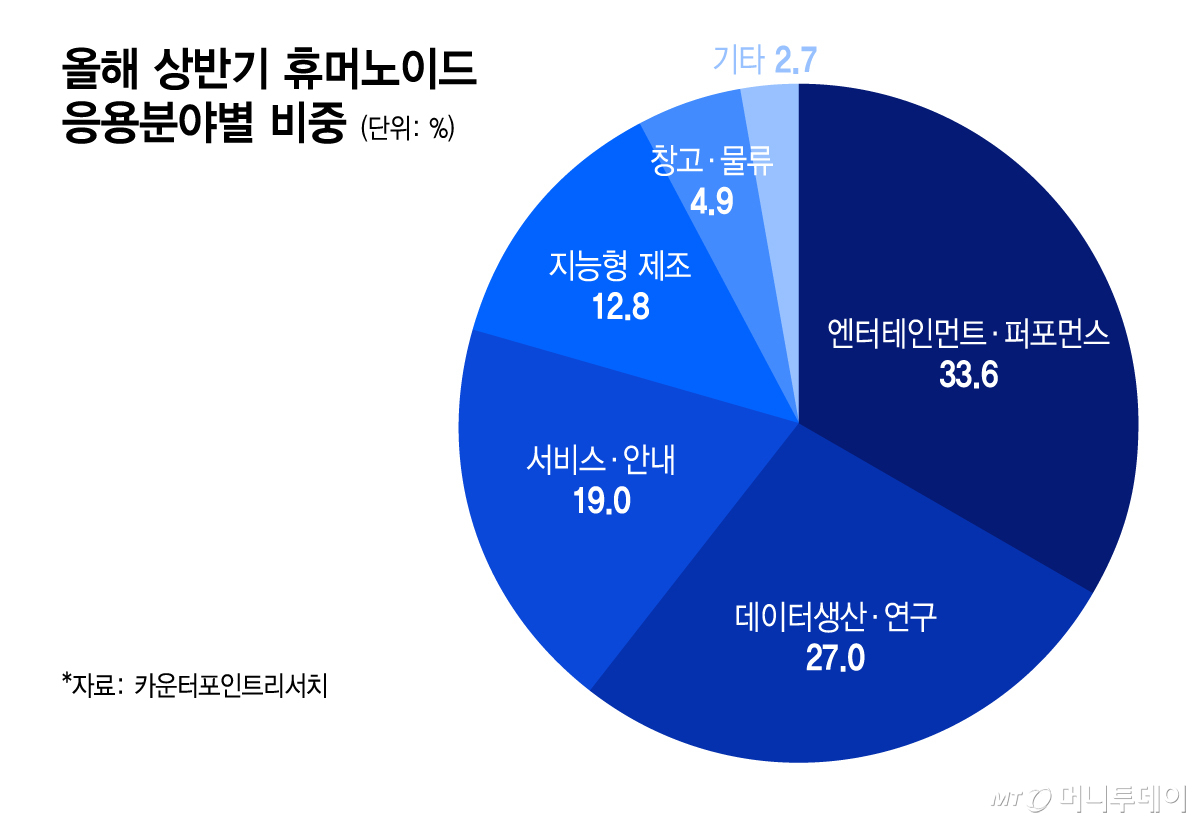
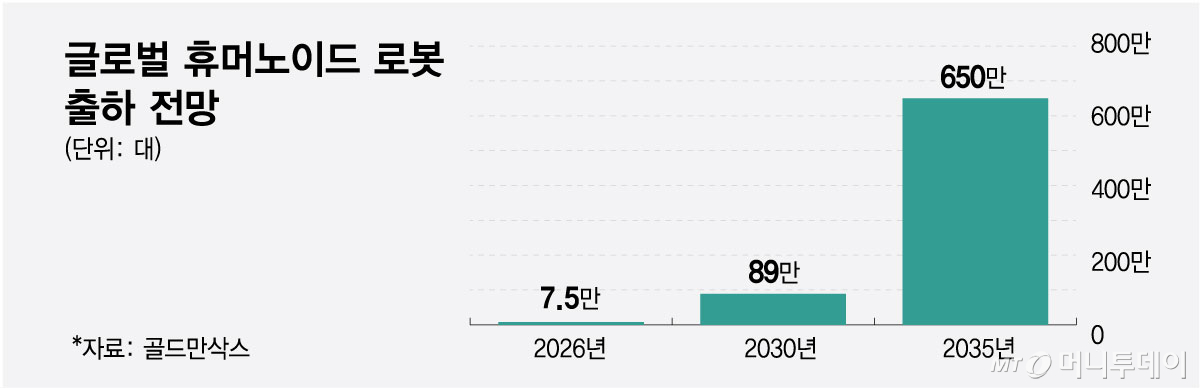
The global humanoid robot market is also growing rapidly. Goldman Sachs forecasts that annual shipments of humanoid robots will reach 6.5 million units by 2035. This is approximately 4.6 times the 1.4 million units projected in 2024. However, the utilization of humanoid robots in actual industrial sites remains limited. According to market research firm Counterpoint Research, among global humanoid robots shipped in the first half of this year, those for entertainment/performance and data collection/research purposes accounted for more than 60%. The proportions for intelligent manufacturing and warehouse/logistics fields were only 13% and 5%, respectively.
The part Samsung Electronics is paying attention to is the actual work capability of robots. Chris Hauser, Lab Head of Samsung Electronics' RX Business Promotion Office, said at the "Samsung AI Forum 2026" held on the 30th of last month, "A robot may be able to do a backflip, but it might not be able to open a water bottle cap." This means that even if full-body control technology for robots has developed, fine manipulation capabilities remain insufficient.
This is why "robot hand" technology is drawing attention. Samsung Electronics is developing methods such as the tendon approach, which moves fingers using cables like human tendons, to secure precise movement and force control technology. The core capability is the ability to finely adjust force so that objects can be grasped stably without being damaged. Securing economic viability is also a challenge. Humanoid robots incur significant costs not only in hardware prices but also in the cost of learning tasks and maintenance fees. It is currently evaluated that hiring humans is economically more advantageous.
An industry official said, "Samsung has favorable conditions for cultivating the robotics business at the group level," adding, "Within the group, it holds related business capabilities such as camera modules, sensing, batteries, and motors, which are core components of robots."

 in INDUSTRY

