

As the penetration of Chinese-made electric vehicles in the domestic market rapidly expands, voices are growing that the government must strengthen support for domestically produced vehicles. There is also a point being made that this is an opportunity to transition the current 'purchase subsidy' system to a 'production support' model.
The United States, China, the EU (European Union), and Japan, among others, have determined that the automobile industry is a strategic sector with a significant impact on the national economy, and are strengthening the protection of domestic brands. While the South Korean government also supports domestic products, criticism has emerged that its efforts are relatively weak and lack sophistication in structure.
South Korea's Jeong Bu-ui (CEO) support measure is the purchase subsidy system. For electric passenger cars, it provides up to 6.5 million won in national funds and up to 3 million to 6.5 million won in local funds (varying by local government) to reduce the burden on buyers. While this has contributed to the promotion of EV adoption, imported vehicles, including Chinese-made ones, receive the same benefits, limiting its effectiveness as a 'domestic support measure.'
The government decided in July to consider factors such as 'contribution to the domestic supply chain' when selecting operators for the EV distribution program, but Tesla remained included among the supported entities. Although BYD was excluded from the target list, it is defending against performance declines with its originally high price competitiveness and self-implemented discounts.
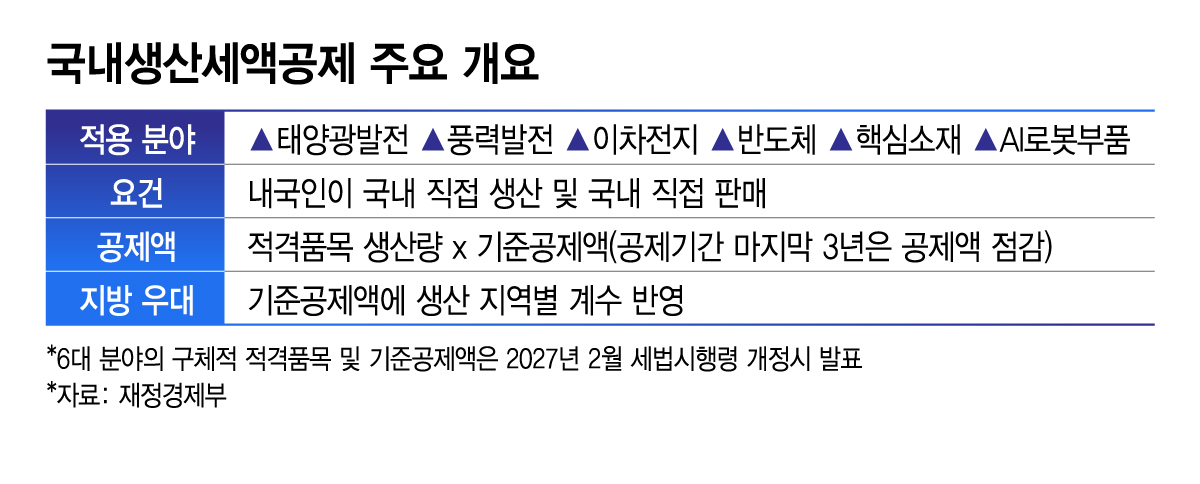
The automotive industry is strongly demanding the application of a 'domestic production tax credit' that reduces taxes based on domestic production volume. The government announced plans to introduce this system in its tax reform proposal released in August, but excluded electric vehicles from the scope of application, including solar and wind power generation, secondary batteries, and semiconductors instead. The reason cited was that EVs would receive 'duplicate support' alongside purchase subsidies.
The industry pushed back, stating that "the government's response is too complacent," and Yeo Ya (Rep.) also took action. Rep. Yoon Han-hong of the People Power Party and Rep. Lee Eon-ju of the Democratic Party of Korea each introduced bills to amend the Special Tax Restriction Act to include electric vehicles in the scope of tax credits. Recently, Rep. Yun Hu-deok of the Democratic Party co-introduced an amendment bill with Yoon Han-hong (Rep.) again, adding momentum to the effort.
There are also opinions that the current support system centered on purchase subsidies needs improvement. According to National Assembly meeting minutes, Lee Eon-ju (Rep.) recently argued in the National Assembly's Committee on Strategy and Finance for including electric vehicles in the scope of tax credits, stating bluntly, "The United States and China provide only production subsidies without purchase subsidies, yet our government continues to pour massive budgets into EV purchase subsidy support regardless of which country produces the EVs." He added, "Policies centered solely on purchase subsidies, which were necessary for expanding the distribution of eco-friendly vehicles, are no longer sufficient to protect the domestic production base and jobs for electric vehicles," and noted that "it is questionable whether it is rational to continue this program."

 in INDUSTRY
