

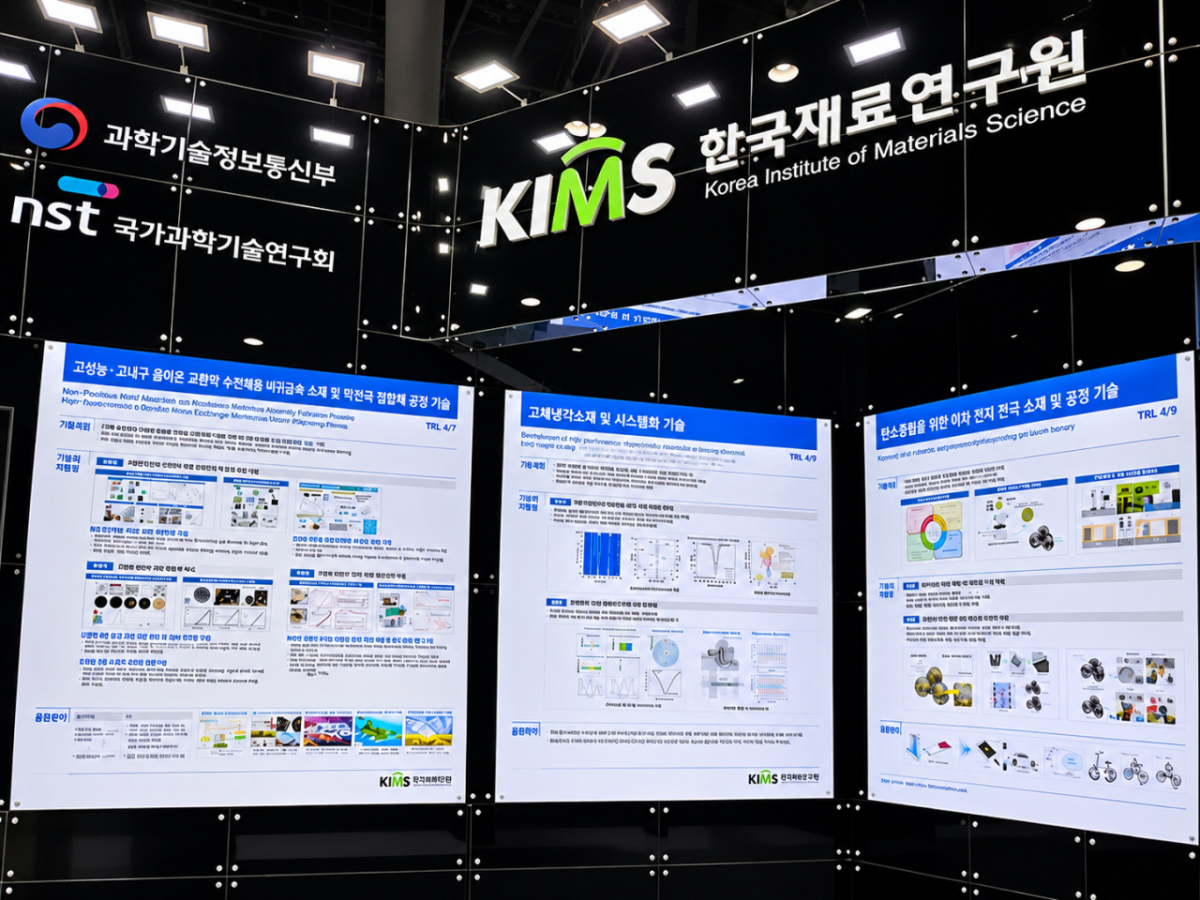
Large letters reading "Korea Institute of Materials Science (KIMS)" stood out on a black wall. Below them, advanced materials technologies supporting carbon neutrality were introduced side by side, ranging from battery manufacturing processes to refrigerant-free cooling and hydrogen production.
At the "Smart Energy Plus (SMART ENERGY PLUS·SEP) 2026" event held on the 28th at Hall B of COEX in Seoul Samsung-dong, the Korea Institute of Materials Science showcased next-generation materials technologies aimed at improving energy efficiency and reducing environmental burden.
The most eye-catching was dry electrode technology to be utilized in next-generation battery manufacturing processes. Existing battery electrodes are manufactured by mixing active materials and binders with a solvent, coating them onto metal foil, and then drying them. In contrast, dry electrodes can reduce or eliminate the use of solvents, thereby lowering energy consumption and environmental burden required for the drying process.
The Korea Institute of Materials Science has secured fundamental technology for dry mixing processes and is developing materials and processes necessary for electrode manufacturing together. The exhibition panel introduced the dry electrode manufacturing process, from powder mixing to kneading, sheet production, and cutting, accompanied by photos.
Functional binder and composite material technologies for realizing high-energy-density batteries were also exhibited. A binder is a material that binds active materials inside the battery and maintains the structure of the electrode. The institute is developing new binders for high-performance cathodes and composite materials that improve the capacity and performance of active materials. This technology can be utilized in electric vehicles, energy storage systems (ESS), urban air mobility (UAM), and more.
Cooling technology utilizing solid-state materials instead of refrigerants was also introduced. "Solid-state cooling materials and systematization technology" utilizes the property of magnetic materials whose temperature changes when a magnetic field is applied. It is a method that transfers heat by utilizing the temperature change of solid-state materials, rather than using gaseous refrigerants employed in existing cooling devices.
The institute is developing manganese (Mn) and lanthanum (La)-based solid-state cooling materials to replace gadolinium (Gd), a rare earth element. The exhibition panel presented graphs measuring the magnetocaloric effect of the materials and the design structure of the cooling system. In addition to material development, it is also researching performance verification and modularization technology for application in actual cooling devices.
Materials technology aimed at lowering hydrogen production costs also drew attention. The institute introduced non-precious metal catalysts and membrane electrode assembly (MEA) manufacturing processes applicable to anion exchange membrane water electrolysis (AEM) technology, which produces hydrogen by electrolyzing water.
The institute is developing catalysts that can ensure high performance and durability while reducing the use of expensive precious metals. It is expanding its research scope from mass production of catalysts and manufacturing of large-area electrodes to the fabrication and operational evaluation of water electrolysis stacks. The exhibition panel included various catalysts, electrode prototypes, and the structure of water electrolysis devices.
However, all three technologies require additional verification before commercialization. The technology readiness level (TRL) presented by the institute was 4 out of 9 stages for battery and solid-state cooling technologies, while the water electrolysis technology was marked as 4 out of 7 stages in the exhibition materials. Beyond research to enhance material performance, proving mass production feasibility, long-term durability, and economic viability compared to existing technologies is a future challenge.

 in TECH
