

Chronic global oversupply and sluggish demand, compounded by the fallout from the Middle East war, have pushed major domestic petrochemical companies into collective losses in the third quarter of this year. As prolonged industry downturn makes a near-term earnings turnaround difficult to expect, the sector has reaffirmed its plan to accelerate the restructuring of its business model centered on commodity products. At the same time, it aims to speed up structural improvements by pivoting toward high-value-added and specialty materials.
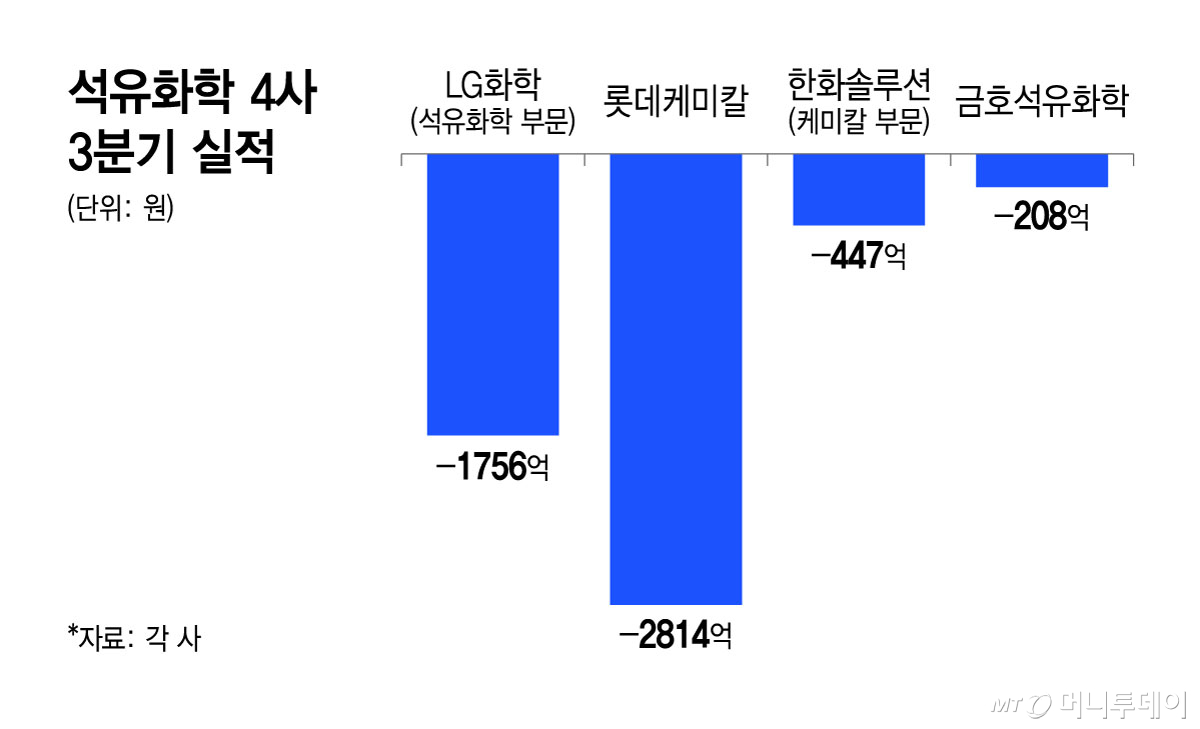
According to industry sources on the 10th, with the third-quarter earnings releases from four major domestic petrochemical firms—LG Chem, Lotte Chemical, Hanwha Solutions, and Kumho Petrochemical—now complete, the combined operating loss for their petrochemical-related business segments totaled 522.5 billion won. By company, LG Chem’s petrochemical segment posted an operating loss of 175.6 billion won, while Lotte Chemical recorded a loss of 281.4 billion won. Hanwha Solutions’ chemical division also reported a loss of 44.7 billion won. Notably, Kumho Petrochemical, which had maintained profitability even amid the industry slowdown, posted an operating loss of 20.8 billion won on a consolidated basis, marking its first shift into the red since the fourth quarter of 2015.
Amid persistent oversupply and weak demand, increased naphtha price volatility driven by the Middle East war has further eroded profitability. Petrochemical product prices are typically linked to naphtha prices at the time of sale. As crude oil and raw material prices, which had spiked due to the prolonged conflict in the Middle East, have since turned downward, companies find themselves producing goods with raw materials purchased at high prices early in the war but selling them at relatively lower prices. This is known as the “reverse lagging” effect. On top of this, rising ocean freight rates and a decline in the won-dollar exchange rate have added to earnings pressure.
The industry’s immediate challenge is business restructuring. Lotte Chemical launched its joint venture H&L Advanced with HD Hyundai Oilbank at Dasan, and is now pushing for an integration of operations with Yecheon NCC at Yeosu. The Yeosu restructuring is underway, aiming to establish a consolidated entity with Yecheon NCC by the first half of next year following a physical spin-off of the Yeosu plant. LG Chem also aims to prepare and submit a business restructuring plan with GS Caltex for its Yeosu site within this year.
Alongside these moves, the four major petrochemical firms are set to focus on transitioning toward high-value-added businesses. LG Chem seeks to improve profitability by expanding sales of high-value-added products such as IPA (isopropyl alcohol) for semiconductor cleaning and SSBR (styrene-butadiene rubber) for electric vehicle tires. In its cathode materials business, the company is finalizing contracts with suppliers to build a supply chain capable of producing 40,000 tons of high-density LFP (lithium iron phosphate) cathode materials by 2028–2029.
Lotte Chemical’s Yulchon compounding plant began full operation across all 24 lines in September last month, establishing the country’s largest single compounding production system with an annual capacity of 500,000 tons. The company plans to operate additional dedicated lines for high-value-added products in the first quarter of next year to increase the share of specialty products. It also aims to diversify its business structure away from a commodity petrochemical focus by expanding its specialty business into semiconductor materials and food and pharmaceutical-grade materials.
Hanwha Solutions is working to diversify its portfolio by linking its basic chemical materials business with solar power and advanced materials value chains. In particular, the company is ramping up operations at SolarHub, its U.S.-based solar manufacturing base, to boost the earnings contribution of its renewable energy segment and reduce reliance on petrochemical industry conditions. Additionally, it is strengthening its high-performance wire and cable materials business in response to rising power demand driven by the spread of AI (artificial intelligence) data centers.
Kumho Petrochemical is enhancing the competitiveness of its high-performance products, centered on synthetic rubber, to elevate its business portfolio. The company is expanding production capacity for SSBR, a material used in electric vehicle and premium tires, while advancing the development of high-grade products. It is also strengthening its high-performance materials business through its subsidiary Kumho Polychem. Furthermore, Kumho Petrochemical is accelerating efforts to secure future growth engines by jointly developing next-generation anode-free lithium-metal batteries incorporating carbon nanotube (CNT) technology in collaboration with POSCO Future M and BEI.

 in INDUSTRY
