

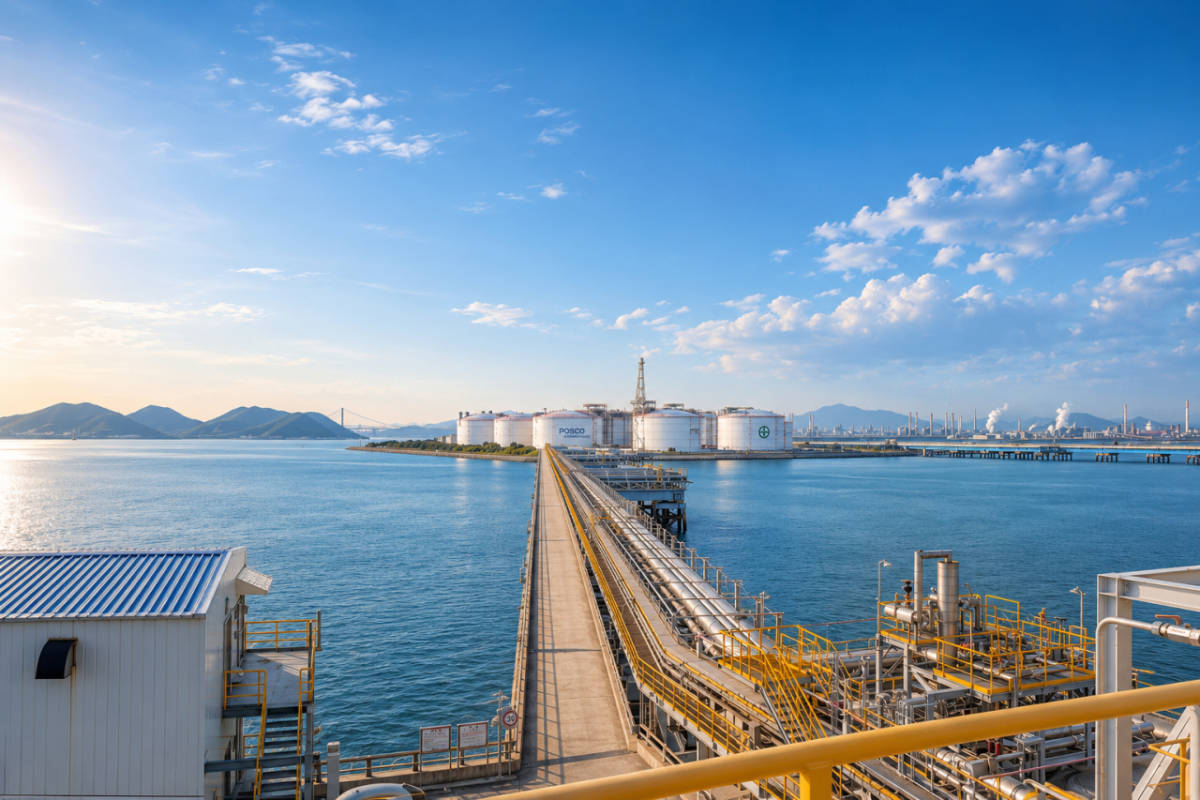
On the 3rd, atop Mount Gu-bong in Gwangyang, South Jeolla Province. Amid smoke rising from various points across a steel mill located approximately 10 kilometers away, massive cylindrical tanks came into view. Upon entering the terminal, pipelines stretching long along Gwangyang Bay caught the eye. This is the route through which liquefied natural gas (LNG) imported from the sea flows to storage facilities. The presence of LNG storage tanks situated next to a steel mill that produces molten iron and steel products demonstrated that POSCO's blueprint in Gwangyang is expanding from steel into energy.
The Gwangyang LNG Terminal, which serves as the foundation for the POSCO Group's LNG business, is expanding its energy infrastructure by securing additional storage facilities. The plan is to build a value chain covering everything from LNG importation to storage and supply, thereby enhancing energy supply stability and business competitiveness. In addition, the POSCO Group is pursuing a 'Triple Core' strategy that positions steel, energy, and strategic resources—such as lithium—as its three main pillars.
POSCO International held the completion ceremony for Terminal 2 at the Gwangyang LNG Terminal on the 10th. The newly completed storage tanks each have a capacity of 200,000 cubic meters. With the addition of Tanks 7 and 8 in Terminal 2 to the existing Tanks 1 through 6 in Terminal 1, the total storage capacity of the Gwangyang LNG Terminal has increased to 1.33 million cubic meters. This amount is sufficient for heating use by the entire national population for approximately 40 days.
The significance of the POSCO Group's LNG business lies in its application of capabilities accumulated in existing businesses to new fields. The Gwangyang LNG Terminal began commercial operations in 2005, becoming the first privately owned facility in South Korea to do so; at the time, POSCO E&C participated in the terminal's construction. POSCO International is responsible for operations, and the storage tanks utilize ultra-low-temperature high-manganese steel developed by POSCO. This material replaces the previously widely used 9% nickel steel and can withstand extreme low temperatures of minus 162 degrees Celsius. It also offers higher price competitiveness than nickel steel, thereby reducing construction costs. The group has connected resource securing, materials technology, and construction and operational capabilities within its own ecosystem.
POSCO entered the LNG business to break away from a steel-centric business structure and secure future growth drivers. This decision was driven by the judgment that the company needed to diversify its business portfolio, given that the steel industry is heavily influenced by global economic conditions and demand fluctuations. Accordingly, POSCO International is building a value chain that spans gas field development and production, LNG trading, terminals, and power generation.
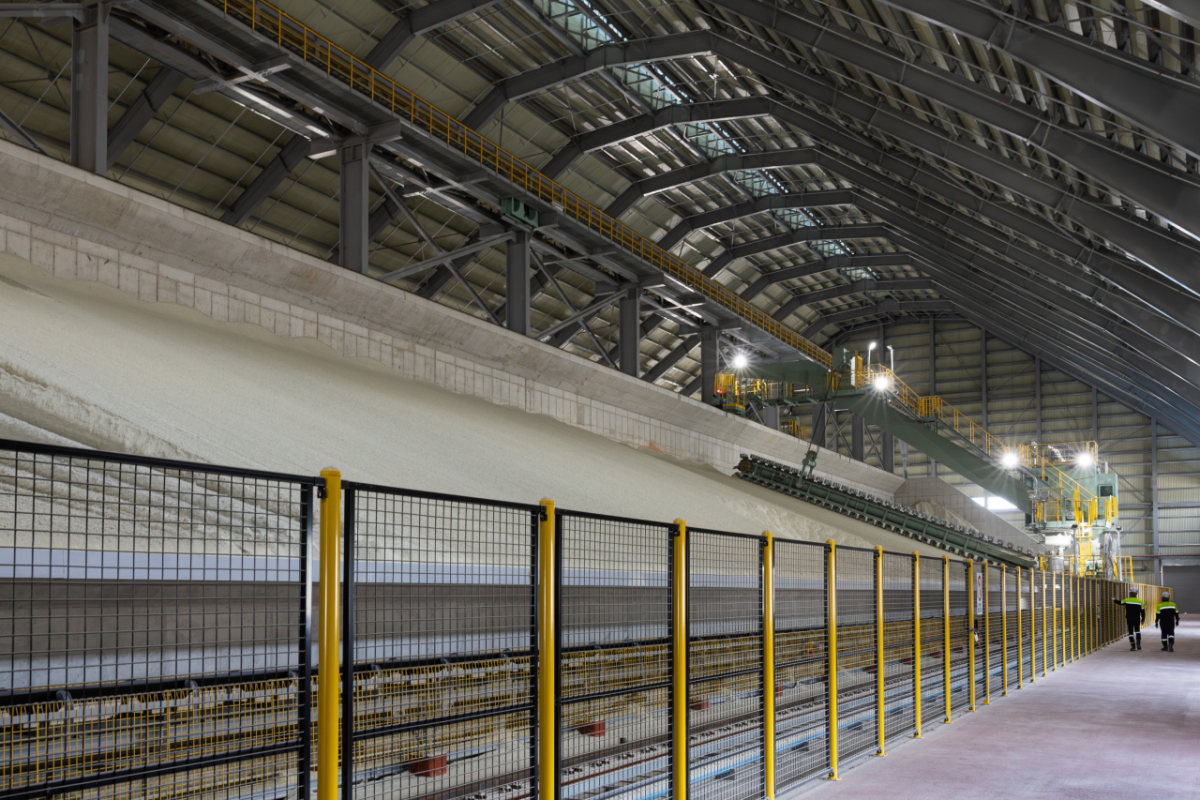
If LNG forms the current foundation of the POSCO Group's energy business, battery materials represent its future growth driver. As the importance of securing key minerals has grown with the energy transition and the expansion of the electric vehicle industry, the POSCO Group is broadening its business scope to cover everything from lithium production to battery material manufacturing and resource recycling. Lithium production plants and cathode material factories located in an industrial complex not far from the LNG terminal play this role. In fact, during a visit on the 3rd, conveyor belts were seen busy transporting lithium ore concentrate imported from Australia at the raw material warehouse of POSCO Pilbara Lithium Solutions. This raw material is then passed to the next process, where it is processed into lithium hydroxide for batteries.
The lithium business has moved beyond securing production capacity into a phase focused on improving profitability. According to the POSCO Group, its first brine lithium plant in Argentina recorded a quarterly profit based on operational stabilization and equipment improvements in the second quarter of this year. The POSCO Group is diversifying its lithium raw material supply chain by securing both Argentine brine and Australian ore.
The lithium produced in this manner is transformed into cathode materials, a key component of the battery value chain, at POSCO Future M. Resource recovery after production is also a pillar of the value chain envisioned by the POSCO Group. POSCO HY Clean Metal takes on this role by processing scrap generated during battery manufacturing and black mass from spent batteries to recover valuable metals such as nickel, cobalt, and lithium.
A POSCO Group official stated, "The POSCO Group places securing core resource supply chains at the center of its business operations, expanding the limits of national industry as a 'national representative core resource supplier' while maximizing the value of resources."

 in INDUSTRY


