

The Bank of Korea (BOK) has found that while the number of workers using generative AI in their jobs is growing rapidly, its use in core tasks remains limited. In other words, workers are using the technology widely and efficiently, but not deeply, as the central bank put it.
The BOK announced the findings on Tuesday in a report titled "BOK Issue Note: AI Diffusion and Productivity Effects." The study was based on a household survey on generative AI use conducted among 16,342 employed people in August and September this year. The central bank conducted a similar survey of 5,502 people last year.
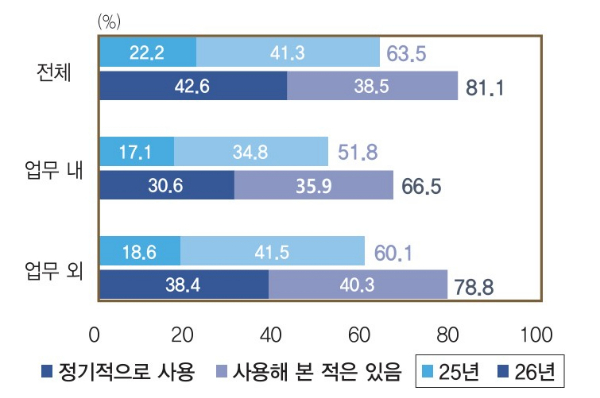
The proportion of workers who regularly use generative AI has expanded. The utilization rate for work purposes rose from 51.8% last year to 66.5% this year. The regular usage rate increased from 17.1% to 30.6% over the same period. The utilization rate outside of work also rose from 60.1% to 78.8%. Average weekly usage time increased from 5.9 hours to 8.0 hours.
The utilization rate for work purposes is relatively high compared to major countries. Korea's utilization rate this year was 66.5%, which was higher than the United States (43.0%), the United Kingdom (36.3%), the Netherlands (35.6%), Sweden (35.6%), Germany (31.5%), and France (28.1%).
Workers with a high proportion of core tasks in their work processed during the previous week were less likely to utilize AI in the same week. This analysis was calculated based on evaluations of the core nature of each task. The researchers explained, "This suggests the possibility that current AI utilization has not sufficiently diffused into tasks close to the essence of the job."
Among work-related AI users, 28.4% have paid subscriptions. The average monthly expenditure is 49,000 won. The Bank of Korea estimated the total annual usage fees for all workers at approximately 2.8 trillion won. The potential value of time saved through AI utilization in work, converted into monetary terms, is approximately 61.1 trillion won.
The average reduction rate in working hours rose by a factor of 2.4, from 3.8% last year to 9.2% this year. In particular, the time-saving effect was relatively larger for highly educated workers and paid subscribers. The researchers stated, "Panel analysis results showed that additional improvement effects from workers' AI usage experience or learning were limited," adding, "This suggests the possibility that the development of AI technology itself played an important role."
The correlation between the time-saving rate and work throughput was weak. The correlation coefficient between the two variables increased slightly from 0.00 last year to 0.08 this year but remains at a low level. The correlation coefficient between the quality improvement rate and the time-saving rate also remained at 0.09. According to the Bank of Korea's analysis, the effect of reduced working hours leading to actual work processing or quality improvements is limited.
The BOK said, "Going forward, it has become important to go beyond the quantitative expansion of AI utilization by enhancing workers' utilization capabilities and improving companies' work methods and organizational operations to connect the potential benefits of AI with actual performance."
It added, "When evaluating the performance of AI, it is necessary to consider various benefits together, including quality improvements and worker welfare, in addition to time savings and throughput."

 in ECONOMY
