

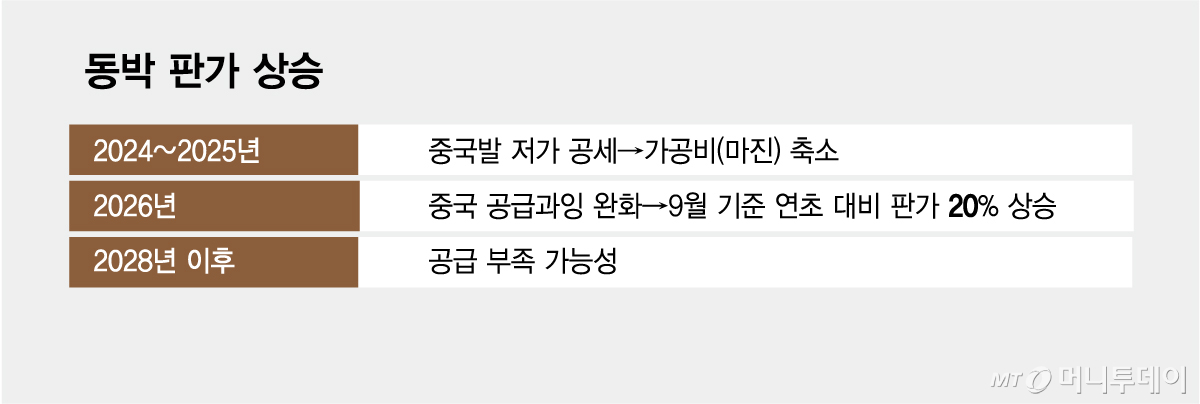
Anode foil prices, which had fallen due to oversupply from China, have rebounded this year, heightening expectations for improved profitability among domestic copper foil manufacturers. With the Chinese government's policies to curb oversupply easing downward pressure on prices, and combined with expanding demand for electric vehicles and energy storage systems (ESS), the industry is expected to continue its recovery.
According to industry sources on the 18th, China's anode foil prices rose by an average of approximately 20% compared to the beginning of the year as of September. Prices for general-purpose products in the 8th-micrometer (μm) range increased by 18%, while high-end products in the 6th μm range rose by 26%. The average operating rate of major Chinese manufacturers also increased from 80% in the third quarter of 2025 to the 90% range in the first quarter of 2026. The average operating rate of major non-Chinese manufacturers similarly recovered from the 30-50% range in the third quarter of 2025 to the 70% range in the first quarter of 2026.
Previously, China's anode foil processing fees had dropped sharply during the period when oversupply fully emerged in 2024-2025, but they turned upward this year. This appears to be due to the partial easing of oversupply resulting from the Chinese government's implementation of the "anti-involution" policy to suppress overheated competition in strategic industries such as batteries and solar power since the second half of last year.
The price increase is also having a positive effect on the selling prices of domestic companies. Solus Advanced Materials expects its average selling price in the fourth quarter of this year to rise by more than 50% compared to the previous quarter. The company is currently negotiating price increases with most of its customers and has completed negotiations with some, planning to apply the increased prices starting from sales in November. SK Nexilis and Lotte Energy Materials are also reported to have completed price increase negotiations with a significant number of their customers in the third quarter of this year.
The industry views the trend of easing oversupply as likely to continue in the medium to long term. On the demand side, electric vehicle demand centered on China remains steady, while ESS demand has recently expanded. With an increase in large-scale ESS projects and battery production facility investments centered on North America, it is emerging as a new source of demand for anode foil. Given the characteristics of ESS, which require the construction of large-scale battery storage systems, it is expected to contribute to the medium- and long-term expansion of battery and anode foil demand.
On the supply side, concerns are arising about a reduction in anode foil supply as some copper foil manufacturers shift their focus to circuit foil to meet artificial intelligence (AI)-related demand. Lotte Energy Materials is a representative example, having converted its Iksan plant in North Jeolla Province for circuit foil use and considering additional expansion of high-value-added circuit foil production. In addition, the possibility that supply shortages will intensify after 2028 has been raised as anode foil manufacturers undertake restructuring, such as production cuts or business withdrawals, due to prolonged industry sluggishness.
The strengthening of regulations on China-based battery supply chains and the resulting expansion of supply chain diversification efforts in the North American ESS market are also favorable for domestic companies. This is because new supply opportunities may increase for non-Chinese anode foil manufacturers that can participate in local supply chains. Solus Advanced Materials, which will begin copper foil production in Canada next year, is also expected to benefit. The Canadian anode foil plant will start operations with a Phase 1 capacity of 25,000 tons per year and plans to gradually expand up to a maximum of 63,000 tons depending on future North American market demand.
An industry official said, "Amid signs of price normalization across the entire copper foil market recently, this is a natural process for customers and suppliers to build a sustainable business structure," adding, "We view this selling price increase as an important turning point for improving the profit structure of the anode foil business."

 in INDUSTRY
