

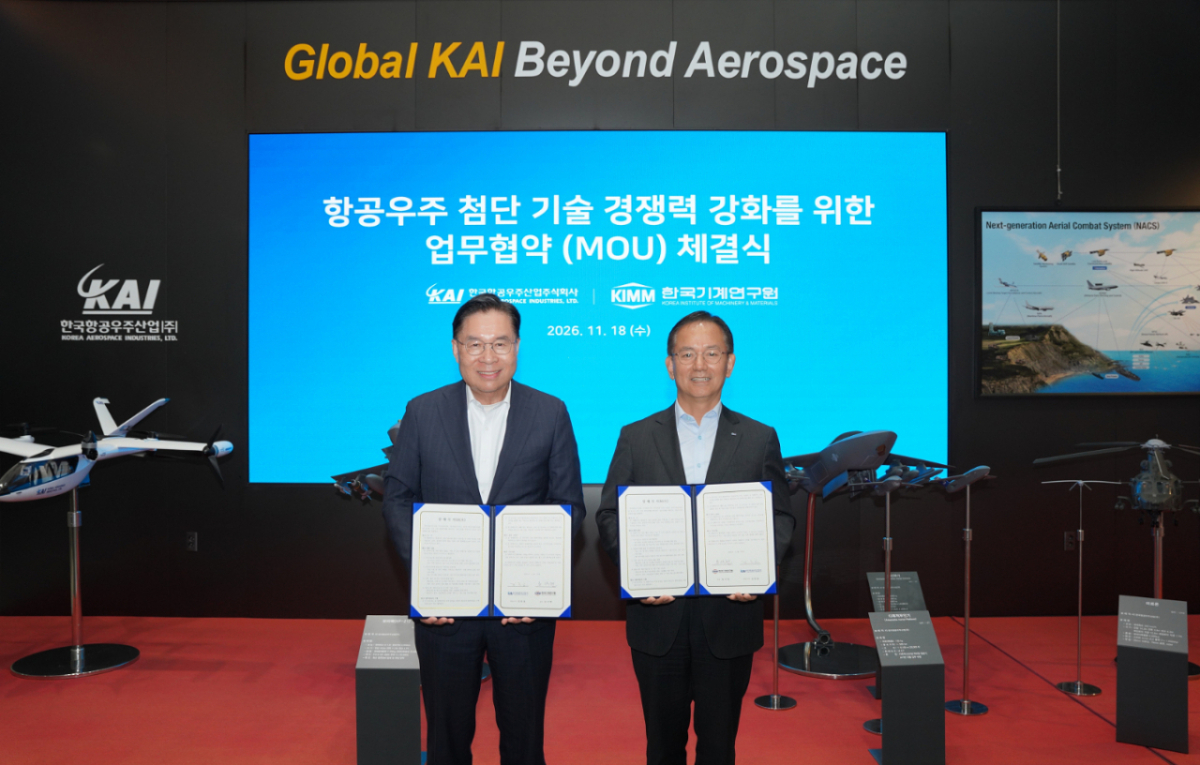
Korea Aerospace Industries (KAI) said Thursday that it has signed amemorandum of understanding with the Korea Institute of Machinery and Materials (KIMM) to enhance competitiveness in aerospace cutting-edge technologies.
The agreement was established to secure core technologies essential for the future aerospace industry and expand the industrial application of research outcomes by linking KAI's aerospace system development capabilities with the KIMM's fundamental technologies and research infrastructure.
The two institutional investors plan to advance joint research on core technologies in the future aerospace sector, such as low-observable surface technology and intelligent metal additive manufacturing, and seek cooperation plans applicable to aircraft development and production sites.
Key areas of cooperation include △exchange of core technologies and specialized personnel △identification of joint research projects and joint response to national government projects △utilization of testing and evaluation infrastructure △and advancement of advanced materials, manufacturing, and AI (artificial intelligence)-based technologies.
In particular, the KIMM's research capabilities and infrastructure in reliability verification and testing/evaluation will be leveraged for KAI's aerospace technology development to enhance aircraft performance and quality reliability.
KAI aims to strengthen its technological competitiveness required for aircraft development, production, and performance enhancement, while KIMM is expected to secure opportunities for applying research outcomes to industrial sites and new research demands.
At the technical exchange meeting held following the signing of the agreement, presentations were made on four areas of technology aimed at strengthening future aerospace technological competitiveness.
The presentation topics included △reliability evaluation of aerospace and defense parts to improve the reliability of aircraft structural components △transparent meta-display for application in the stealth field △metal additive manufacturing process technology to strengthen AI-based intelligent production and maintenance capabilities △and active control technology for aircraft radar energy to enhance low-observable performance of aircraft.
The two institutional investors plan to identify detailed cooperation projects based on the discussions at the technical exchange meeting and pursue follow-up cooperation, including joint research and participation in government R&D projects.
KAI CEO Kim Jong-chul said, "Preparing for future businesses requires above all else the proactive acquisition of new technologies and the internalization of core technologies."
He added, "Through this cooperation, we will strengthen our technological competitiveness in the aerospace field and strive to secure future growth drivers."

 in INDUSTRY
