

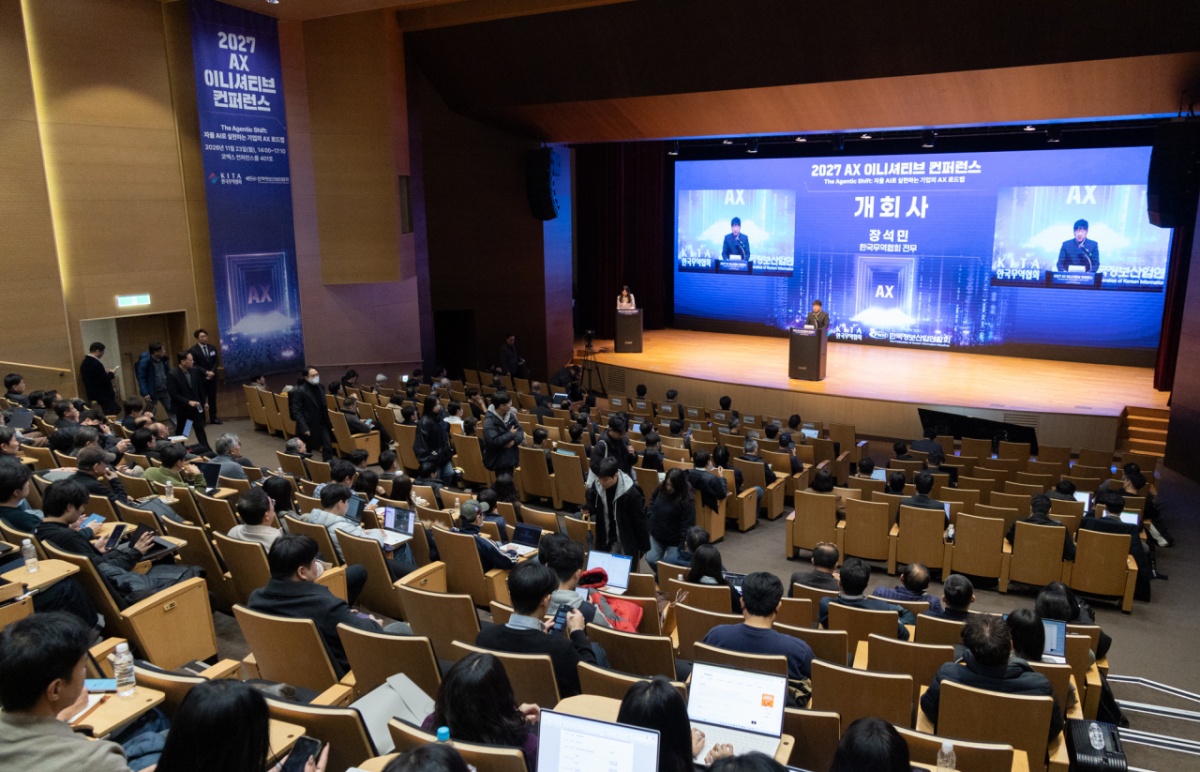
The Korea International Trade Association said that it held the '2027 Artificial Intelligence Transformation (AX) Initiative Conference' jointly with the Korea Federation of Information Industry at COEX in Samsung-dong, Seoul on Monday.
The two institutional investors have been holding this event annually since 2022 to promote digital transformation in the industrial sector. This year's theme was 'The Agentic Shift: Corporate AX Roadmap Realized by Autonomous AI,' and corporate AX strategies were discussed. Approximately 300 officials from companies and institutional investors attended the event.
According to a survey conducted by the KITA last September targeting 1,080 export manufacturing companies, approximately 60% of responding companies rated AX as important or very important.
However, only about 12% of companies are actively utilizing artificial intelligence (AI) in trade operations. The event discussed measures to bridge the gap between awareness of AI transformation and actual utilization within companies.
Jung Ji-hoon, a professor at Daegu Gyeongbuk Institute of Science and Technology (DGIST), who delivered the keynote speech, forecasted next year's global AI technology trends and their impact on various industries.
Lee Dae-ui, Senior Managing Director at Deloitte Consulting, diagnosed that AI is evolving into 'digital employees' that are granted roles and authorities to perform tasks, and that corporate operations are being restructured in a manner where AI handles repetitive work while humans take charge of judgment and approval.
Lee Young-hwan, director of the Digital Innovation Research Center at Korea University, introduced cases of export companies utilizing AI for buyer discovery and quote response, and proposed phased implementation starting with urgent tasks.
Cases of AI utilization in corporate field operations were also shared. Lee Geon-chan, Lead at Upstage, introduced a case of automating Bill of Lading (B/L) processing for a logistics company, explaining the importance of converting document notations that differ by trading partner to fit internal company systems.
Song Chang-woo, Team Leader at Orkestra, shared his experience in software development using AI agents, emphasizing the need for a system to control AI so that it does not arbitrarily guess uncertain parts.
Jang Seok-min, senior managing director of the KITA, said, "As the agentic shift, where AI judges and executes on its own, is fully underway, fundamental changes are occurring in the overall way companies work."
He added, "We will strengthen AX support to enable our export companies to establish autonomous AI technology in their field operations and secure substantial competitiveness in the global market."

 in INDUSTRY
