

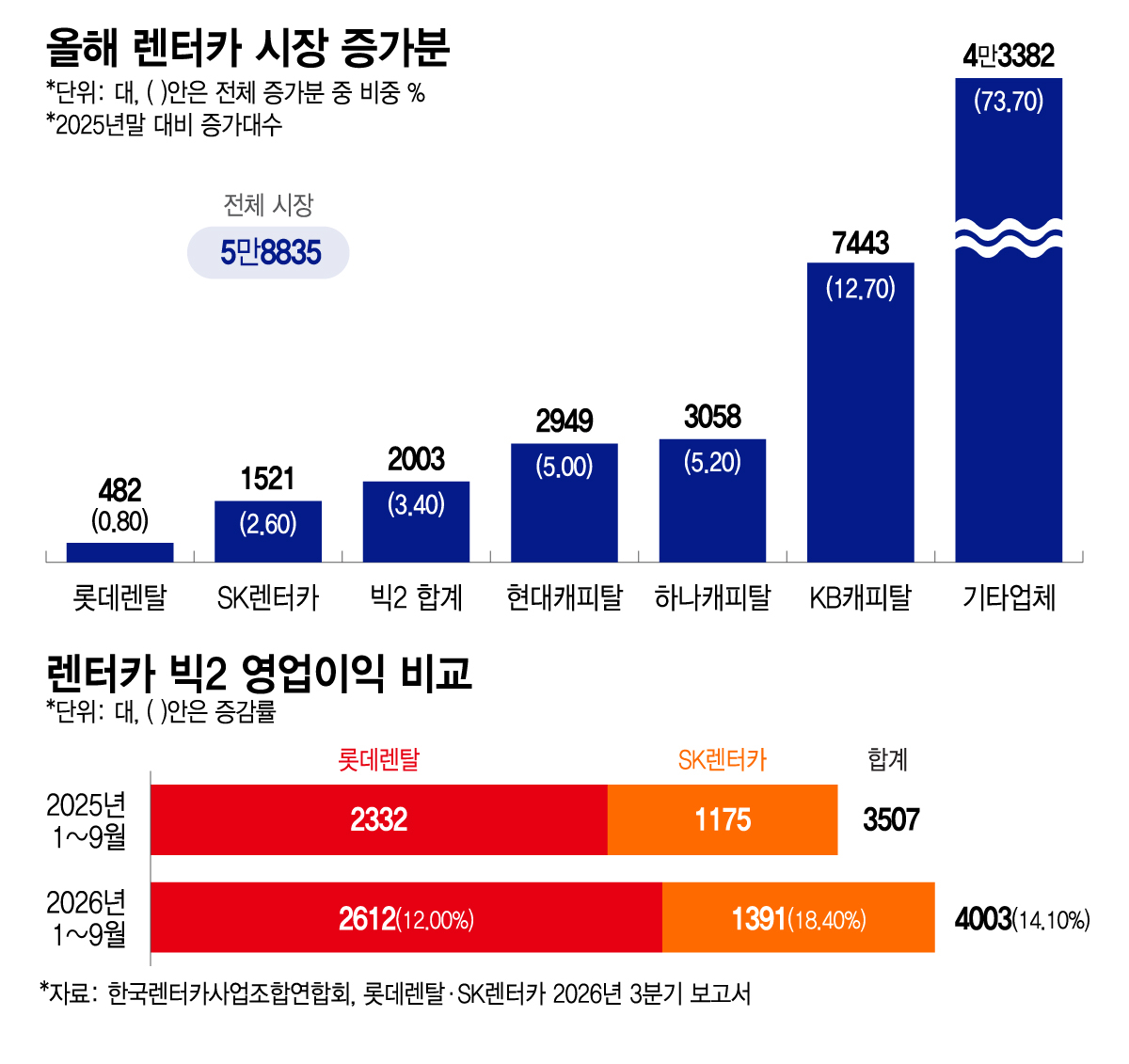
While the domestic rental car market is expanding, the scale growth of the industry’s top two players remains sluggish. The market share of Lotte Rental and SK Rent-a-Car, which compete for the No. 1 and No. 2 positions, has declined, yet their operating profits have actually posted double-digit growth. The market share and profitability of leading rental car companies are showing diverging trends.
According to the Korea Rental Car Business Association Federation and industry sources on the 24th, the number of registered domestic rental cars increased by 58,835 vehicles (4.5%), from 1,296,233 at the end of last year to 1,355,068 as of the end of September this year.
Over the same period, Lotte Rental’s registered fleet grew by 482 vehicles (0.2%), from 255,553 to 256,035. SK Rent-a-Car increased by 1,521 vehicles (0.8%), from 195,008 to 196,529. The combined increase for the two companies was 2,003 vehicles, accounting for only 3.4% of the total market’s net growth.
Market share is also on a downward trend. The combined market share of Lotte Rental and SK Rent-a-Car fell from 36.3% at the end of 2024 to 34.8% at the end of last year, and further to 33.4% as of the end of September this year. Lotte Rental’s share dropped from 20.7% to 18.9%, while SK Rent-a-Car’s declined from 15.6% to 14.5% over the same period.
In contrast, the registered fleets of companies other than the two leaders have grown rapidly. The number of registered vehicles for other firms, excluding the top four companies including Lotte Rental and SK Rent-a-Car, increased by 43,382 vehicles, from 545,286 at the end of last year to 588,668 as of the end of September this year. This accounts for 73.7% of the total market growth. KB Capital’s fleet grew by 14.6%, from 50,981 to 58,424 vehicles over the same period, while Hana Capital also increased by 3.3%, from 91,798 to 94,856 vehicles.
A notable point is that despite declining market share, the profitability of the rental car duopoly has actually improved. The combined operating profit for the two companies from January to September this year was 400.3 billion won, a 14.1% increase from 350.7 billion won in the same period last year. While the combined revenue growth rate was only 2.9%, the operating profit margin rose by 1.1 percentage points, from 10.5% to 11.6%.
By company, Lotte Rental’s consolidated operating profit for January to September was 261.2 billion won, up 12.0% year-on-year. SK Rent-a-Car also recorded an operating profit of 139.1 billion won over the same period, an increase of 18.4%.
Lotte Rental is restructuring its business by increasing the share of high-profitability products. According to the company, the proportion of used car long-term rentals within its long-term rental business in the third quarter of this year was 21.2%, up 2.4 percentage points from 18.8% in the same period last year. A Lotte Rental official stated, “Structural improvements centered on our core rental business, such as expanding high-revenue products and innovating costs, have led to balanced profit growth across all divisions, including auto long-term, auto short-term, and Biz rentals.”
SK Rent-a-Car has also seen profits grow faster than revenue, despite a limited increase in registered vehicles. Revenue from January to September this year was 1.1801 trillion won, up 1.6% year-on-year, showing a contrast with the 18.4% operating profit growth rate. An SK Rent-a-Car official noted, “We are restructuring our vehicle and product portfolio centered on rental profitability. Additionally, despite the contraction of the used car market due to geopolitical risks, we have operated our own auction platform since July last year to improve the profitability of used car sales.”

 in INDUSTRY
