

The return of Jensen Huang, CEO of NVIDIA, has allowed Samsung Electronics and SK hynix to alleviate some of the uncertainty surrounding their medium- and long-term investments in HBM (High Bandwidth Memory).
As the likelihood that NVIDIA's next-generation GPU (Graphics Processing Unit) development strategy will be maintained increases, both companies are expected to be able to advance their technology development and production capacity expansion plans more steadily.
According to semiconductor industry sources on the 24th, NVIDIA decided unanimously through its board of directors the previous day (local time) to reinstate CEO Huang.
This comes just 11 days after his resignation on the 12th. The atmosphere is also easing concerns about a contraction in AI infrastructure investment and delays in next-generation memory development that had arisen following the departure of CEO Huang, who has led the construction of the global AI (Artificial Intelligence) memory semiconductor (hereinafter referred to as "memory") supply chain.
In particular, the significance lies more in the development and investment strategy for next-generation GPUs from 2028 onward than in immediate performance results. The likelihood that HBM volumes already secured through long-term supply contracts will change due to a management turnover is low.
However, products such as NVIDIA's next-generation GPU "Feynman," scheduled for release in 2028, require HBM development and equipment investment to be carried out first in line with the launch schedule and specifications.
This means that any changes to the GPU launch schedule or customer-requested specifications could also affect both companies' production plans and the timing of investment recovery.
As the competitive arena expands with HBM4E (7th-generation High Bandwidth Memory) and custom HBM, early design collaboration has become even more important.
Custom HBM must be designed with components such as the base die (the control semiconductor at the bottom of the HBM stack) tailored to the customer's AI accelerator, making it difficult to redirect volumes to other customers. Consequently, production plans must be formulated based on each customer's product development schedule and projected demand.
Customized HBM development capabilities for individual customers are also necessary to respond to the diversification of demand sources. This is because big tech companies (large IT firms) such as Google and Amazon are expanding their in-house AI semiconductor development.
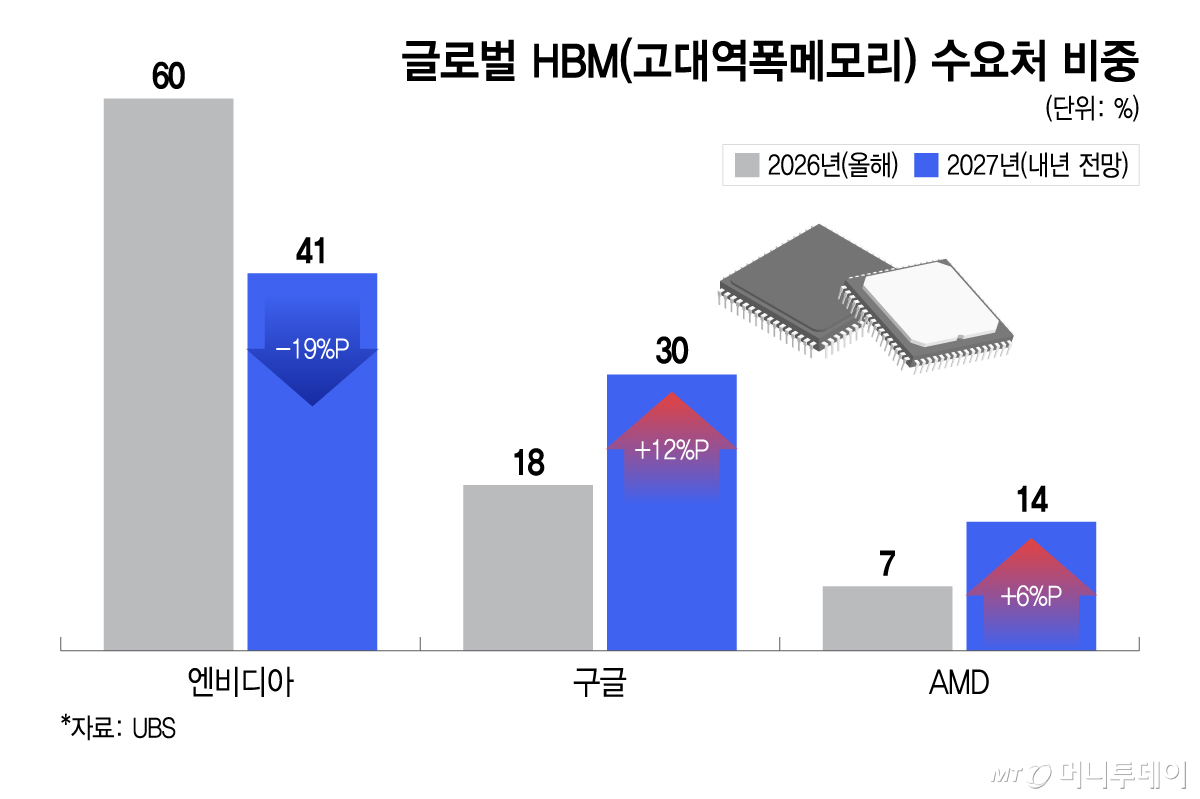
Global investment bank UBS forecasts that NVIDIA's share of global HBM demand will decrease from 60% this year to 41% next year, while Google's share will rise from 18% to 30%, and AMD's from 7% to 13%.
The two companies' response strategies to this situation also show differences. Samsung Electronics plans to increase its supply share to NVIDIA by enhancing the competitiveness of HBM4E and subsequent products, while simultaneously securing new customers to broaden its revenue base.
KB Securities forecasts that non-NVIDIA shipments will account for 65% of Samsung Electronics' HBM shipment volume next year. SK hynix, currently NVIDIA's largest HBM supplier, faces the challenge of maintaining its advantage in the custom HBM market based on its collaboration on HBM4 (6th-generation High Bandwidth Memory).
This is the backdrop for both companies proceeding with large-scale production facility investments. Samsung Electronics is investing 1.3 trillion won to build a new HBM packaging plant at its Onyang site in Asan, Chungnam Province, while SK hynix is investing more than $4 billion to construct an advanced HBM packaging production facility in West Lafayette, Indiana, USA.
Given that construction takes several years, the product development schedules and ordering plans of major customers are key variables determining the timing and scale of expansion for both companies.
An industry official said, "While short-term volumes are already contracted and thus largely unaffected, NVIDIA's leadership stability is important for decision-making that looks several years ahead, such as custom HBM or overseas packaging investments," adding, "The fact that the development schedules of core customers are being maintained is a positive signal even in the process of broadening the customer base."

 in INDUSTRY
