

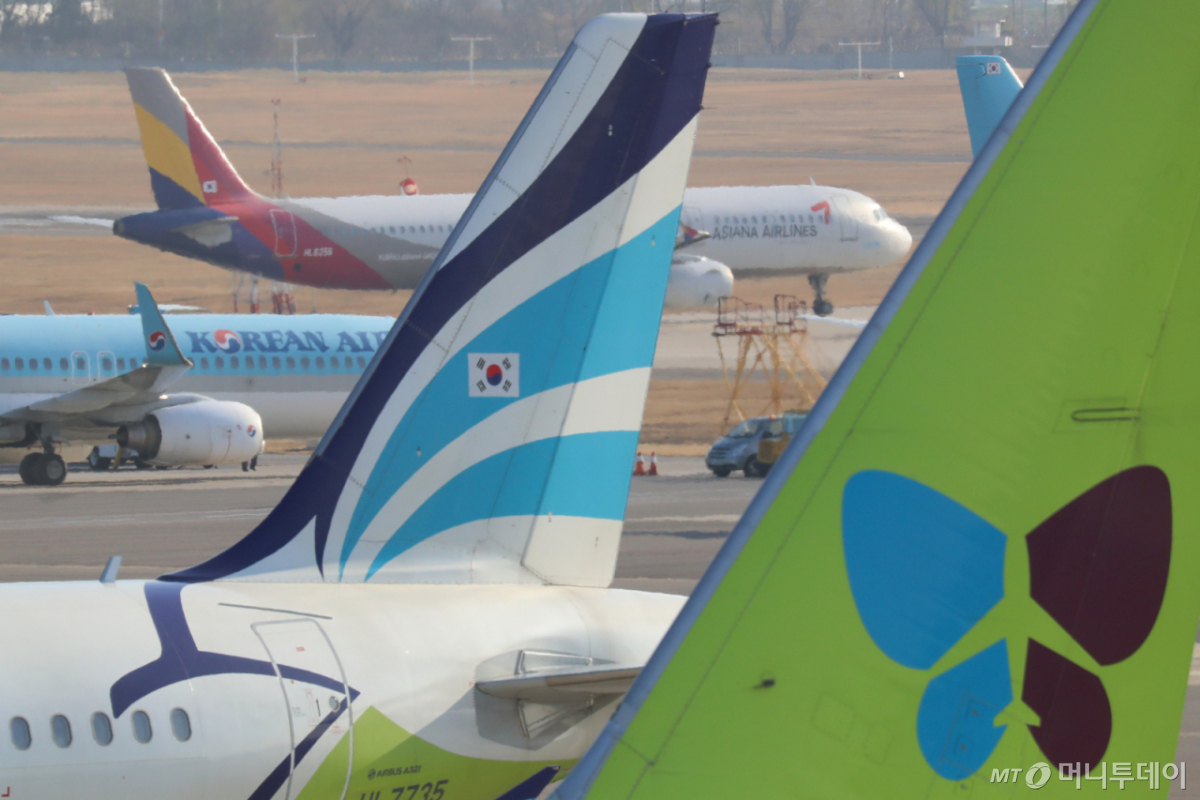
Jin Air, which has absorbed Air Busan and Air Seoul, aims to develop Busan into an international transit hub connecting Southeast Asia and Japan.
The strategy is to escape the competition among low-cost carriers (LCCs) over domestic passenger demand by increasing the share of overseas sales. By establishing Seoul and Busan as its two major hubs, Jin Air plans to restructure its route network and maintenance and training infrastructure, targeting a minimum annual merger synergy of 26 billion won starting from the first year of integration.
Jin Air held a shareholder briefing at the headquarters of Korea Investment & Securities in Yeouido, Seoul, on Tuesday, disclosing this direction for the merger and its post-integration business strategy. Key executives, including Jin Air President Lee Jin-ho, attended the event.
First, Jin Air will expand destinations from Busan from the current 29 to 35 after integration, an increase of approximately 21%. To this end, it will add six new destinations, including Toyama, Hiroshima, and Kitakyushu in Japan. The company also plans to secure international transit demand via Busan by utilizing the traffic rights and new routes held by Air Busan.
On that day, President Lee stated, “If LCCs hold Korean-origin demand and engage in endless competition, it becomes very difficult to secure a future vision.” He explained, “Geographically, it is convenient for many Southeast Asian cities to transit through Busan to reach Japan, with good connecting flights and reduced travel time.” He added, “Jin Air alone has a low share of overseas sales,” and stated, “We plan to cultivate Busan as a secondary hub, something other LCCs do not have.”
Plans to relocate the headquarters to Busan after integration are also under consideration. However, the decision on relocating the headquarters has not yet been finalized. Jin Air plans to maintain regional personnel and organizations in Busan stably while building a route network that leverages the characteristics of both Seoul and Busan.
The company will also improve profitability by appropriately allocating aircraft between the two major hubs. It will adjust the frequency of overlapping routes operated individually by the three companies and deploy the secured aircraft to new revenue-generating routes. To align with outbound demand from Korean travelers, flights concentrated in the morning will be distributed to afternoon and evening time slots, broadening options for foreign tourists as well.

The annual merger synergy effect estimated by Jin Air is a minimum of 26 billion won. Jin Air executives emphasized, “We aim to achieve the synergy effect immediately in the first year of integration (2027) and will implement it as quickly as possible.”
In addition, Jin Air executives plan to establish a low-cost structure by strengthening negotiating power through expanded purchasing volumes for aviation fuel and aircraft. They will also restructure maintenance and training infrastructure.
The operational maintenance bases in Incheon and Busan will be dualized, with maintenance personnel and parts warehouses managed systematically.
By leveraging Korean Air’s maintenance technology, the company aims to minimize duplicate resources while enhancing on-site response capabilities to improve aircraft punctuality. The existing Airbus-focused Air Busan training center will also be equipped with Boeing B737 training facilities.
The number of codeshare routes with Korean Air, currently over 30, will also increase. By improving connectivity between Korean Air’s long-haul routes and the integrated Jin Air’s medium-haul routes, network competitiveness will be strengthened.
The integrated Jin Air aims to launch on March 17 next year. The combined revenue of the three companies last year was approximately 2.5 trillion won.
At the time of the integrated launch, it is expected to secure over 60 aircraft and approximately 85 routes. Available Seat Kilometers (ASK), which indicate passenger supply capacity, are projected to increase by more than 80% compared to the existing Jin Air.
Jin Air plans to submit a securities registration statement to the Financial Supervisory Service next week and proceed with the merger approval process through an extraordinary general meeting of shareholders in February next year.

 in INDUSTRY

