

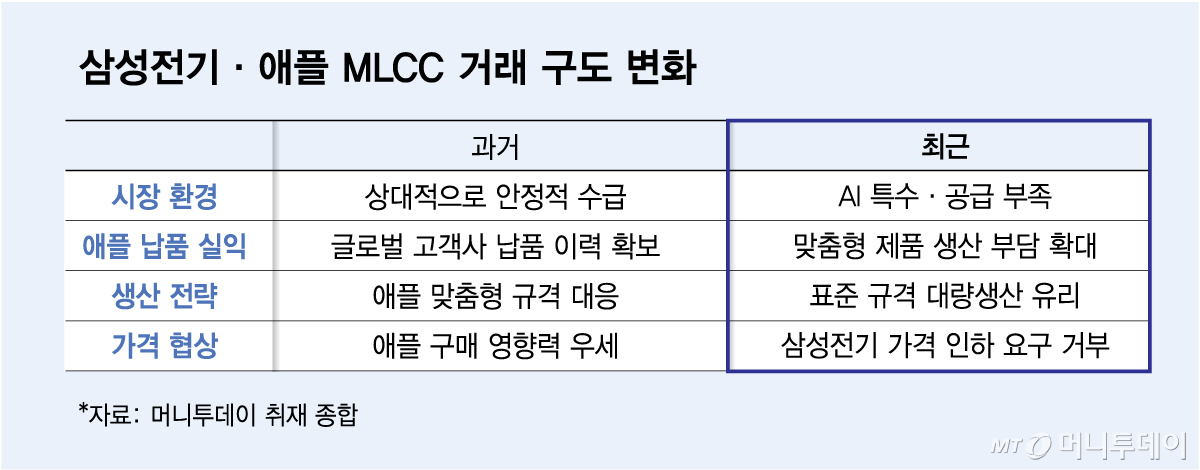
Samsung Electro-Mechanics has rejected Apple's request for a reduction in component unit prices, successfully defending its pricing. This unusual dynamic, in which the component supplier holds the upper hand in price negotiations with Apple, has emerged as AI-driven demand has reduced the supply capacity for MLCCs (multilayer ceramic capacitors).
According to the electronics industry on the 29th, it is being assessed that Samsung Electro-Mechanics securing the lead in price negotiations with Apple is a first since its founding. It was reported that Samsung Electro-Mechanics internally judged that there would be no practical benefit in separately allocating production volumes if Apple did not raise supply prices.
The trigger for the negotiations was Apple's cost pressure. As rising memory semiconductor (hereinafter referred to as "memory") prices increased manufacturing costs, Apple attempted to offset this by lowering unit prices for non-memory components. In fact, John Turners, Apple's CEO, stated in an earnings announcement conference call earlier this month that some of the increase in Q3 memory costs had been offset by utilizing existing inventory and falling non-memory component prices, and warned that the burden of memory costs would grow further in Q4.
Despite this, low transaction dependency and a changed profit structure are cited as reasons why Samsung Electro-Mechanics was able to draw a line against Apple's demands. It is known that Apple accounts for a negligible share of Samsung Electro-Mechanics' MLCC revenue. For years, Samsung Electro-Mechanics has supplied products while bearing the burden of meeting Apple's demanding custom specifications in order to secure a track record of deliveries to global customers. However, with recent increases in MLCC unit prices, standard-specification products that can be mass-supplied to multiple customers to lower manufacturing costs have become far more advantageous in terms of profitability. This has effectively increased the opportunity cost of producing Apple-exclusive products within limited production capacity.
The surge in demand for high-specification MLCCs for AI servers has bolstered Samsung Electro-Mechanics' negotiating power. This is because major manufacturers have increased their production share of high-capacity products, tightening supply capacity even for general consumer-grade items. According to Mirae Asset Securities, recent MLCC lead times have reached 40 weeks, exceeding three times the standard lead time of 12 weeks.
As supply shortages worsen, price hikes are also gaining momentum. According to an SK Securities Non-Disclosure Agreement (NDR) report, Samsung Electro-Mechanics raised distributor supply prices twice in June and August this year, and has largely concluded price increase negotiations with major customers, set to embark on full-scale unit price increases starting from Q1 next year. Market research firm TrendForce forecasts that some consumer-grade MLCC prices from Samsung Electro-Mechanics will rise by 25% to 30% in Q4 this year, while some AI server products will see increases of 10% to 20%.
The expansion of Long-Term Agreements (LTAs) is also underpinning Samsung Electro-Mechanics' price negotiating power. In an earnings announcement conference call last month, Samsung Electro-Mechanics stated that it has signed or is in negotiations for high-value-added MLCC long-term supply contracts with approximately 50 customers, and expects more than half of its total MLCC revenue next year to be generated from LTAs. According to iM Securities, Samsung Electro-Mechanics plans to allocate 60% of its MLCC production capacity next year to LTAs, with contract sizes estimated to reach 6 trillion to 7 trillion won. Analysts note that while actual supply requests from customers exceed this amount, a cap was placed on contract sizes to ensure flexibility in operating production capacity.
Go Yeong-young, a research analyst at iM Securities, analyzed, "As the room for concluding LTAs shrinks and industry conditions become tighter, the price terms of future contracts are highly likely to become more favorable for Samsung Electro-Mechanics."

 in INDUSTRY
