

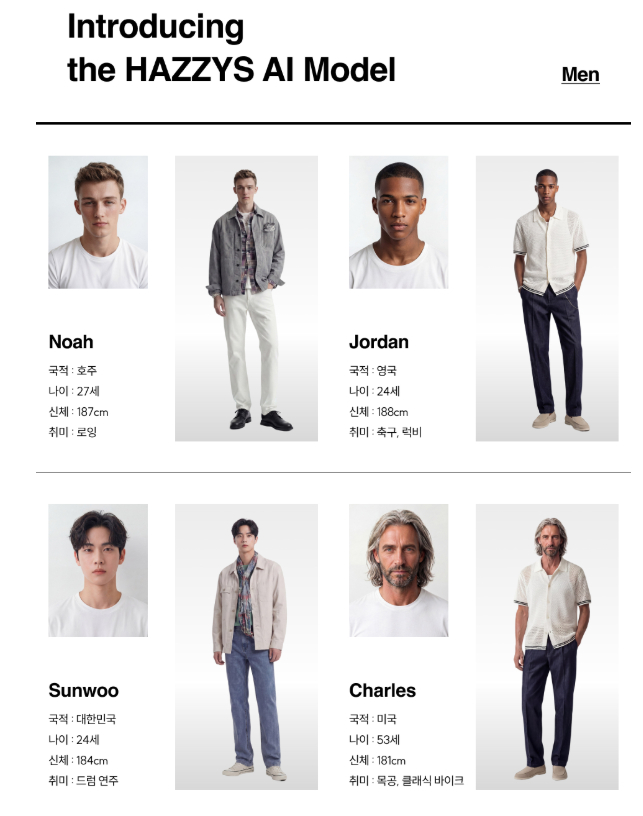
The fashion industry's use of AI is expanding beyond simple image generation to building 'digital personas' that represent brands. This approach involves assigning nationalities, ages, hobbies, lifestyles, and other attributes to AI models and utilizing them continuously as if they were real individuals. Efforts are underway to move beyond one-off content creation and leverage these assets to convey brand identity.
According to LF on the 7th, Hedge will operate 12 AI models as fixed brand models starting from the fall-winter (FW) 2026 season. The models include a diverse range of ages and ethnicities, covering whites, blacks, Asians, seniors, and children. Each model has detailed settings for nationality, age, hobbies, residence, and lifestyle. Representative examples include 'Noah,' a 27-year-old rowing enthusiast living in Australia, and 'Helen,' a 54-year-old woman residing in France who enjoys visiting art galleries.
Hedge plans to operate these models not as seasonal replacements but as fixed AI models representing the brand. Starting with the 26FW lookbook, the same characters will be continuously utilized in advertising campaigns, digital content, and global marketing. As time passes, the characters' settings and stories accumulate, simultaneously conveying the lifestyle the brand pursues.
While the creation of models using AI is already a common practice in the fashion industry, most cases have remained limited to generating images needed for photo shoots or advertisements. There are few domestic examples of cultivating specific AI models over an extended period to serve as representative figures for brands.
Cases of utilizing virtual models in marketing within Korea have continued steadily. Virtual influencers based on 3D technology, such as Rozie and Lucy, have been active primarily through social media and advertisements since the early 2020s. However, their focus was on growing as individual influencers, differing from roles that build a specific brand's worldview or convey long-term brand identity.
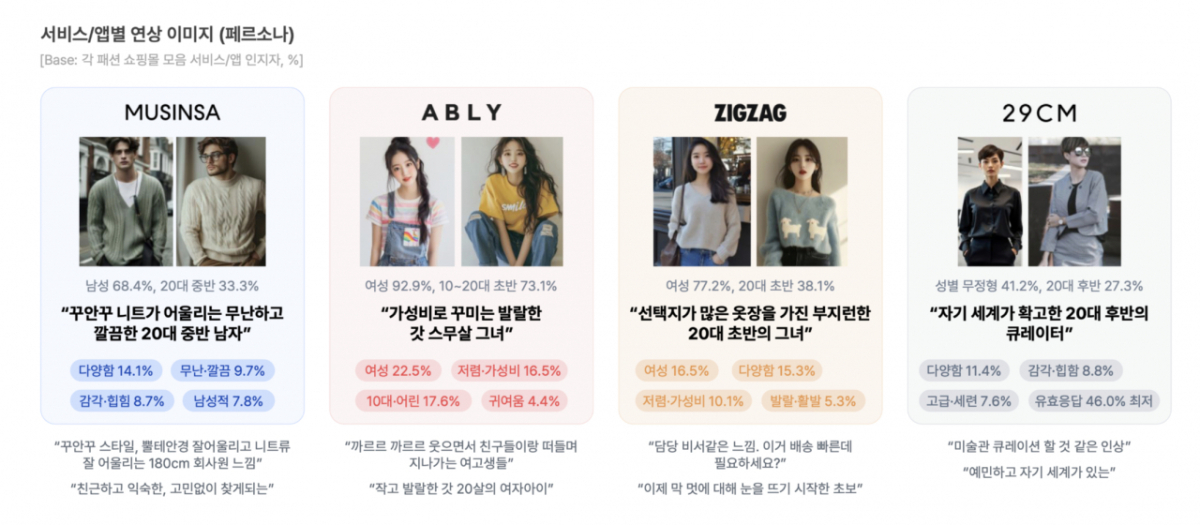
This shift also aligns with the trend of consumers perceiving brands as-like entities. According to an OpenSurvey poll, Musinsa is perceived as 'a mid-20s male who fits well with casual knitwear.' Able is evaluated as 'a 20-year-old woman dressing cost-effectively,' while 29CM has formed the image of 'a curator-type figure with a firm personal world.'
The difference lies in how these images are formed. Platform images naturally emerge from accumulated user experiences. In contrast, Hedge's AI models were designed by the brand from the outset, including personality, preferences, and lifestyle. This represents an expansion beyond the stage where consumers form brand images to a method where brands directly create and utilize desired characters.
Industry observers are focusing on the possibility that generative AI's application will expand from improving production efficiency to managing brand assets. Repeatedly exposing the same AI model across multiple seasons can establish it as a face symbolizing the brand. Projections also suggest that usage scope may broaden in the future to include various areas such as country-specific content creation and consumer communication.
A Hedge official stated, "We view AI not merely as a production technology but as a new asset for conveying brand value and identity," adding, "We plan to continuously expand stories and content for each model to broaden touchpoints with global customers."

 in LIVING

