

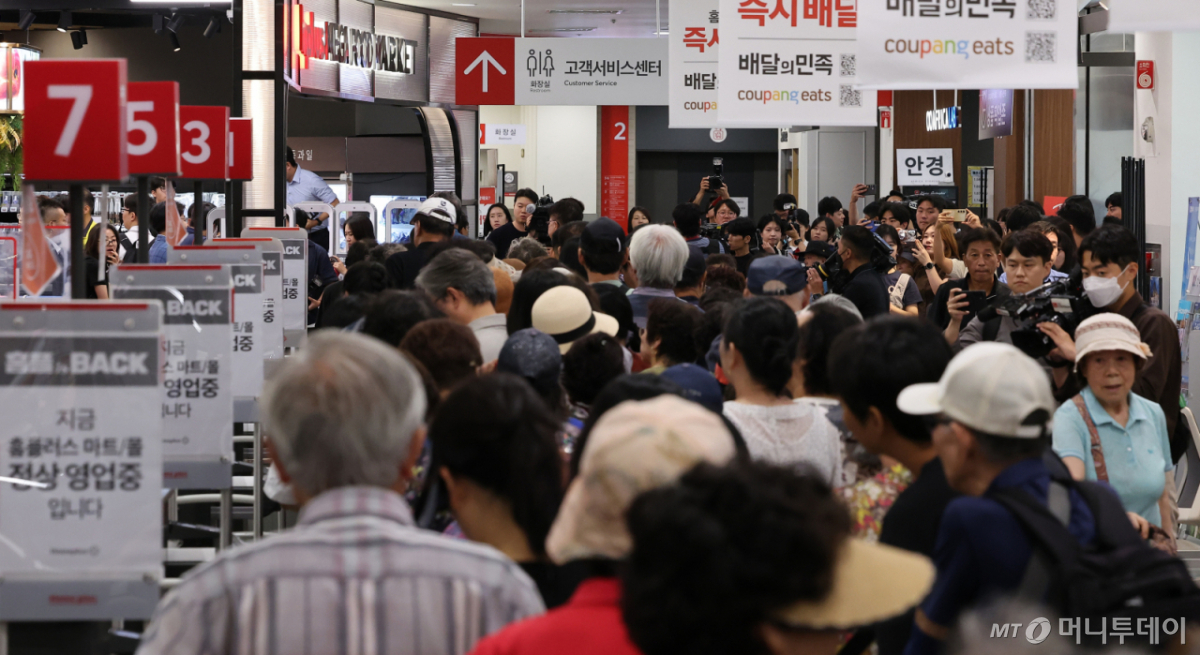
Homeplus, a major department store chain pushing to sell its own stores to repay debts, faces uncertainty over whether it can dispose of all its stores within the scheduled timeframe to raise funds. Many of the stores on the sales list are located in non-capital areas where the local real estate market is sluggish, leading to forecasts that the disposal process will be difficult.
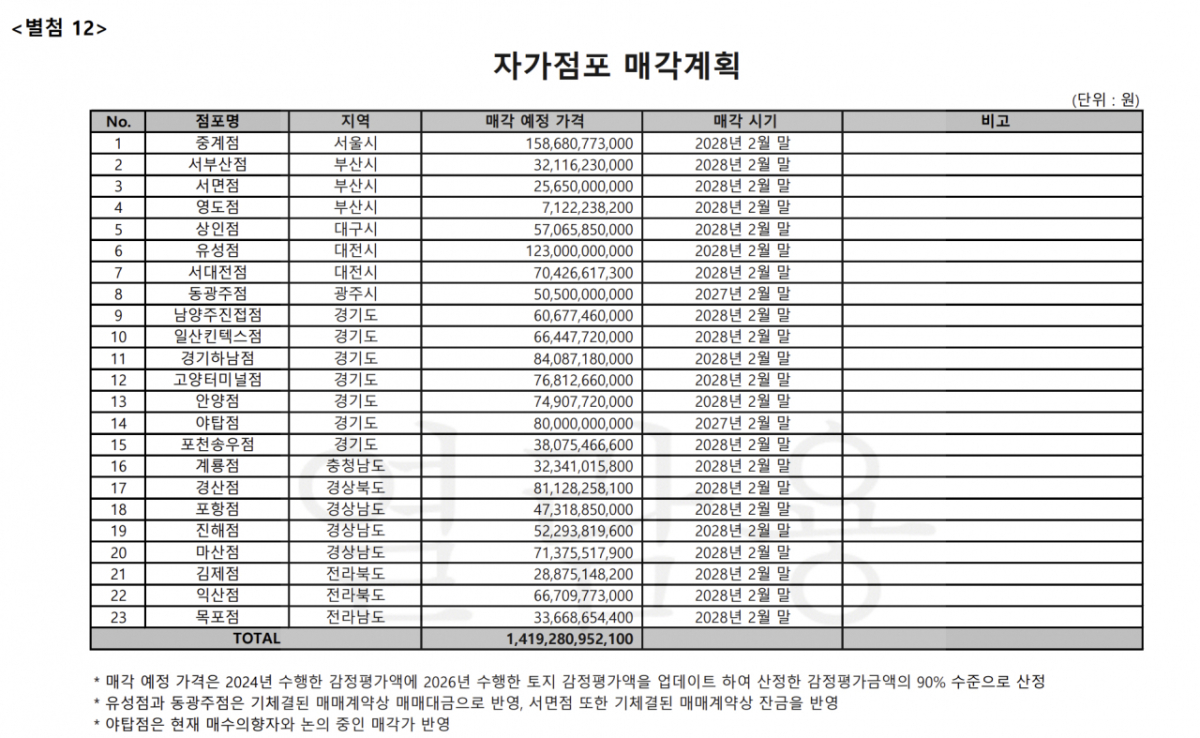
According to Homeplus's second revised reorganization plan submitted on the 24th, the company plans to dispose of 23 of its own stores by February 2028. The expected sales proceeds are estimated at 1.4192 trillion won. The projected sales amount was calculated at 90% of the land appraisal value conducted this year. Homeplus explained that it set the figure conservatively to ensure the fastest possible disposal within the deadline.
Among the 23 stores slated for sale, contracts have been signed for three locations: Yuseong Store (123 billion won), Dong-Gwangju Store (50.5 billion won), and Seomyeon Store (25.6 billion won). The Yatab Store (80 billion won) is currently negotiating the sale price with a prospective buyer. The remaining 19 stores will be marketed for sale once the reorganization plan is approved.
Among the 19 stores newly listed for sale, Junggye Store is the only one in Seoul and has the highest expected sales price at 158.6 billion won. In addition, six stores are located in the Seoul Capital Area: Namyangju Jinjeop Store (60.6 billion won), Ilsan Kintex Store (66.4 billion won), Gyeonggi Hanam Store (84 billion won), Goyang Terminal Store (76.8 billion won), Anyang Store (74.9 billion won), and Pochon Songu Store (38 billion won).
In contrast, 12 stores are located in local areas: Seo-Busan Store (32.1 billion won), Yeongdo Store (7.1 billion won), Daegu Sangin Store (57 billion won), Seo-Daejeon Store (70.4 billion won), Gyeryong Store (32.3 billion won), Gyeongsan Store (81.1 billion won), Pohang Store (47.3 billion won), Jinhae Store (52.3 billion won), Masan Store (71.3 billion won), Gimje Store (28.8 billion won), Iksan Store (66.7 billion won), and Mokpo Store (33.6 billion won).
Industry observers predict that selling non-capital area stores will be difficult. Park Won-gap, senior real estate expert at KB Kookmin Bank, stated, "While the locations of Homeplus's stores slated for sale are generally excellent commercial hubs in their respective regions, the increase in e-commerce demand has weakened the commercial real estate investment market, and the local real estate market is in a slump. These are key variables." He added, "There may be demand for mixed-use developments such as residential-commercial complexes, but it remains to be seen whether they can be disposed of within the set timeframe."
Homeplus is also in a situation where it cannot sell quickly due to time pressure. The proceeds from these sales must be used to repay trust-secured bonds held by Marius Financial Group, the largest creditor. Only after releasing this lien can other store liens be released, allowing Homeplus to secure additional funding from institutional investors.
After releasing all liens, Homeplus plans to repay all emergency operating fund (DIP) loans and, by February 2030, raise approximately 600 billion won using 38 of its own stores as collateral to pay off public creditors such as unpaid wages and taxes. By 2037, the company has decided to increase the secured loan scale to about 900 billion won to secure repayment funds.
At the same time, Homeplus must operate the remaining 67 stores to increase sales by more than 20% within one year and improve its operating profit/loss by at least 130 billion won in order to repay borrowed funds stably.
Creditors and lienholders are scheduled to review this reorganization plan at a creditors' meeting set for the second of next month. If the creditor group opposes the reorganization plan on that day, Homeplus's reorganization proceedings will be terminated. In such a case, there is a possibility that liquidation (bankruptcy) procedures will follow. Even if the reorganization plan is approved, if Homeplus faces difficulties in normalizing its management and the loss scale for public creditors becomes large, Homeplus itself may abandon the reorganization plan.

 in LIVING

