

Homeplus, a major hypermarket chain pushing to sell its owned stores to repay debt, faces scrutiny over whether it can liquidate all planned locations by the set deadline to secure necessary funds. Many of the stores on the disposal list are located in non-metropolitan areas where the local real estate market is sluggish, leading to expectations that the sales process will be arduous.
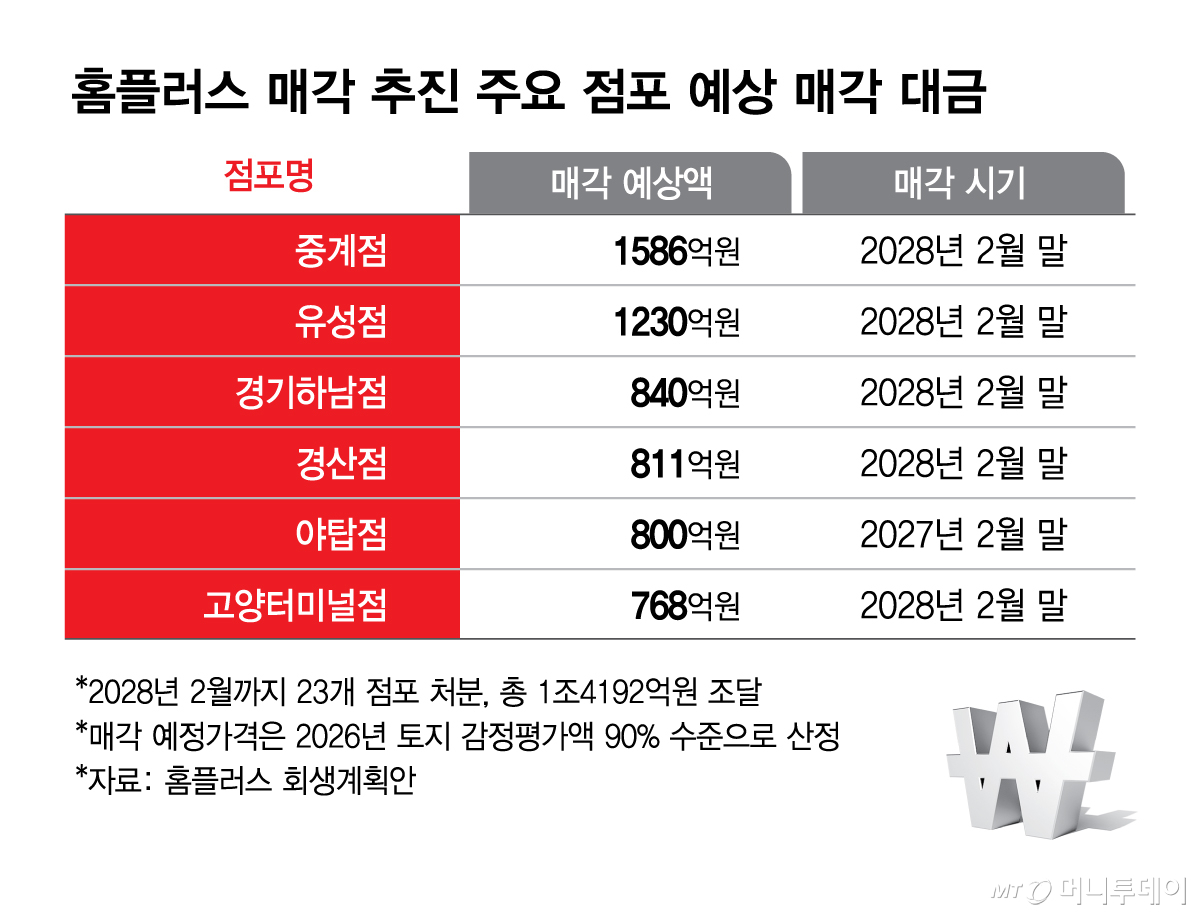
According to Homeplus's second revised reorganization plan filed on the 24th, the company plans to dispose of 23 owned stores by February 2028. The estimated proceeds from these sales are projected at 1.4192 trillion won. This figure was calculated as 90% of the land appraisal values conducted this year. Homeplus explained that the amount was conservatively set to ensure the most rapid possible disposal within the deadline.
Among the 23 stores slated for disposal, three locations—Yuseong Store (123 billion won), Dong-Gwangju Store (50.5 billion won), and Seomyeon Store (25.6 billion won)—have already signed sales contracts. The Yatab Store (80 billion won) is currently negotiating the sale price with a prospective buyer. The remaining 19 stores will proceed with sales once the reorganization plan is approved.
Of these, the Junggye Store, the only Seoul location with an estimated sale price of 158.6 billion won, represents the largest single asset. Six other stores, including Namyangju Jinjeop Store, are located in the metropolitan area. In contrast, 12 stores, such as the Seo-Busan Store, are situated in regional areas and are considered relatively less attractive. Industry observers predict that selling non-metropolitan stores will be difficult to accomplish quickly.
Park Won-gap, senior real estate expert at KB Kookmin Bank, stated, "While the locations of Homeplus's stores slated for sale are generally excellent commercial hubs in their respective regions, the commercial real estate investment market is not performing well due to increased demand from e-commerce, and the regional real estate market remains sluggish. These are key variables." He added, "There may be demand for mixed-use developments such as residential-commercial complexes, but it remains to be seen whether they can be disposed of within the set deadline."
Homeplus is also in a situation where it cannot simply offload properties at fire-sale prices due to time constraints. The proceeds from these sales must be used to repay the trust-backed bonds set by Marius Financial Group, the largest creditor. Only after this security interest is released can other ownership rights on the remaining owned stores be cleared, allowing Homeplus to secure additional funding from institutional investors.
Following the release of security interests, Homeplus plans to borrow approximately 600 billion won using 38 owned stores as collateral by February 2030, after repaying all DIP (debtor-in-possession) loans. This capital will be used to settle public interest claims such as unpaid wages and taxes. By 2037, the company intends to increase its secured loan scale to around 900 billion won to prepare for repayment. Simultaneously, it must operate the remaining 67 stores to boost sales by more than 20% within one year and improve operating profit/loss by at least 130 billion won to ensure stable debt servicing.
Creditors and security holders are scheduled to review this reorganization plan at a creditors' meeting set for the 2nd of next month.
If the creditor group opposes the reorganization plan on that same day, Homeplus's reorganization proceedings will be terminated. In such a case, there is a possibility that liquidation (bankruptcy) procedures will follow. Even if the reorganization plan is approved, if Homeplus faces difficulties in normalizing its management and the scale of losses to public interest creditors grows, the company itself may choose to abandon the reorganization plan.

 in LIVING
