

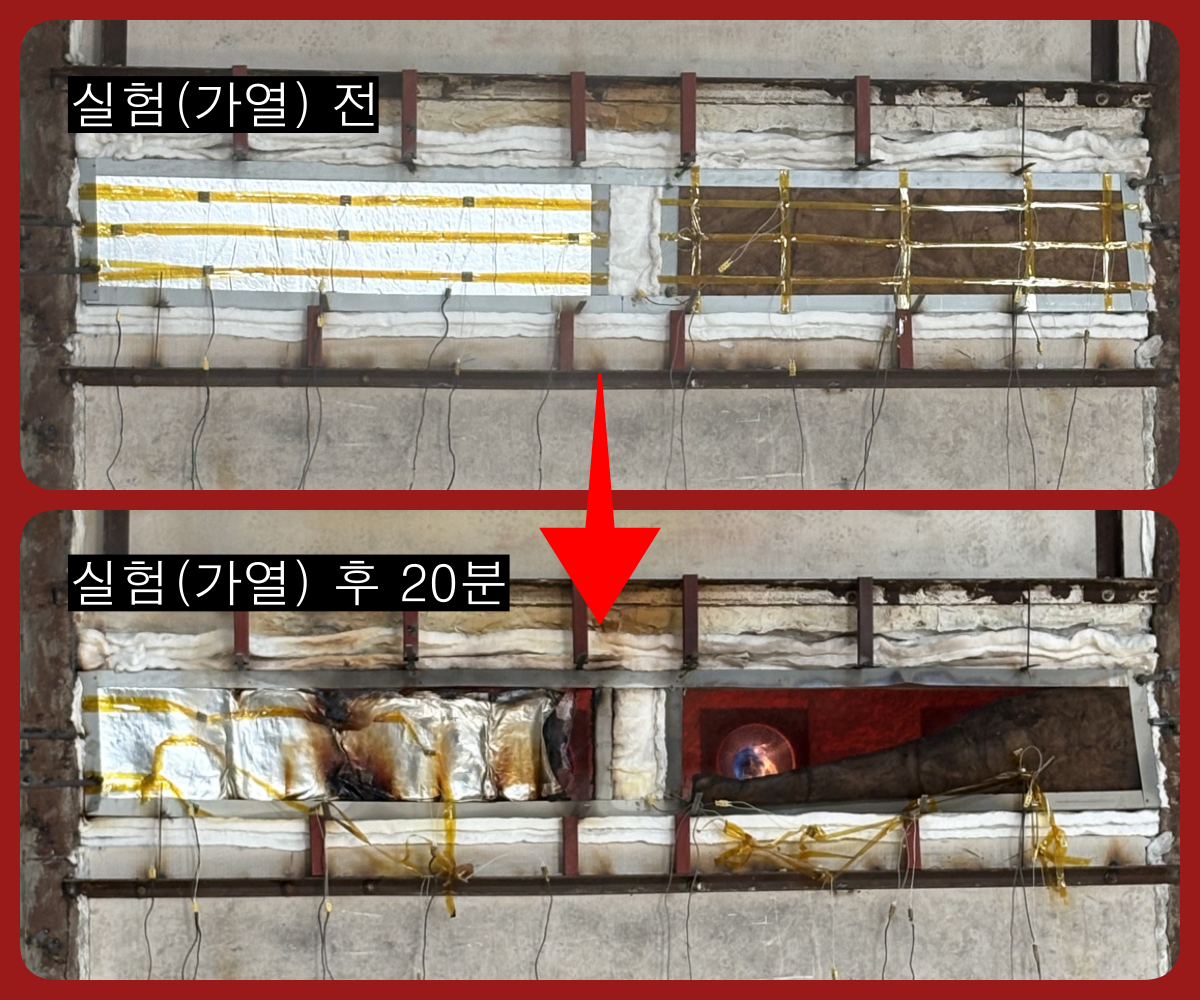
#On the 4th, we visited a national accredited fire test institution. An experiment was conducted where 'flame-retardant urethane' and 'non-combustible glass wool', used as core materials for sandwich panels, were placed side by side and subjected to heat of up to 800 degrees or higher. After 20 minutes, the flame-retardant urethane only burned on the surface while maintaining its shape, but the non-combustible glass wool shrank and peeled off under high temperatures, completely collapsing its structure. The vertical heating furnace exposed the interior through a gaping hole.
This scene raises doubts about whether non-combustible glass wool can guarantee shape retention and heat insulation performance in actual fire scenes exceeding 1,000 degrees. At the five-minute mark of heating, the back temperature remained at 37–38 degrees for flame-retardant urethane, but soared to nearly 200 degrees for glass wool. This moment fully exposed a loophole in the current system that exempts all fire safety verification procedures for glass wool sandwich panels solely because their core material is non-combustible.
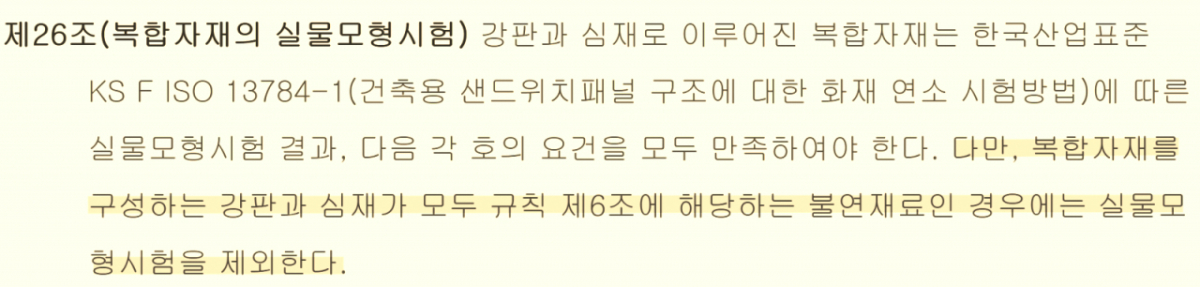
The current Ministry of Land, Infrastructure and Transport Notice 'Standards for Quality Recognition and Management of Building Materials', etc., includes a mandatory provision requiring 'full-scale model testing' for sandwich panels composed of steel plates and core materials. This test involves assembling panels in the same manner as actual construction and igniting them to comprehensively verify flame generation at joints, ceiling temperatures, radiant heat, and whether flames are ejected. With large fires repeatedly occurring in logistics warehouses and other facilities in recent years, its importance has grown even greater.
However, if both the steel plate and core material are non-combustible materials like glass wool, the finished product's full-scale model test is entirely exempted. This clause was originally a temporary measure introduced to resolve delays (1–2 years) caused by insufficient testing facilities at the time of the system's launch. Yet, even as full-scale fire test facilities have significantly increased over the years, the exemption provision remains unchanged for several years.
The problem is that the fire safety of sandwich panels cannot be determined solely by materials. Safety varies widely depending on the core material's density and thickness, adhesion to the steel plate, and the joint structure between panels. Even with non-combustible core materials, skipping finished product full-scale testing makes it difficult to filter out quality variations from manufacturing processes or substandard products under fire conditions.
There is also a loophole in the premise of 'panels composed entirely of non-combustible materials'. In the case of glass wool sandwich panels, combustible adhesives are ultimately used when attaching the core material to the steel plate. If testing is exempted based solely on the use of non-combustible steel plates and non-combustible glass wool, there is no way to verify the real-world risk that adhesives could ignite during a fire, causing flames to spread and joints to separate.
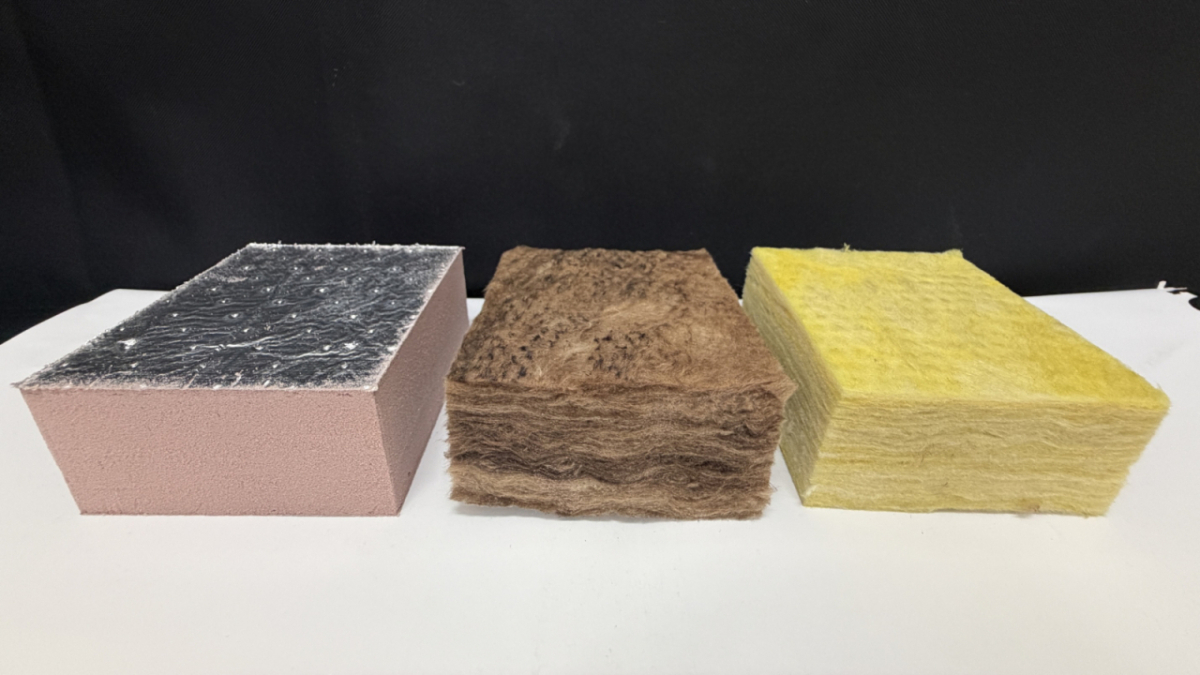
In contrast, for example, flame-retardant urethane panels must pass both performance tests on the core material itself and full-scale model testing of the finished product. Although urethane was previously an organic material vulnerable to fire, flame-retardant urethane has evolved to form a carbonized film on its surface when exposed to flames, blocking internal heat and oxygen penetration. This explains why flame-retardant urethane demonstrated shape retention and heat insulation capabilities in today's experiment.
Nevertheless, market evaluations remain biased. Due to the entrenched stereotype that 'organic materials are dangerous' formed by past fire accidents involving combustible urethane and EPS panels, flame-retardant urethane—which has applied flame-retardant technology and passed full-scale fire tests—is undervalued. The criteria for judging safety have become trapped in prejudice against 'materials' rather than scientific verification.
Equity issues regarding cost and time burdens are also serious. According to the relevant industry, obtaining quality recognition requires undergoing a total of four tests—two types of full-scale model tests conducted twice each—resulting in costs exceeding approximately 32 million won. Non-combustible panel manufacturers compete while saving all these costs and times simply because their materials are non-combustible.
The building materials industry emphasizes that to ensure true safety amidst recurring large-scale building fires, 'all sandwich panel finished products' entering the market must be subjected to identical experiments. This is because what is exposed in actual fire scenes is not just a single insulation material but the entire panel structure.
A building materials industry official stated, "While special privileges for specific materials are problematic, the real issue is safety." They added, "Whether non-combustible or flame-retardant, all products must undergo full-scale testing under identical conditions to determine safety based on 'performance'—specifically, whether they can effectively block the spread of flames and heat during actual fires."

 in LIVING


