

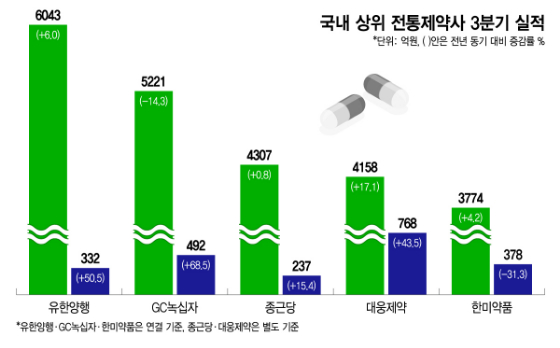
Among the five major traditional pharmaceutical companies in South Korea, four increased their Q3 operating profit this year, with GC Green Cross, the only company to see a revenue decline, recording the highest profit growth rate. In Q4, the upfront payment from a technology export contract is expected to be reflected in Hanmi Pharmaceutical's results, reversing its Q3 operating profit decline, while Daewoong Pharmaceutical, which had the highest revenue growth rate due to strong exports, is projected to see changes such as a decrease in shipments of Nuvotax to the United States.
According to industry sources on the 8th, Yuhan, GC Green Cross, Hanmi Pharmaceutical, Jonggeun Dang, and Daewoong Pharmaceutical have all recently completed their preliminary earnings announcements for Q3 this year. The year-on-year operating profit growth rates are as follows: GC Green Cross (68.5%), Yuhan (50.5%), Daewoong Pharmaceutical (43.5%), and Jonggeun Dang (15.4%). Hanmi Pharmaceutical was the only one among the five to see a decrease in operating profit (-31.3%). Yuhan, GC Green Cross, and Hanmi Pharmaceutical reported on a consolidated basis, while Daewoong Pharmaceutical and Jonggeun Dang reported on a standalone basis.
Q3: GC Green Cross leads with 68.5% operating profit growth…Hanmi sees profit decline due to sluggish China performance
GC Green Cross's Q3 revenue decreased by 14.3% year-on-year to 522.1 billion won, but its operating profit increased by 68.5% to 49.2 billion won over the same period. Revenue declined as GC Green Cross Wellbeing was excluded from the consolidation scope, while high-profit blood products 'Aligllo' and flu vaccines boosted profits. Aligllo's U.S. revenue reached approximately $46 million, up about 77% year-on-year, and flu vaccine sales included revenue deferred from Q2. The company's U.S. plasma center subsidiary also narrowed its losses due to increased utilization rates.
Yuhan benefited from growth in its pharmaceutical and healthcare businesses, as well as royalties (regular technology fees) from overseas sales of its lung cancer drug 'Lecraza'. Q3 revenue increased by 6.0% year-on-year to 604.3 billion won, while operating profit rose by 50.5% to 33.2 billion won over the same period. In particular, licensing revenue, including Lecraza royalties, increased by 82.5% to 7.9 billion won.
Daewoong Pharmaceutical's revenue reached 415.8 billion won and operating profit 76.8 billion won, representing year-on-year increases of 17.1% and 43.5%, respectively. The company's botulinum toxin 'Nuvotax', which saw concentrated shipments to the U.S., recorded a quarterly revenue high of 116.3 billion won, serving as a key driver. Digital healthcare revenue also increased by 40% to 17.9 billion won, contributing to the strong results.
Jonggeun Dang's imported products, such as the obesity treatment 'Wegovy' and ophthalmic disease treatment 'Ailiya', partially offset the revenue decline of existing products. Q3 revenue increased by 0.8% year-on-year to 430.7 billion won, while operating profit rose by 15.4% to 23.7 billion won over the same period. Profit improvement exceeding the revenue growth rate appears to be due to reductions in commissioned research fees and clinical trial costs.
Hanmi Pharmaceutical's revenue increased by 4.2% year-on-year to 377.4 billion won, driven by the growth of key products such as the dyslipidemia treatment 'Rosuvet'. However, operating profit decreased by 31.3% to 37.8 billion won over the same period. Sluggish performance and cost burdens at Beijing Hanmi Pharmaceutical negatively impacted profitability.
Q4: Hanmi and GC Green Cross reflect technology fees…Daewoong expects Nuvotax shipment decline
In Q4 this year, the upfront payment for a Fabry disease treatment candidate jointly exported to U.S.-based BioMarin by Hanmi Pharmaceutical and GC Green Cross is a variable affecting results. The two companies will split the total $70 million upfront payment equally. GC Green Cross plans to reflect its share of $35 million (approximately 46.8 billion won) in its Q4 results. Aligllo generated revenue of $97 million (approximately 131.5 billion won) through Q3, leaving $53 million short of the annual target of $150 million (approximately 203.4 billion won).
In addition to the Fabry disease treatment, Hanmi Pharmaceutical is expected to see improved Q4 results due to the reflection of the upfront payment for its obesity drug candidate 'HM17321', which was exported to Genentech. The securities industry expects that Genentech's upfront payment of approximately 260 billion won will be recognized in split portions across Q4 this year and Q1 next year. Yuhan is projected to see its Q4 profits influenced by the scale of royalties linked to overseas sales of Lecraza, alongside growth in its pharmaceutical and healthcare businesses.
Expectations are growing that Daewoong Pharmaceutical's Q4 shipments will decrease compared to the previous quarter due to the impact of pulling forward U.S.-bound Nuvotax shipments into Q3. The transition to direct domestic sales of 'Fexoclue', for which joint marketing with Jonggeun Dang has ended, could also burden results. Reflecting the impact of these two products, Daewoong Pharmaceutical's standalone operating profit in Q4 is projected to be significantly lower than in Q3. Daewoong Pharmaceutical aims to complete the transition to direct sales for all dosages of Fexoclue within the year to defend profitability.
Jonggeun Dang expects revenue gaps resulting from the termination of sales contracts for 'Atovet' and 'Fexoclue' to widen starting in Q4. The contracts for these two products ended in August and September, respectively, meaning only part of the impact was reflected in Q3. However, the full three-month impact will be reflected in Q4. Jonggeun Dang plans to supplement the revenue gap by expanding sales of its gastritis treatment 'Ziget', launched last month, and securing newly imported products.

 in THEBIO
