

K-beauty companies are expanding their business scope into the beauty medical device market. They are diversifying their portfolios by targeting medical devices, which offer higher value-added potential than cosmetics, as a new growth engine. APR is entering the professional treatment market by manufacturing medical devices, while Amorepacific and Anua have partnered with medical device firms to pursue the convergence of beauty and medical sectors.
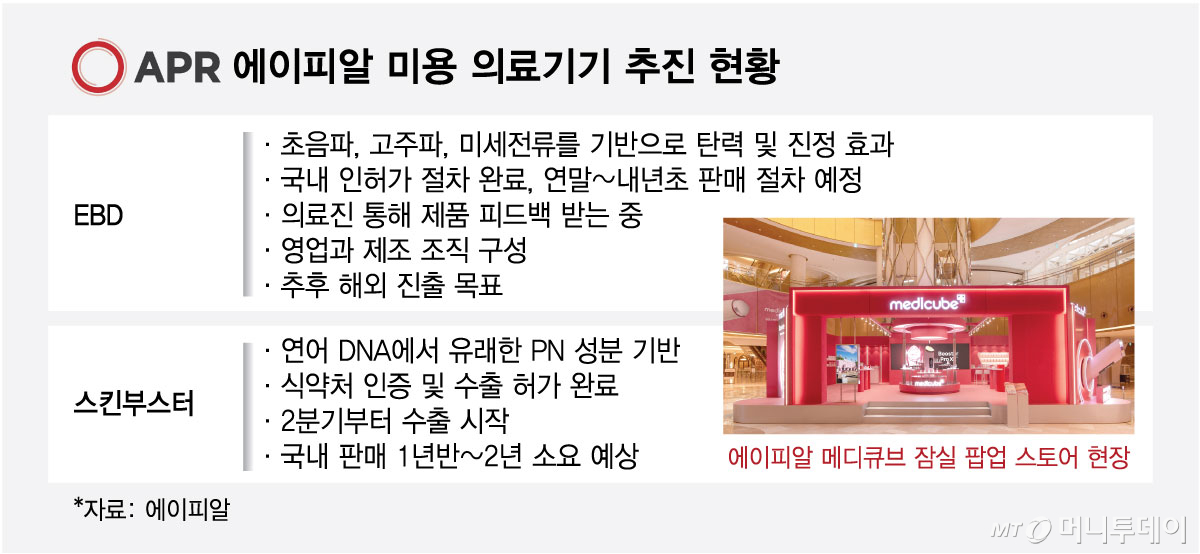
According to industry sources on the 10th, APR will launch two types of medical devices: EBD (Energy Based Device·energy-based equipment) and skin boosters, led by its brand MedyCube. Until now, APR has targeted the domestic and international home-use beauty device market through MedyCube; this marks an attempt to expand into devices used by professional medical staff.
EBD refers to equipment that utilizes energy sources such as ultrasound, radiofrequency, and microcurrents to achieve skin firmness and volume improvement, soothing effects, and other benefits. EBD has recently completed domestic regulatory approval procedures and is preparing for sales from the end of this year into early next year. The company is contacting dermatology clinics and hospitals in Korea to gather feedback from medical professionals and has established its sales and manufacturing divisions. It also plans to pursue overseas expansion in the long term.
Production infrastructure has also been transformed. Earlier this year, APR converted its first factory at APR Factory in Gasan-dong, Geumcheon-gu, Seoul, from a device production facility into a dedicated facility for beauty medical devices.
Another medical device under development is a skin booster based on PN (Polynucleotide) ingredients. This product utilizes PN derived from salmon DNA. For this business, APR plans to produce raw materials at its third campus of APR Factory in Pyeongtaek, Gyeonggi Province.
The skin booster will first target overseas markets. It received medical device certification and export approval from the Ministry of Food and Drug Safety in the second quarter and has begun limited exports. Starting in the third quarter, sales will be officially launched focusing on Japan and the Middle East. In Korea, it is currently undergoing the 4th-grade medical device licensing process with the Ministry of Food and Drug Safety; approval is expected to take approximately one and a half to two years.
The reason APR has turned its attention to medical devices lies in its intention to diversify its business structure, which has been heavily focused on cosmetics, and create new growth axes. In the second quarter of this year, cosmetics accounted for 84.5% of sales, devices made up 14.6%, and other businesses represented about 1%. The strategy is to leverage the technological capabilities and consumer feedback accumulated through its cosmetics and device businesses in developing medical devices.
Other beauty companies are also expanding their connections with medical and beauty devices. Amorepacific has signed a memorandum of understanding for joint business activities on medical devices with VioMedical, a global specialist in energy-based medical devices, and plans to discuss device development and marketing. Through this, Amorepacific aims to build a beauty solution that covers both professional treatments and home care.
The Founders, which operates Anua—a rising K-beauty powerhouse—has established a joint venture with Cellac Bio, a filler production company. Market analysts have suggested that Anua may challenge high-value-added businesses by partnering with medical beauty companies.
An industry official stated, "This is a strategy to connect the technological capabilities and brand awareness accumulated through beauty devices into medical devices to secure new revenue streams." The official added, "Medical devices face high entry barriers such as regulatory approvals, so they must be approached from a long-term perspective; however, once established in the market, they can grow into high-value-added businesses."

 in LIVING
