

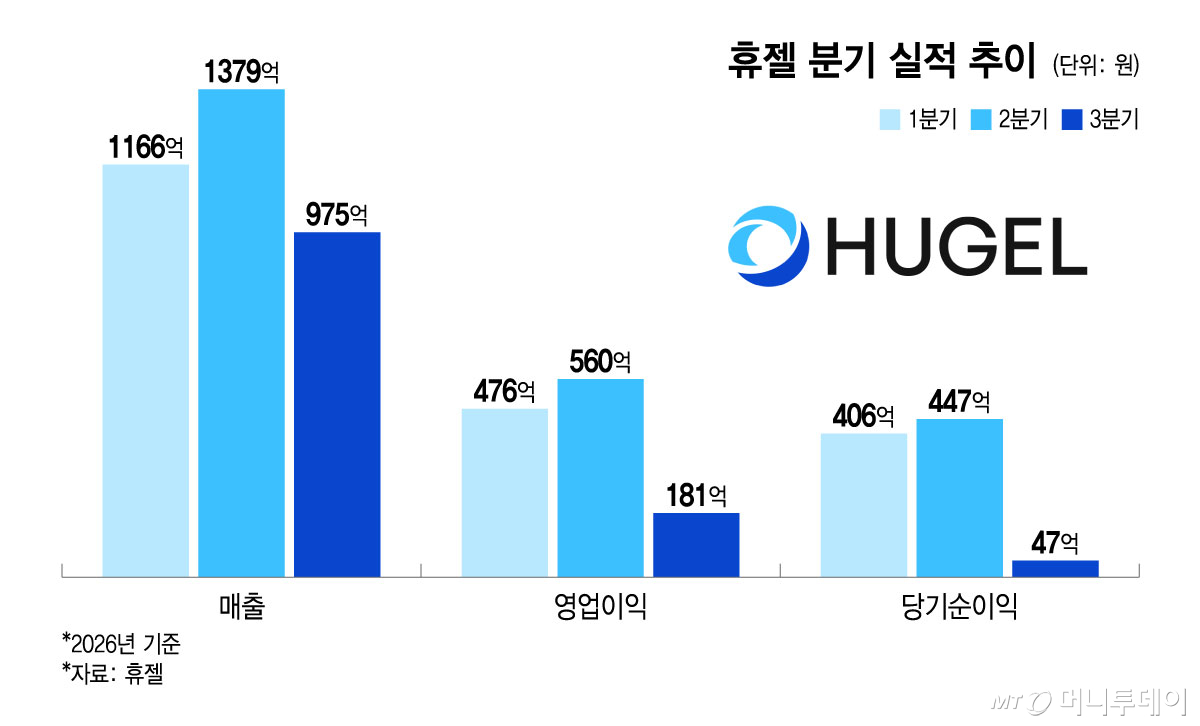
As Hugel continues its growth in the domestic toxin and filler market, it is accelerating the expansion of its global business in the U.S., Europe, China, Brazil, and other regions. Despite a temporary performance slump resulting from the restructuring of its U.S. distribution structure, the company maintains its long-term revenue targets, expressing confidence in medium- to long-term growth.
Hugel said Wednesday that it recorded Q3 revenue of 97.5 billion won this year, a decrease of 7.9% from the same period last year. Operating profit was 18.1 billion won, and net income for the period was 4.7 billion won, down 61.8% and 87.6%, respectively, from the previous year. Cumulative Q3 revenue reached 352.1 billion won, an increase of 15.1% from the same period last year, but cumulative operating profit (121.7 billion won) and net income for the period (90 billion won) decreased by 14.9% and 15.9%, respectively.
Q3 revenue by product category totaled 47.2 billion won for botulinum toxin and 30.9 billion won for fillers and skin boosters, based on combined domestic and overseas figures. The cosmetics and other segments generated 19.4 billion won in revenue, an increase of more than 25% from the previous year.
By region, the combined Q3 revenue for toxins, fillers, and skin boosters in the domestic market surged by 54% from the same period last year to reach 27.4 billion won, continuing its upward trend since Q3 of last year.
Overseas markets showed notable results in Europe, China, and Brazil. In Europe and other regions, combined Q3 revenue for toxins, fillers, and skin boosters reached 17.8 billion won, an increase of 18% from the same period last year. In China, the company secured a market share of 22%, firmly establishing itself as the second-largest player in the market. Brazil achieved its highest-ever quarterly performance in Q3, marking the first anniversary of its re-entry into the market.
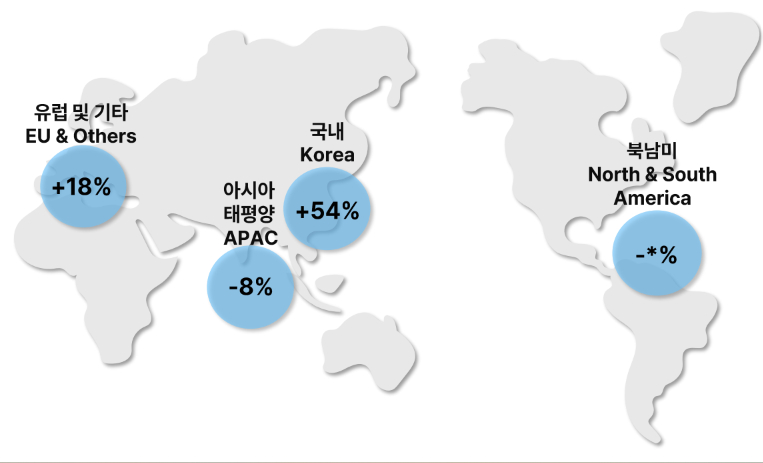
The company explained that the Q3 performance slump is a temporary phenomenon due to negative growth in North and South America. Ithas focused on expanding overseas markets while solidifying its dominance in the domestic botulinum toxin market. In particular, the U.S., considered the largest market, is transitioning its sales system from a distributor-centric model to a contract sales organization (CSO) approach.
Hugel said that it was unavoidable to repurchase inventory held by partners during this transition to a local direct sales system. A company official said, "The impact of the CSO transition has been fully reflected as a one-time factor in Q3," adding, "As U.S. local demand continues to steadily grow due to factors such as strengthened academic marketing, Q4 revenue will normalize."
Hugel plans to transition to the CSO model in the second half of this year and establish a full direct sales system by the second half of next year. Accordingly, it expects to strengthen strategic advantages such as expanding customer touchpoints within the U.S. market, price control, and securing market leadership.
"The transition to direct sales in the U.S. is already a planned matter, and there are no changes to the long-term guidance (forecast) of '90 billion won in revenue' by 2028," it said.
On the same day, Hugel decided through its board of directors to cancel 300,000 treasury shares, taking steps to enhance shareholder value. The amount is 53.7 billion won, and the scheduled cancellation date is the 11th.
Kerry Strom, Global CEO of Hugel , said, "Hugel continues to broaden its foundation for global growth based on its leading position in Korea," adding, "In particular, having made significant progress in establishing a direct sales operating model in the U.S., a core market, we will firmly secure the company's medium- and long-term profitability based on the competitiveness of 'Retibo' (known domestically as Botulax)."
Jang Doo-hyun, Korea CEO of Hugel , said, "We have once again confirmed a solid growth foundation as toxins and fillers achieved high performance side by side in the domestic market," adding, "As we continue to maintain growth in major overseas markets such as Europe, China, and Brazil, we will work to strengthen the competitiveness of our core business while diversifying our product portfolio."

 in THEBIO


