

As it has become commonplace for corporate valuations to surge significantly on themes such as semiconductors and artificial intelligence (AI), concerns have been raised that it has become difficult to gauge the actual investment value of companies. The argument is that the valuation of unlisted companies has reached trillions of won, making initial investment costs excessively high, which in turn means that the resulting corporate valuations fail to reflect the current state of the businesses.
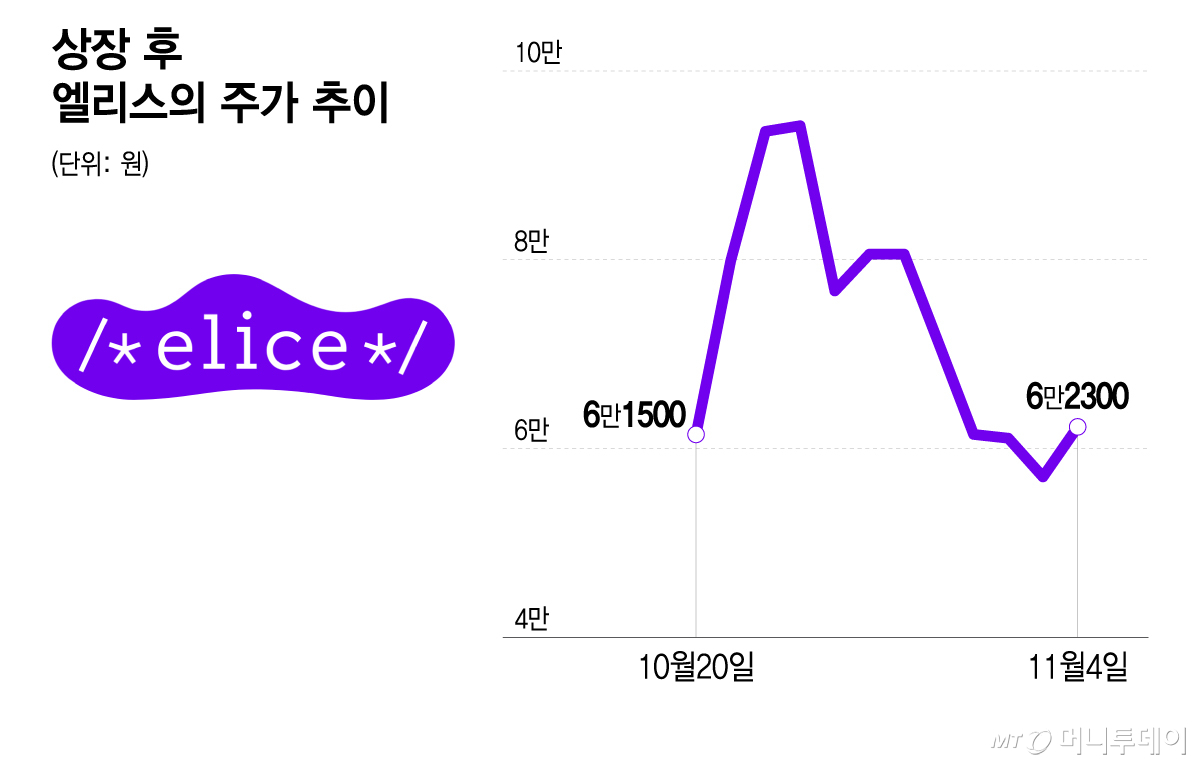
On the 4th, Ellis, a KOSDAQ-listed company, closed regular trading at 62,600 won, up 9.82% from the previous day. This marked a rebound after four consecutive days of decline. However, the stock failed to recover its previous losses. On the 23rd of last month, Ellis's share price had reached as high as 101,300 won before falling to its current level. Based on the closing price on the 4th, Ellis's market capitalization stood at 697.8 billion won.
Ellis is an AI infrastructure company that listed on the KOSDAQ on the 20th of last month. Its initial public offering (IPO) price was set at 95,000 won, the upper end of the target range. Based on the number of shares scheduled for listing (2.222 million), Ellis was assigned a market capitalization of 1 trillion and 4 billion won. On its first day of trading, the stock plunged 32% before rebounding, exhibiting volatile price action. Ellis's current share price is formed at a level approximately 40% below initial expectations.
The high corporate valuation assigned to Ellis upon its market entry is analyzed as being due to the attention received because its peer group was classified as AI-themed stocks. Starting as a coding education company, Ellis transformed into an AI cloud and data center infrastructure firm, which changed its peer group. In determining the IPO price, CoreWeave, DigitalOcean, Equinix, Digital Realty, GDS Holdings, VNET, Vertiv Holdings, and Schneider Electric were included in the peer group.
The method for calculating the IPO price also differed. While previous valuations reflected the average price-to-earnings (PER) ratio of the peer group to determine share prices, Ellis's valuation incorporated enterprise value to earnings before interest, taxes, depreciation, and amortization (EV/EBITDA). This is analyzed as a reflection of the business characteristics of data center-related stocks, which incur costs such as depreciation and capital expenditure. The average EV/EBITDA of the eight comparable companies was recorded at 27.13 times. Additionally, forecasts that AI cloud performance would continue to grow had a positive impact.
In investments in unlisted AI semiconductor companies as well, corporate valuations are frequently set in the trillions of won. It is judged that expectations for investment in domestic AI semiconductors have been reflected more heavily than the current profitability of these firms.
AI semiconductor company Rebellions reportedly raised 640 billion won through pre-IPO investments in March this year, securing a corporate valuation of 3.4 trillion won. This represents an increase of 1.5 trillion won from the 1.9 trillion won valuation recognized during its Series C investment last year, meaning the valuation rose by nearly 80% in about six months. Investors included the National Growth Fund (250 billion won) and the Korea Development Bank (50 billion won).
FuriosaAI, which completed its Series D investment last month, is also known to have secured a pre-investment corporate valuation of 3 trillion won. It is analyzed that the company's valuation increased by that amount as new funds of 820 billion won flowed in. The largest investor in this round was the National Growth Fund, which invested 370 billion won.
The financial investment industry expresses concern that price bubbles may occur because government-backed institutional investors such as the National Growth Fund and the Korea Development Bank are supporting the valuation of unlisted companies.
An official in the investment banking (IB) industry stated, "There is a possibility of price bubbles arising because corporate valuations for unlisted companies are being set high, while the methods of calculation have changed from before." The official added, "It has become more difficult to gauge whether profits can be made after investing compared to the past, leading to more instances where investors hesitate to proceed with investments."

 in STOCK
