

#. Management control of home appliance maker Cheongho Nice was transferred to global private equity fund Carlyle in August this year. After founder Chairman Chung Hui-dong passed away last year, when his family began selling their shares, the investment banking (IB) industry cited the need to secure funds for inheritance tax payments as the background for the sale. The news that a top-tier domestic rental company was sold fully revealed the reality that passing a business on to the next generation is just as difficult as building it.
According to industry sources on the 9th, the Korea Federation of SMEs (SME Central Association) and the Korea Mid-Sized Companies Association (Mid-sized Association) are concerned about the strengthening of family business inheritance deduction requirements included in the government’s tax reform proposal. While the intent is to prevent illegal inheritance, they argue that tightening deduction requirements could make normal corporate succession more difficult. In particular, they pointed out that this could disrupt the plans of companies that have been preparing for succession over a long period in accordance with existing systems.
The government is pushing a plan to increase the minimum management period for family business inheritance deductions from the current 10 years to 30 years, and to expand the post-inheritance management period from 5 years to 10 years. The family business inheritance deduction is a system that excludes a portion of family business assets from inheritance tax assessment when a company transfers management control while meeting certain requirements. The government stated that it will raise the deduction limit from a maximum of 60 billion won to 100 billion won, but will strengthen management period and review requirements to prevent the system from being abused as a means to avoid inheritance tax.
Recently, the Korea Federation of SMEs gathered opinions from member companies and submitted an opinion letter to the Ministry of Economy and Finance requesting that the family business inheritance deduction requirements and target industries be maintained as they are. Among the 257th cases where the National Tax Service decided on family business inheritance deductions last year, 91 cases (35.4%) had a management period of 10 years or more but less than 20 years. If the government’s reform proposal is applied to these management periods, these 91 cases would not meet the duration requirement.
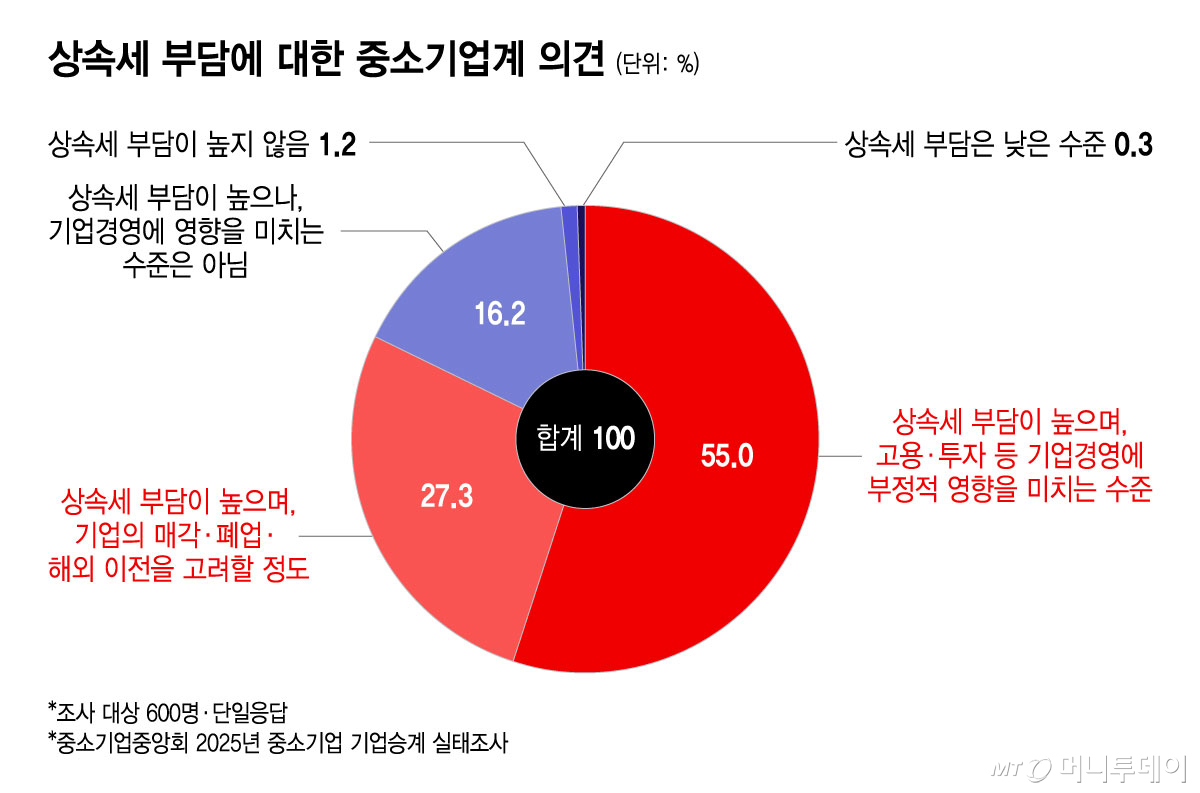
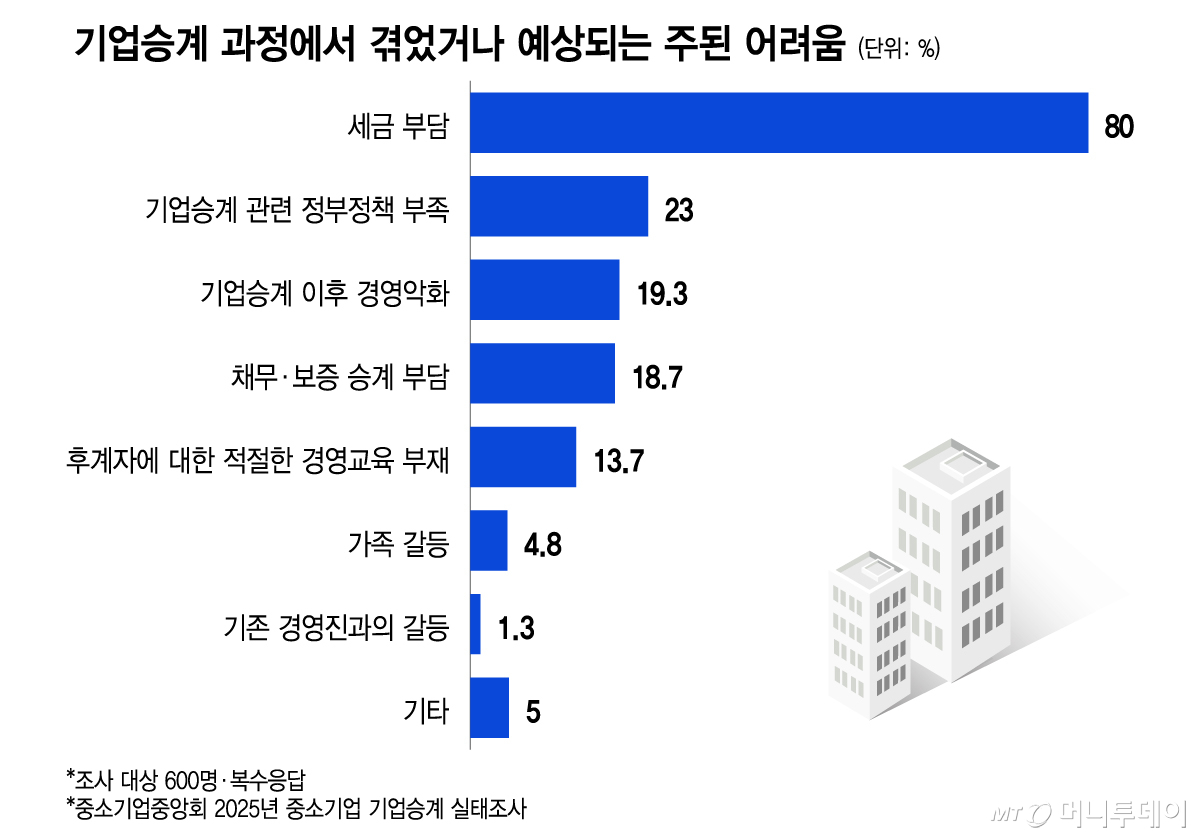
Inheritance tax is already the biggest burden SMEs face in the succession process. A survey conducted last year by the Korea Federation of SMEs targeting 600 representatives, executives, and successors of SMEs with more than 10 years of business history found that 80.0% (multiple responses allowed) cited tax burdens as a difficulty experienced or anticipated during succession. Additionally, 27.3% (single response) answered that the inheritance tax burden is so heavy that they are considering “selling the company, closing down, or relocating overseas.”
The mid-sized company sector also worries that strengthening management period requirements could hinder corporate succession at an appropriate time. According to a survey by the Korea Mid-Sized Companies Association, the average management period for 646 mid-sized companies where the founder continues to serve as CEO is approximately 23 years, and the average age of representatives is 65, meaning a significant number of companies will have to delay their succession timing. In August last year, the association submitted an opinion letter to the government requesting that the minimum management period be relaxed from 30 years to 20 years and that the post-inheritance management period be maintained at the current 5 years.
The SME and mid-sized company sectors also pointed out flaws in the review of deduction targets through a separate review committee. They noted that a company’s competitiveness is not only proven by technical capabilities such as patents, but also by tacit knowledge accumulated over a long period, including customer relationships, sales power, and production know-how, making it difficult to prove all of these with objective materials. The Korea Mid-Sized Companies Association also viewed that if every change in industry within the same manufacturing sector requires a separate review, rapid business restructuring could become difficult.
Voices are emerging that companies pushing new businesses to respond to market changes in an era of intensifying competition within industries may actually suffer disadvantages in the family business succession process. At a symposium on reforming the family business inheritance deduction system held at the National Assembly on the 2nd, Song Gong-seok, Chairman of Watco Korea, expressed concern, saying, “Even if we develop new products to compete with Chinese-made goods, changes in sales composition that alter our main industry could result in exclusion from the deduction targets.”
An official from the Korea Mid-Sized Companies Association said, “We should not view companies that have protected jobs and technology for decades as potential tax evaders just to prevent illegal inheritance by some firms,” adding, “If the perception spreads that selling a company is better than passing it on, the damage will ultimately fall on the companies, workers, and the national economy as a whole.”

 in LIVING

