

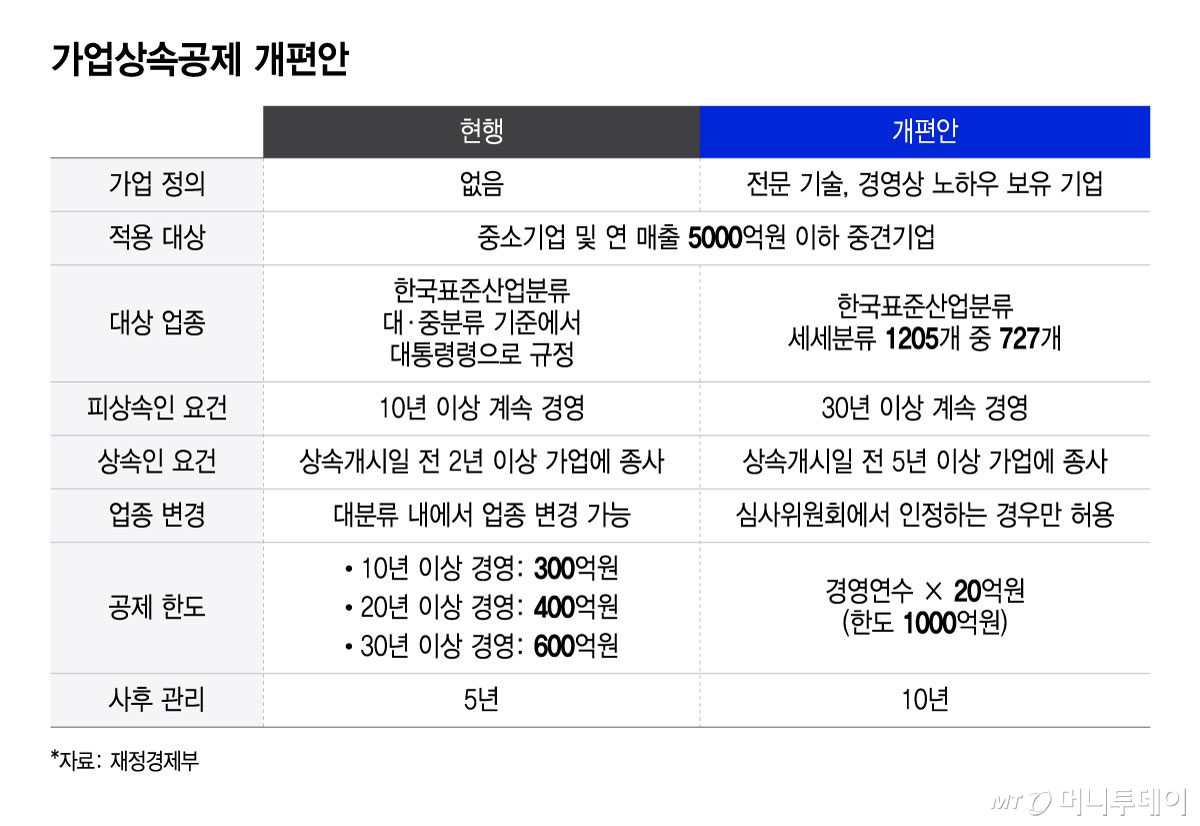
The family business inheritance tax deduction was introduced in 1997. It is a system designed to reduce the inheritance tax burden on small and medium-sized enterprises (SMEs) to facilitate smooth succession. The stated rationale was to encourage long-established companies. At the time of introduction, the deduction limit was only 100 million won. It had limitations in making a substantial impact on family business succession.
The situation began to change starting in 2008. The government then raised the deduction limit from 100 million won to 3 billion won. Subsequently, the deduction limit increased sharply. Starting with 6 billion to 10 billion won (2009), it was expanded to 10 billion to 30 billion won (2012) and then to 20 billion to 50 billion won (2014).
As the deduction limit increases, inheritance tax payments decrease accordingly. The current deduction limit of 30 billion to 60 billion won was set in 2023. The method provides a deduction of 30 billion won for management periods of 10 years or more, 40 billion won for 20 years or more, and 60 billion won for 30 years or more.
It is not just the deduction limit that has been expanded. At the time of introduction, only small and medium-sized enterprises (SMEs) were eligible for the family business inheritance tax deduction. Then, in 2011, mid-sized companies with sales of 150 billion won or less were included as targets. The sales criteria for mid-sized companies eligible for the family business inheritance tax deduction increased to 200 billion won or less in 2013, under 300 billion won in 2014, under 400 billion won in 2022, and under 500 billion won in 2023.
The family business inheritance tax deduction was a favorable topic for the political sphere. There was the justification of supporting small and medium-sized enterprises (SMEs) and mid-sized companies, and it also connected with voter sentiment. Consequently, there were many demands for expansion from both the political sector and the industry. This is why the family business inheritance tax deduction has focused on "relaxation" regardless of which administration was in power until now.
This trend of expansion was halted starting this March. President Lee Jae-myung raised issues regarding "clever tax avoidance" by some large bakery cafes and instructed a review of the need to supplement the system. At the State Council meeting last April, he continued to raise concerns, stating, "What kind of family business is a parking lot business? It is astonishing."
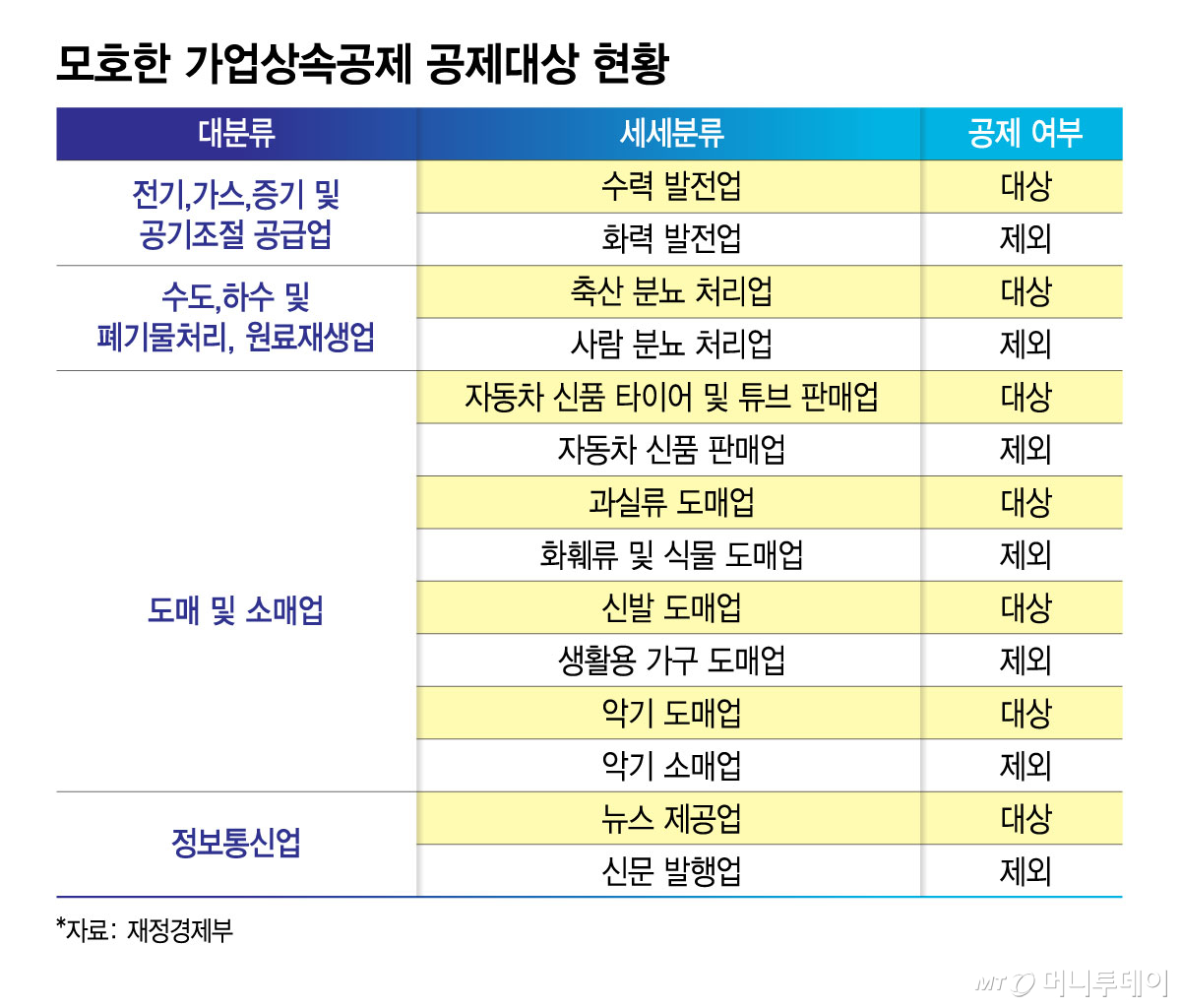
As mentioned by President Lee, some industries have exploited loopholes in the system. Under current regulations, confectioneries are eligible for the family business inheritance tax deduction. On the other hand, coffee specialty shops are not. According to a survey conducted by the National Tax Service on 25 large bakery cafes in the metropolitan area, seven companies were registered as confectioneries but actually operated as coffee specialty shops or did not have baking facilities.
A check of privately owned parking lots in the metropolitan area also revealed that 761 out of 1,321 (58%) opened after 2020. The year 2020 is when the parking lot business was included in the family business inheritance tax deduction. Following the release of survey results supporting President Lee's criticism, the Ministry of Economy and Finance moved to improve the system.
Until now, eligible industries for the deduction were determined by the government through enforcement decrees. Going forward, they will be adjusted based on law. According to the government proposal, parking lot businesses, marts, bus and taxi transportation, warehousing, hospitals, pharmacies, hotels, etc., will be excluded from the deduction targets. Backlash is strong from the hospital and hotel industries, among others.
Somewhat ambiguous criteria for deductible industries also fueled dissatisfaction. According to the government proposal, "musical instrument wholesale" is a deductible target, while "musical instrument retail" is excluded. Among wholesale businesses, fruit is an applicable target, while flowers are excluded. Although the system improvement started with large bakery cafes, the deduction industry criteria for confectioneries and coffee specialty shops have not actually changed.
Considering this, system improvements continued in a manner that strengthens all family business inheritance tax requirements and post-management, in addition to deductible industries. Raising the management period requirement from the current 10 years or more to 30 years or more, and extending the post-inheritance management period from 5 years to 10 years, acts as a burden on all industries.
Kim Woo-cheol, a professor in the Department of Taxation at Seoul National University, said, "Regardless of progressive or conservative stances, the family business inheritance tax deduction has been expanded, but making it regressive now that effects are starting to show brings more drawbacks than benefits," adding, "It would be enough to adjust mainly parking lots and bakeries, but strengthening the requirements themselves is problematic."

 in ECONOMY

