

Major countries, including the United States, the EU (European Union), and Japan, have launched large-scale investments to secure AI (artificial intelligence) competitiveness. However, there is a gap between the announced investment scale and the funds actually secured, making the feasibility of these plans a key issue.
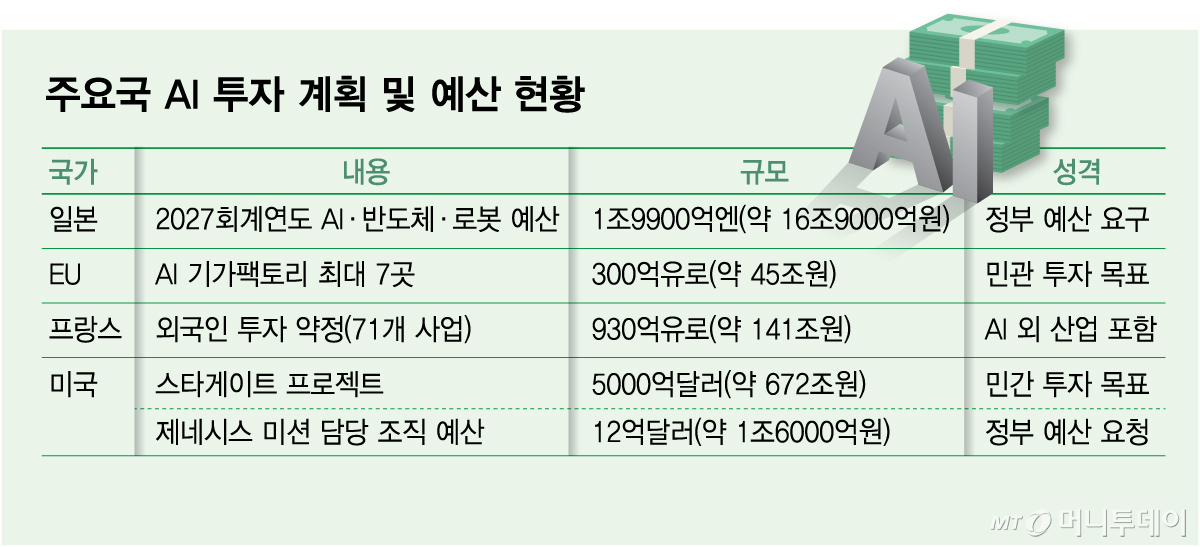
According to government announcements from various countries and foreign media on the 9th, Japan's Ministry of Economy, Trade and Industry requested approximately 1.99 trillion yen (approximately 16.9 trillion won) for AI, semiconductors, and robotics in its budget request for fiscal year 2027. This is an increase of about 60% from this year's base budget.
Emphasis was placed on the development of 'physical AI,' where AI directly controls robots and machines. The impact of incorporating projects previously allocated through supplementary budgets into the base budget also played a role. Japan aims to provide over 10 trillion yen (approximately 85 trillion won) in public support for the AI and semiconductor sectors by fiscal year 2030, thereby inducing more than 50 trillion yen (approximately 425 trillion won) in public-private investment over 10 years.
The EU launched a competition in July to build up to seven 'AI Gigafactories.' These are ultra-large-scale computing facilities that integrate advanced AI chips on a massive scale. The plan is for the EU and member states to provide up to 10 billion euros, while attracting at least 20 billion euros from the private sector, resulting in a total investment of over 30 billion euros (approximately 45 trillion won).
France is focusing on attracting foreign capital. Following its announcement of an AI investment plan worth 109 billion euros last year, it secured foreign investment commitments totaling 93 billion euros (approximately 141 trillion won) across 71 projects in June this year. This amount includes sectors other than AI. Of this, 45 billion euros (approximately 68 trillion won) is for a project by Japan's SoftBank to build three AI data centers with a total capacity of 3.1 GW by 2031.
In the United States, the private sector leads large-scale AI infrastructure investment while the government supports research and development. The 'Stargate' project, involving OpenAI, SoftBank, Oracle, and others, will invest up to 500 billion dollars (approximately 672 trillion won) in AI infrastructure over four years.
The Trump administration requested 1.2 billion dollars (approximately 1.6 trillion won) for the Department of Energy's AI scientific research project, 'Genesis Mission,' in its fiscal year 2027 budget. The White House announced in July that federal agencies have committed to supporting the Genesis Mission with over 5 billion dollars (approximately 6.7 trillion won).
South Korea is also expanding investment, including increasing next year's Ministry of Science and ICT AI budget to 9.4 trillion won, but there are calls for a strategy to efficiently allocate limited resources. An industry official said, "It is realistically difficult for South Korea to pursue AI investments on the same scale as the United States," adding, "We must maximize investment efficiency to achieve maximum results with limited resources and concentrate resources in areas where we can secure competitiveness."
[Production support: Ministry of Culture, Sports and Tourism Public-Centered Communication Activation Project]

 in TECH
