

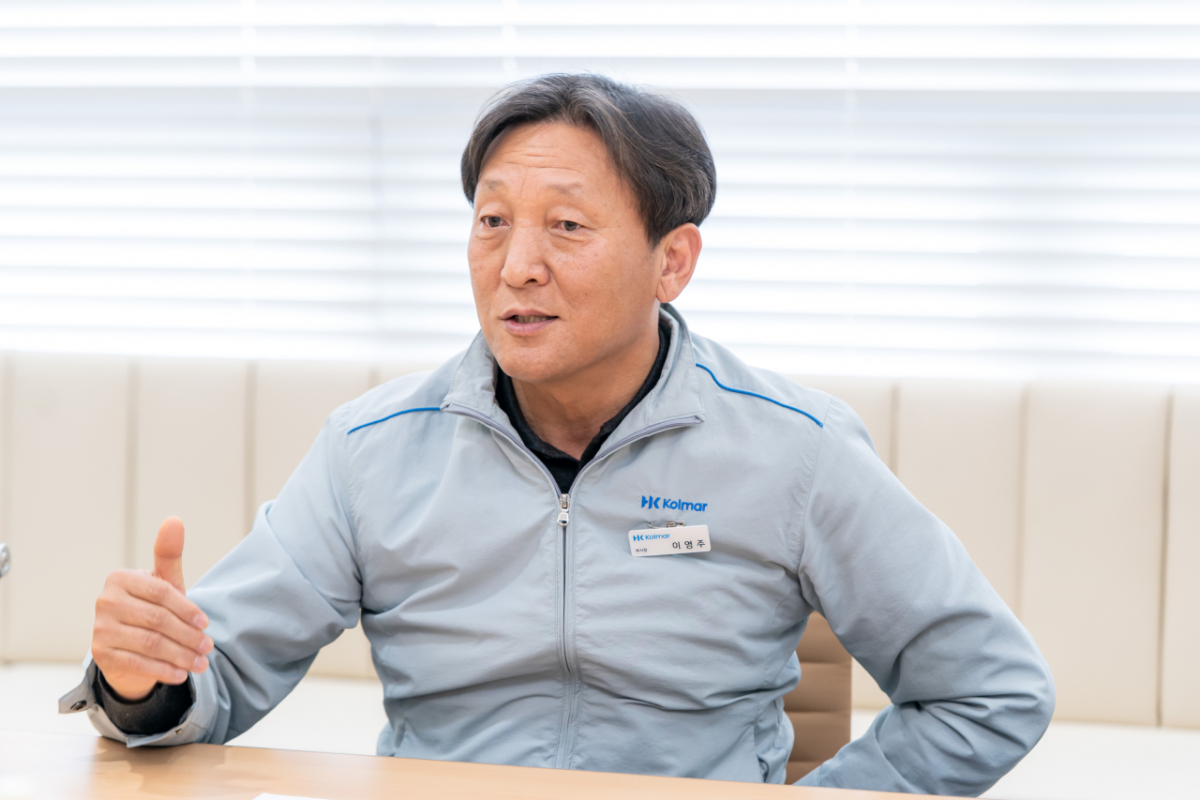
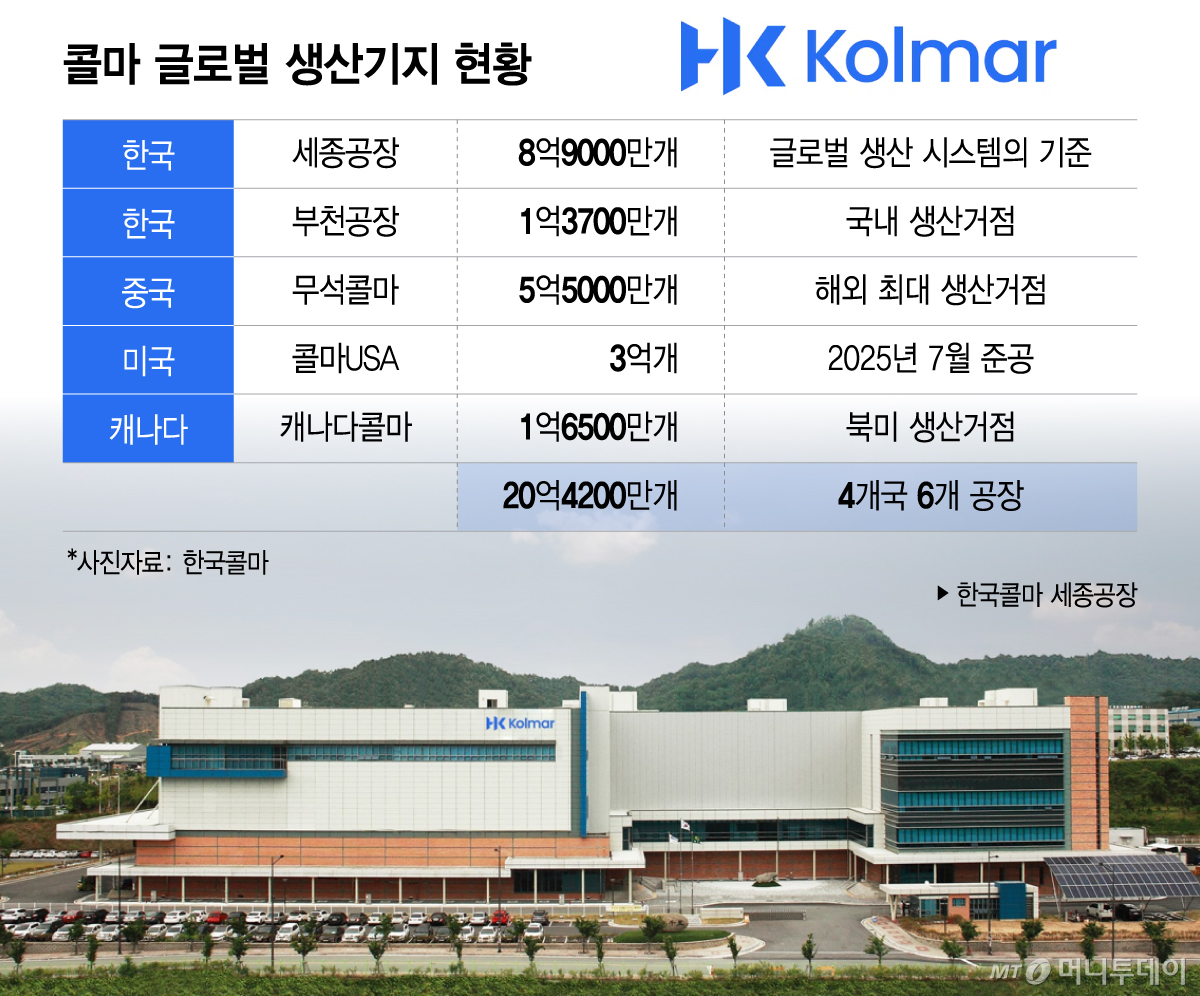
Kolmar Korea can produce 2.042 billion units annually across six factories in four countries: South Korea, China, the United States, and Canada. While some view that the meaning of "Made in Korea" may fade as overseas factories increase, Lee Young-joo, Vice President of Kolmar Korea (Head of Production Division), sees it differently. In an interview with MoneyToday on the 20th at Kolmar Korea's Sejong factory, Vice President Lee stated, "The value of Made in Korea is firmly maintained and will actually become even more premium."
The Sejong factory is Kolmar Korea's largest production base. It produces 890 million units annually. It is the foundation and pride of K-beauty. The differentiator of the Sejong factory highlighted by Vice President Lee is its stabilization capability. When a formula created in a research institute laboratory is scaled up to mass production of 2 to 3 tons at once, the physical properties change; stabilizing this is the technology. Vice President Lee said, "It is often the case that the product characteristics intended in the research institute do not manifest in mass production," adding, "The ability to stabilize these according to the product characteristics is the most important." He noted, "No matter when a consumer buys a product, it must have the same spreadability and user experience as before," stating, "These days, consumers accurately notice if the texture or color changes."
Vice President Lee has guarded the production front lines for nearly 30 years since joining the company in 1995. He cited the simultaneous growth of distribution and manufacturing as the background for the K-beauty boom. Vice President Lee said, "The reason K-beauty possesses world-class quality competitiveness is that the diversification of distribution and the growth of ODM (Original Design Manufacturing) supporting it meshed together precisely." He explained that during the heyday of single-brand stores like The Face Shop in the mid-2010s, ODM production capabilities became necessary, and subsequently, development speed and quality stability accumulated.
He cited both speed and quality as reasons why overseas brands entrust production to Korea. Vice President Lee said, "In Europe or the United States, it takes a minimum of two years to develop one new product. In Korea, seven types of basic cosmetics are developed and brought to market in three to six months." He continued, "This does not mean that quality can be compromised just because fast delivery is desired," adding, "Global companies like L'Oréal must satisfy their own quality standards 100% from inspection onward, and they scrutinize everything down to the systems of raw material suppliers and outsourced production sites."
He served as head of the Sejong factory from 2018 to 2020. He stated that compared to that time, the production scale has grown two to three times and the operational level has also changed. In 2023, as a company-wide project, they switched ERP (Enterprise Resource Planning) to SAP, the number one in this field, and linked APS (Advanced Planning and Scheduling) with MES (Manufacturing Execution System). As a result, it became possible to respond to multi-variety, small-lot production where orders from hundreds of customers run simultaneously each month. The proficiency of employees supported the evolution of the system. More than half of the personnel at the Sejong factory have 10 to 20 years of tenure. Vice President Lee said, "Even if processes are standardized and handed down, products come out slightly differently depending on the skills of field technicians," adding, "The proficiency and problem-solving ability of field engineers accumulated over 36 years is Kolmar's most powerful asset."
He emphasized that Made in Korea is the starting point of consumer trust. He stated that this is because consumers buy products without asking or questioning once they confirm they are made in Korea, regardless of where they are sold, based on trust. He stressed the need to prevent situations where the "Made in Korea" brand is damaged. He said, "There are cases where bulk materials and components from China are imported, only sub-packaged in Korea, labeled Made in Korea, and exported," adding, "If such products cause problems, existing K-beauty products may also be implicated."
Regarding global regulations, he pointed out both short-term burdens and long-term opportunities. Vice President Lee said, "With the implementation of the U.S. Modernization of Cosmetics Regulation Act (MoCRA), regulatory response capabilities such as facility registration, product listing, and safety data management have become more important, and the market will be reorganized around companies equipped with these capabilities." Regarding the pursuit by competing countries, he noted, "Competing countries like China are rapidly catching up in hardware such as equipment and capacity through government support and capital power," but predicted, "It will take considerable time to catch up in flexibility that reflects raw material supply chains, the ODM industrial ecosystem, and customers' demanding requirements."

 in LIVING


