

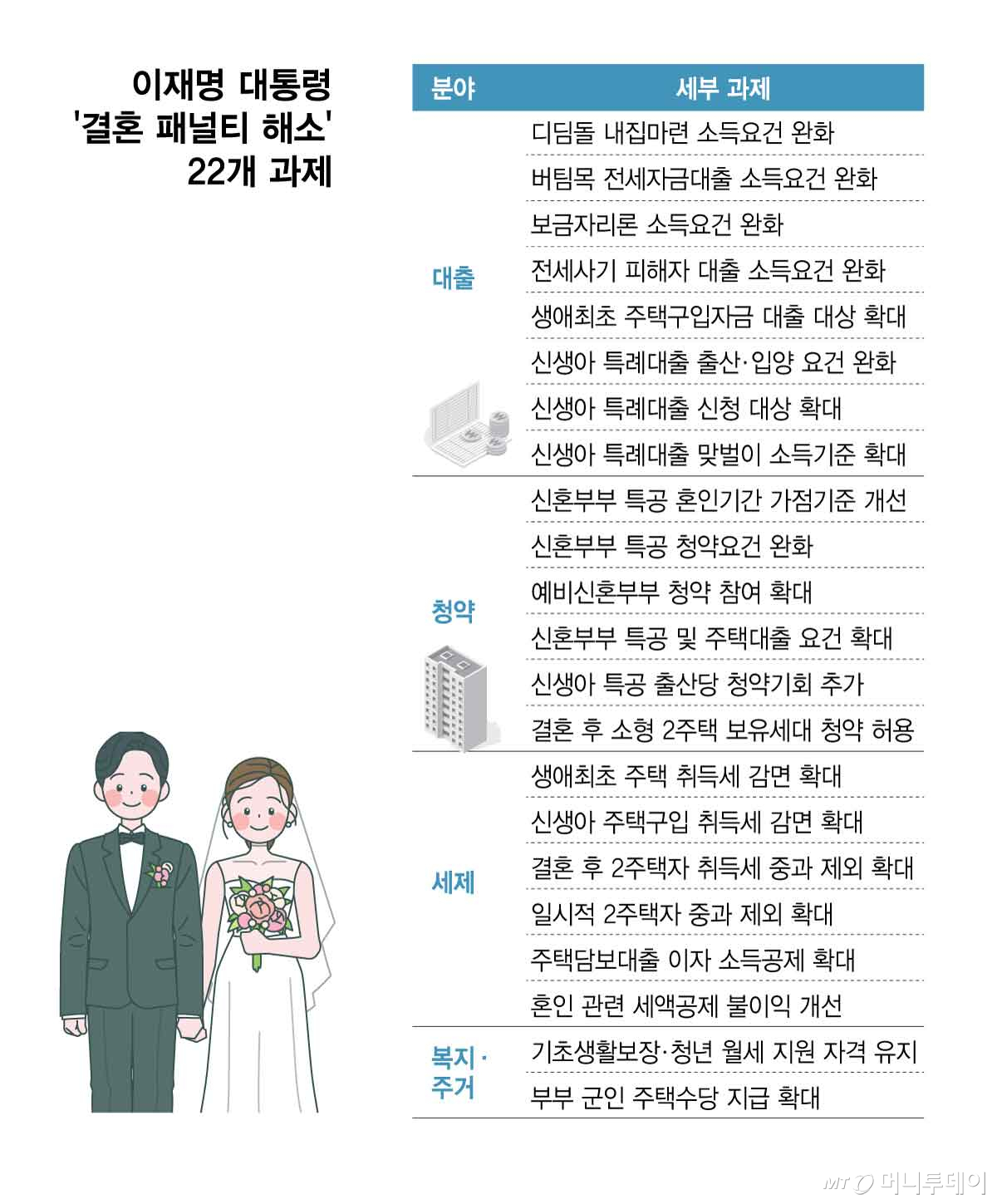
President Lee Jae-myung instructed a comprehensive improvement of the so-called "marriage penalty" policy via social media. This is interpreted as an intention to eliminate the "reverse incentive effect" caused by flawed institutional design and to remove the disadvantages young people faced when registering their marriages.
The 22 tasks shared by President Lee focused on real estate and housing policies, including loans for jeonse funds, special allocations for newlywed couples, and taxes on first-time home purchases. In fact, housing finance and tax criteria have long been criticized as outdated. A typical example is the structure where loan income requirements that were easily met by unmarried households became disqualifying once a couple registered their marriage and became dual-income earners. This was enough to instill in young people a clear negative signal that marriage equates to "economic loss." The background for this institutional contradiction lies in the fact that "fake singlehood" — holding wedding ceremonies but delaying marriage registration — has become a financial strategy.
However, simply distributing more limited resources to married couples cannot heal the despair of the younger generation. If only stopgap measures are offered under the guise of removing the marriage penalty, yet another contradiction will arise. If the combined income criteria for couples are unreasonably expanded to include high-income brackets, benefits may end up concentrated on dual-income couples from large corporations or wealthy asset-holding couples who can rely on parental support, rather than on vulnerable groups in urgent need of assistance. At the same time, diversified household forms such as single-person households and non-marital childbirth families could face another form of reverse discrimination by being excluded from policy support.
Young people's dissatisfaction should not be limited to the marriage penalty. More fundamentally, it stems from the fact that the "housing ladder" — where young people start with jeonse or monthly rent near their workplace and save up to eventually own a home — has been broken. The growing disappointment among young people following the government's recent announcement of tax reform plans is not unrelated to this issue. With the prospect of increased taxation on non-residential properties, landlords are more likely to convert them to owner-occupied homes, spreading "fear of eviction" among young tenants.
The government must begin by refining the 22nd tasks and consider policies that all young generations can feel regardless of marital status. The volume of special allocations for housing subscriptions should be adjusted reasonably, and income requirements should be made realistic by considering single-person households as well. Above all, household loan regulations that squeeze actual homebuyers and tax systems that exacerbate the jeonse crisis must be re-examined. We hope this will not merely return the flawed "negative system" that disadvantages marriage to "zero (0)," but expand into reforms that restore young people's housing ladder and remove unreasonable regulations across the livelihood economy as a whole.

 in OPINION
