

As KOSPI volatility pushes brokerage receivables above 1 trillion won, concerns grow over potential defaults stemming from 'margin investing (investing with debt)'—borrowing to invest. With banks raising lending thresholds, demand for funds has shifted toward brokerage loans such as credit transactions not subject to DSR (Debt Service Coverage Ratio) requirements, expanding credit risks originating from brokerages. Yet, risk management remains left entirely to the discretion of individual brokerages.
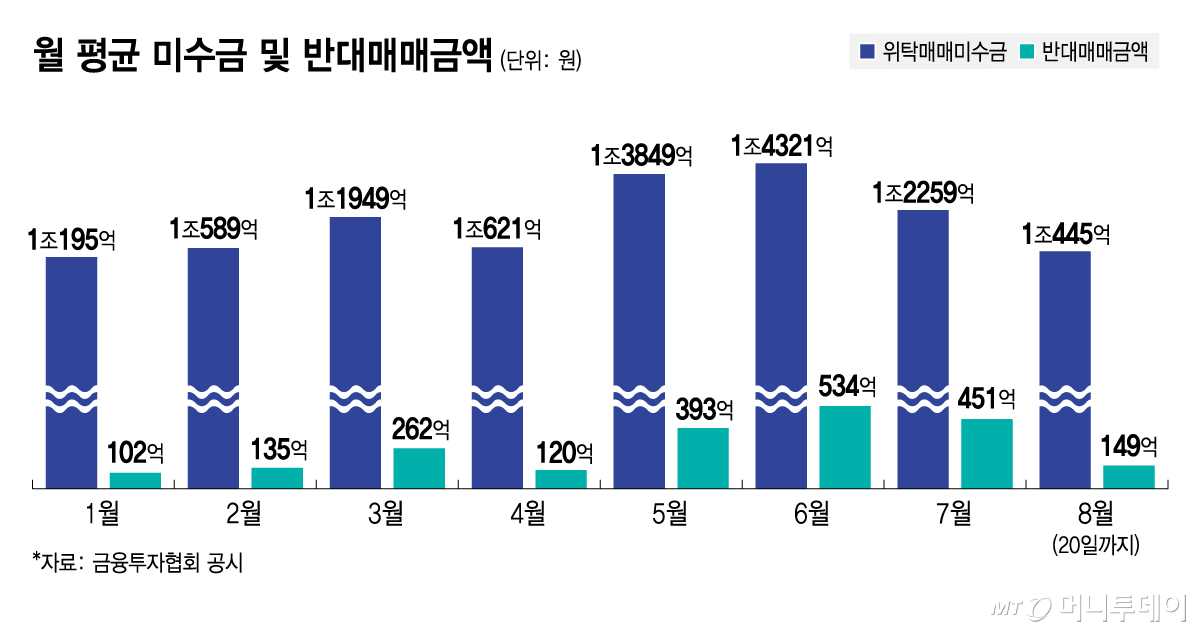
According to the office of Democratic Party of Korea lawmaker Park Hong-bae, as of late May, receivables accounted for 0.5% of domestic brokerages' total credit risk exposure—the highest level since January 2024. Receivables refer to ultra-short-term margin investing (investing with debt), where investors borrow money from brokerages to buy stocks and must repay within two trading days. Last year, receivables made up only 0.1% of total credit risk exposure, but surged rapidly this year as the KOSPI index briefly broke through 9,300 points. While credit extensions are not included in DSR calculations, they are capped at 100% of a brokerage's own capital; receivables, however, are managed internally by brokerages, placing them in a regulatory blind spot.
Following the stock market's peak and sharp decline in June, forced liquidations surged dramatically. The average monthly receivables in June reached 1.4321 trillion won, with average forced liquidation amounts totaling 534 billion won. Forced liquidation alone amounted to 1.1229 trillion won over the month, setting a new yearly high. As retail investors suffering from FOMO (fear of missing out) increased their use of margin investing (investing with debt), the sudden drop in stock prices eroded collateral values, triggering a spike in forced liquidations. Even in August, average receivables stood at 1.0445 trillion won, still exceeding 1 trillion won. Credit transactions also fluctuated sharply this month—falling to around 27 trillion won early in the month before rebounding to 31.9 trillion won by the 20th—indicating that margin investing (investing with debt) shows no sign of slowing down.
Integrated management of margin investing (investing with debt) is urgently needed. While credit extensions currently face a cap at 100% of own capital, receivable transactions have no such limit whatsoever. The first step toward integrated management would be to combine credit extensions and receivables into a single total credit exposure figure and set limits relative to own capital. Only then can regulatory brakes be applied to sales practices where some brokerages prioritize profits over investor protection by encouraging receivable transactions. Brokerages must also significantly strengthen their internal risk management to prevent investor losses from escalating due to forced liquidations of receivables. With complaints arising increasingly from forced liquidations, there is no reason to delay integrated oversight of receivables in the interest of protecting investors.

 in OPINION
