

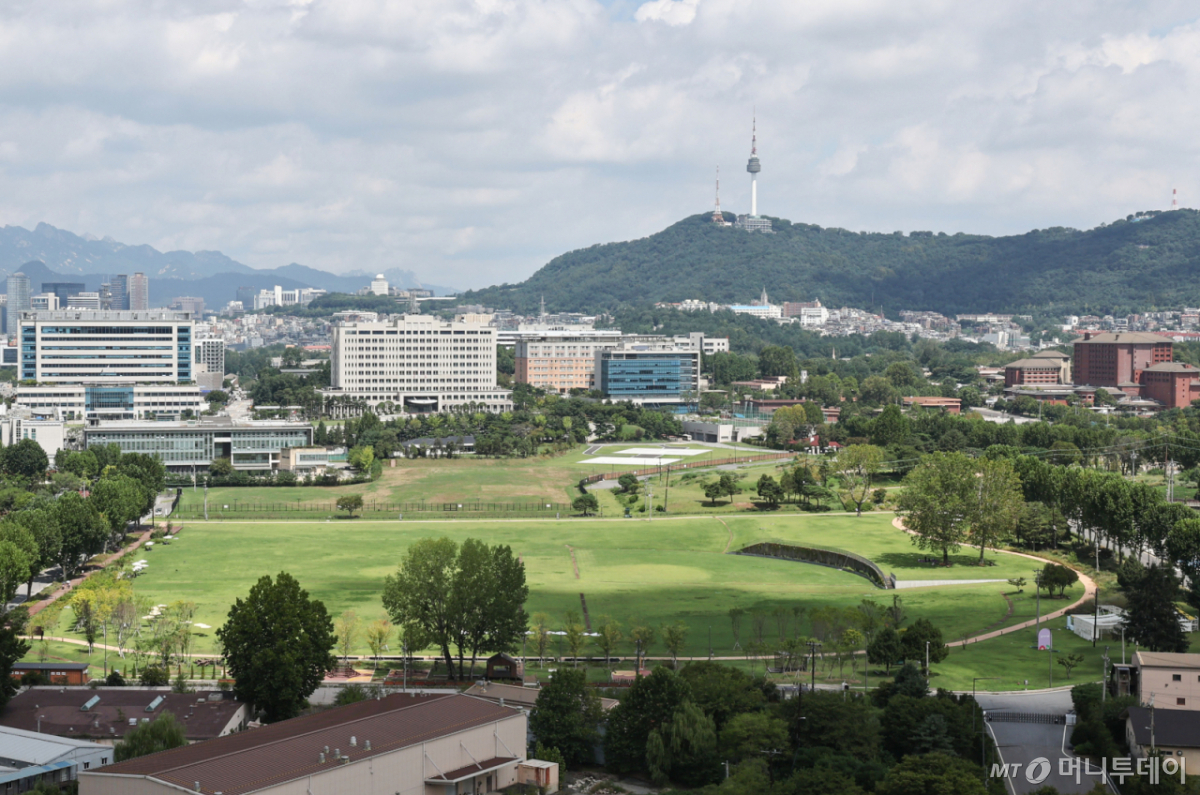
"How could they not have brought up Yongsan?"
The words of a government official were tinged with frustration. He said he had originally opposed building homes on Yongsan Park, citing the burden of re-examining land that has been developed as a national park for a long period for housing supply purposes. However, Seoul faces a shortage of homes and there is no suitable land available for immediate use. Given the president's strong will to expand supply, it was said that Yongsan Park had to be considered as another card in the housing supply debate.
Following MoneyToday's initial report on the 4th regarding the review of housing supply at Yongsan Children's Garden, discussions quickly expanded to cover the entire Yongsan Park. Since then, Minister Kim Yun-deok of the Ministry of Land, Infrastructure and Transport and Seoul Mayor Oh Se-hoon have met twice to discuss plans for utilizing Yongsan Park, but only confirmed differences in their positions. In this process, Mayor Oh proposed an alternative that would combine the Hangang Water Reclamation Center, the Eastern Road Construction Office, and SETEC to supply up to 13,000 households. The government has also agreed to review its feasibility.
However, the answer is not simple just because it involves the Han River. Kim (Minister) stated that "deciding where to relocate is more difficult than moving the Hangang Water Reclamation Center." This is because a new area must be found to accept the water reclamation center, which is an unwanted facility. Since neither the relocation site nor the project method has been determined yet, it is difficult to expect immediate supply effects.
The same applies to Yongsan. The areas under government review include officer quarters, former Defense Acquisition Program Administration sites, and damaged land such as hospitals and schools, but specific target locations have not been decided. It remains undecided what kind of homes will be built and how rental units and sale units will be allocated. Although Kim (Minister) stated that if negotiations with Seoul City go well, an additional 30,000 to 40,000 households could be added, achieving a supply effect of over 100,000 households, the specific project plan has not been finalized.
The voices calling for protecting national parks, which are difficult to restore once damaged, cannot be dismissed lightly. However, we cannot ignore the reality of housing shortages either. Even as tax policies and loans tighten, house prices continue to rise, and the housing ladder for actual buyers continues to narrow.
What matters is not fighting for the initiative over whether it should be Yongsan or the Han River. We must first examine the realism of the cards: how many households can be supplied where, and how much time the project will take. If the urgency of housing shortages is the reason for pulling out another "supply card," now we must prove it not with a card but with actual homes.


 in OPINION

