

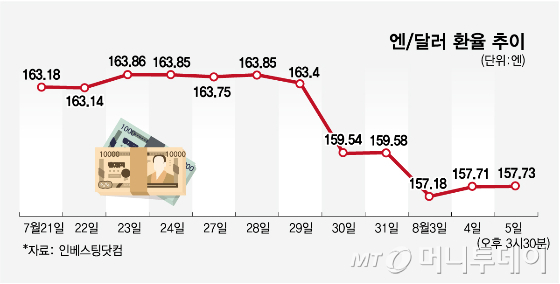
Volatility in the yen's value has recently emerged as a key variable in Korea's capital market. Domestic risks such as won/dollar exchange rate fluctuations and sharp stock market declines have somewhat subsided. However, with the yen/dollar exchange rate plummeting, concerns over unwinding of the yen carry trade — which triggered the "Black Monday" that dragged down KOSPI by more than 10% two years ago — are resurfacing. Nevertheless, some experts suggest this concern may mark the final hurdle in a volatile market phase.
According to the financial investment industry on the 5th, the yen/dollar exchange rate has been trading around the 157th-won level this month. Although it surged to as high as 163.86 yen per dollar on the 23rd last year, accelerating yen weakness, the U.S. and Japanese governments jointly intervened to curb excessive yen depreciation, bringing the rate back to early-year levels.
The securities industry is concerned that a repeat of the so-called "Black Monday" exactly two years ago — when KOSPI fell more than 10% during trading on August 5, 2024, due to unwinding of yen carry trades — could occur again.
The yen carry trade involves borrowing in low-interest-rate yen and investing in high-yield foreign assets such as U.S. Treasury bonds or emerging market stocks with higher expected returns. If the yen suddenly strengthens sharply, investors who employed the yen carry trade strategy may be forced to liquidate their overseas assets en masse to repay borrowed yen, triggering an unwinding process.
In this process, Korea's stock market — as an emerging capital market — faces immense pressure from massive capital outflows. This implies a scenario where short-term shock risks intensify, particularly centered on large-cap and growth stocks.
The "Black Monday" in August 2024 also saw significant shocks to Korea's stock market due to the combination of unwinding of yen carry trades alongside concerns over economic slowdown triggered by U.S. employment data surprises and AI bubble theories.
At that time, the Bank of Japan (BOJ) unexpectedly raised its short-term policy rate from 0–0.1% to 0.25% during its July monetary policy meeting, breaking market expectations for a hold, which led to an appreciation in yen value. Concerns over unwinding of yen carry trades surfaced in the market, and actual large-scale liquidations occurred.
Global stock markets were directly hit by a yen carry trade unwinding shock: on August 5, 2024, the U.S. S&P 500 fell 3%, while the Chicago Board Options Exchange Volatility Index (VIX) exceeded 60. Japan's Nikkei index plummeted more than 12% that day.
Korea's KOSPI also dropped more than 10% during trading, triggering a circuit breaker for the first time in four years and five months. Ultimately, KOSPI closed down 8.77%, while KOSDAQ fell 11.30%, marking a chaotic day for indices.
Accordingly, domestic securities firms view the recent sharp decline in the yen/dollar exchange rate — which had been rising continuously throughout the year until last week — as fueling possibilities of yen carry trade unwinding.
However, some analyses suggest that this concern over yen carry trade unwinding may represent the final hurdle in a volatile stock market phase, and after related selling pressure has been somewhat absorbed, a rebound centered on leading stocks that fell sharply could become possible.
In this regard, Kim Sung-hwan, a researcher at Shinhan Investment Corp., emphasized that since early July, forced liquidations by hedge funds and profit-taking in leading stocks have already progressed significantly, causing technology stocks — which are leading the market — to plunge nearly 40% from their peaks. He stated, "While yen strength is indeed an uncomfortable new issue for the market, considering current positioning and past experiences, it appears that supply-demand instability has entered its final phase." He added, "It should be noted that during the sharp decline in August 2024, unwinding of yen carry trades was raised at the very end, after stock price corrections and all negative factors had already unfolded."

 in STOCK
