

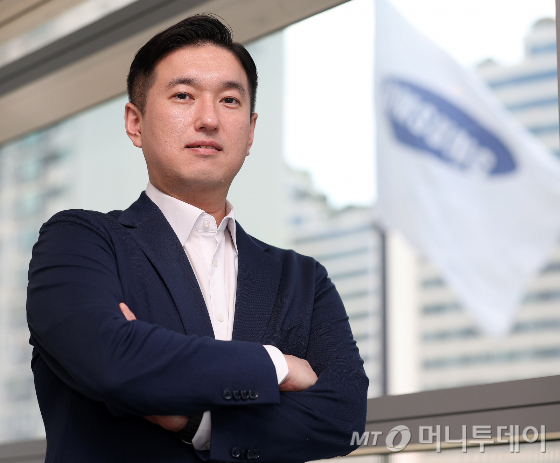
"Even amid AI (artificial intelligence) bubble theories, I believe the AI market will continue to grow. We are focusing on identifying industries that could benefit from AI bottlenecks and implementing them through ETF products. We are currently examining where the next AI bottleneck might be after semiconductors, power infrastructure, optical communications, and aerospace."
Kim Do-hyung, Head of ETF Consulting Division at Samsung Asset Management, explained this while describing the process of developing ETF products in a recent interview with Money Today. Samsung Asset Management is segmenting the AI value chain and creating thematic ETFs from it. For example, "KODEX U.S. CPU Semiconductor TOP10," which was listed on the 4th, is a product launched based on the expectation that demand for CPUs (central processing units) within semiconductors will increase. Samsung Asset Management plans to launch two AI technology ETFs in September as well.
When asked about ETFs to watch this year, Kim highlighted semiconductor themes related to AI. The division head stated, "Among thematic ETFs, 'KODEX AI Semiconductor TOP2 Plus' and 'KODEX U.S. AI Semiconductor TOP3 Plus' emphasize semiconductors the most," adding, "This is because these companies have solid earnings to back them up."
For investors seeking monthly dividends, he suggested covered call ETFs such as "KODEX 200 Target Weekly Covered Call" and "KODEX U.S. NASDAQ100 Daily Covered Call OTM" as alternatives. As volatility in the domestic stock market has increased, interest in these products that can generate cash flow monthly has also risen.
The division head noted, "When we gathered opinions at seminars from individuals, institutional investors, and PBs (private bankers), there was a strong demand for monthly dividends." He added, "'KODEX 200 Covered Call Active,' listed on the 14th of last month, was launched by combining this customer demand with Samsung Asset Management's strength in covered call management know-how." In fact, as of the 11th, the total net assets of all covered call ETFs launched by Samsung Asset Management reached 11.8758 trillion won.
He predicted that volatile market conditions will continue in the domestic stock market during the third quarter. This period is described as a "time for verification" to determine whether AI investments will translate into profits and whether a stock price rebound marks the beginning of a trend-driven rise. At this time, he recommended that investors with spare cash diversify their portfolios by investing in secondary batteries and dividend stocks rather than concentrating solely on semiconductors. However, if they lack the capacity to make additional purchases, he advised maintaining their current portfolios and avoiding hasty trading.
The division head said, "Most portfolios likely have a high weighting in semiconductors. While selling these to buy other industries or stocks is an option, currently, semiconductors are the industry with the strongest fundamentals."
He pointed out that three conditions are necessary for a rebound in the fourth quarter: △expanded AI infrastructure investment by U.S. hyperscalers (large-scale data centers), △earnings surprises from major companies in the U.S. and Korea, and △active shareholder return policies by domestic companies. Kim stated, "The recent correction in the domestic stock market was not caused by a deterioration of corporate fundamentals," and predicted, "If all three conditions are met simultaneously, there is a high probability that they will lift the domestic stock market."
He projected that, buoyed by such a market rebound, the domestic ETF market could grow to a scale of 1,000 trillion won in net assets within the next five years. He cited as evidence the shift of funds within pension accounts from principal-guaranteed products to performance-based dividend types, reflecting increased demand for ETFs as a means of preparing for retirement. The division head remarked, "If asset managers expand their product and educational service offerings, and if ETF investment expands to include institutional investors, reaching 1,000 trillion won within five years is entirely feasible."
He emphasized that for the market to mature qualitatively as well, individual investors must establish their own investment principles. Kim advised, "Investing is a continuous learning process once you begin," and added, "Before investing, it is crucial to reflect on why you are investing in a particular product, what factors you are considering, and to approach it with a long-term perspective."

 in STOCK
