

Korea's three major domestic shipbuilders (HD Hyundai Heavy Industries, Hanwha Ocean, and Samsung Heavy Industries) are on track, having achieved approximately 90% of their annual order targets for this year. While maintaining competitiveness in the core liquefied natural gas (LNG) carrier market, they have expanded their order scope to various vessel types, accelerating performance improvements.
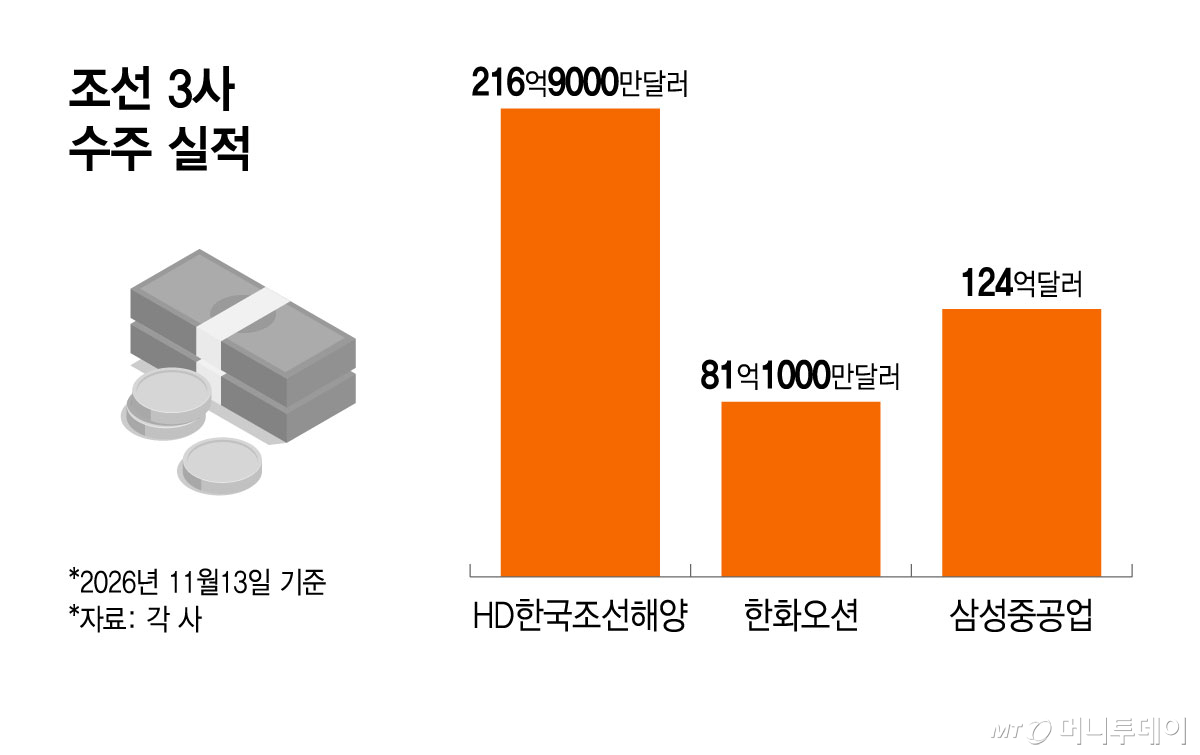
According to shipbuilding industry sources on the 15th, HD Hyundai Heavy Industries, the intermediate holding company for HD Hyundai's shipbuilding division, has secured a total of 195 vessels worth $21.69 billion since the beginning of this year. This figure includes the contract for two LNG carriers with an Africa-based shipping company disclosed on the 9th. It represents 93.1% of the $23.31 billion annual shipbuilding order target set by HD Hyundai Heavy Industries. Despite setting the target 29.1% higher than last year's $18.05 billion, the company is close to achieving its annual goal.
Samsung Heavy Industries has already exceeded its annual order target in the commercial vessel division. The company has secured 46 vessels worth $8 billion in the commercial vessel sector alone since the start of this year, reaching 140% of its initial annual target of $5.7 billion. It achieved order results across various vessel types, including 20 LNG carriers (including one LNG-FSRU), 14 crude oil tankers, six gas carriers, four container ships, and two ethane carriers. Additionally, Samsung Heavy Industries secured orders for two floating liquefied natural gas production facilities (FLNG) in the offshore division this year, totaling $4.4 billion. The combined order value for commercial vessels and offshore projects is $12.4 billion, reaching 89% of the annual target of $13.9 billion.
Hanwha Ocean has not disclosed its annual order target but continues to show an increase in orders compared to the previous year. As of the end of last month, the company secured work worth approximately $8.11 billion for a total of 44 vessels. This is a 25.7% increase compared to the $6.45 billion ordered during the same period last year. By vessel type, this includes 21 very large crude carriers (VLCCs), eight LNG carriers, six container ships, three very large ammonia carriers (VLACs), and three very large gas carriers (VLGCs). The company also secured orders for one wind turbine installation vessel (WTIV), one onshore plant project, and one special-purpose vessel.
This is interpreted as being due to domestic shipbuilders maintaining their advantage in the core LNG carrier market, sustaining strong order momentum. Among 76 large-scale global LNG carrier orders from January to October, domestic shipbuilders secured 44 vessels, recording a 57.9% market share. This volume has already surpassed last year's annual total of 32 vessels.
Furthermore, the domestic shipbuilding industry is diversifying its order portfolio. It is expanding its order scope not only to LNG carriers but also to ammonia and ethane carriers, as well as offshore wind turbine installation vessels. The strategy aims to secure work across various vessel types to reduce the impact of market fluctuations in specific segments and enhance profitability. Indeed, the combined operating profit of the Big Three shipbuilders for the first three quarters of this year reached 7.0477 trillion won, surpassing last year's annual combined operating profit of 5.9343 trillion won.
An industry official said, "Korea's Big Three shipbuilders are steadily accumulating order results across various vessel types this year, including LNG carriers, container ships, and liquefied petroleum gas (LPG) and ammonia carriers." The official added, "It appears that the strategy of diversifying the order portfolio by considering market conditions and profitability for each vessel type is yielding results."

 in INDUSTRY
