

Over the past year and six months, more than 5 trillion won in defined contribution pension assets have moved from banks to securities firms. The amount transferred from pension savings products managed through banks and insurance companies to securities firm pension savings funds has exceeded 9 trillion won. As securities firms absorb a large volume of pension funds previously held by banks and insurers, competition between the industries is expected to intensify with the introduction of the fund-type defined contribution pension system.
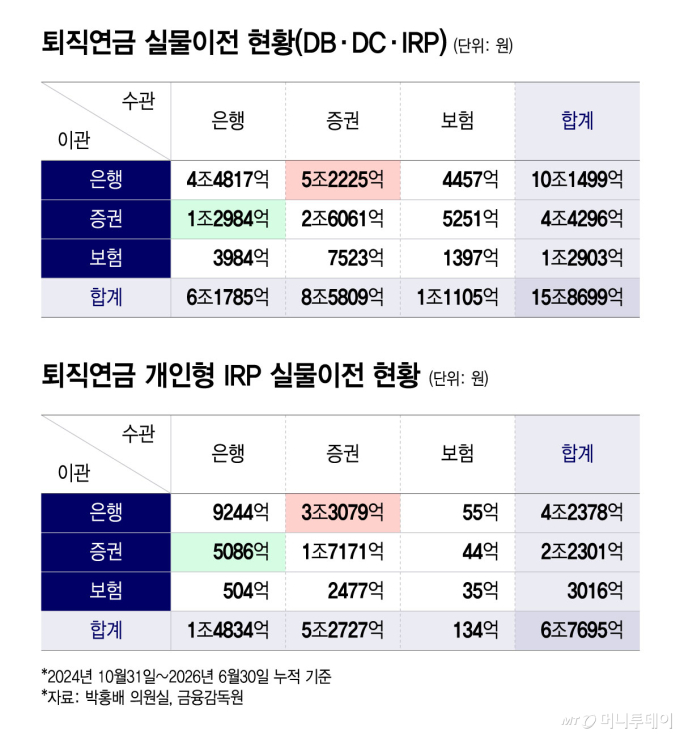
According to data submitted by the Financial Supervisory Service on the 18th to Park Hong-bae, a lawmaker from the Democratic Party of Korea serving on the National Assembly's Political Affairs Committee, a total of 15.8699 trillion won in accumulated funds were transferred under the defined contribution pension asset transfer system from late October 2024 to the end of June this year.
Among these, transfers from banks to securities firms amounted to 5.2225 trillion won, accounting for 33 percent of the total. Transfers from securities firms to banks totaled 1.2984 trillion won, merely one-fourth of the reverse direction (banks to securities firms). The real transfer of retirement pensions is a system that allows subscribers to keep individual products such as ETFs unchanged while switching only the financial institution. Real transfers are possible only within the same category, including DB (defined benefit), DC (defined contribution), and IRP (individual retirement pension).
One year and eight months after the implementation of the system allowing the physical transfer of retirement pensions, bank-managed retirement funds experienced a net outflow, while securities firms saw an equivalent net inflow. At securities firms, inflows amounted to approximately twice the volume transferred out via physical transfer, resulting in a total net inflow of 4.1513 trillion won. Banks recorded a net outflow of 397.14 billion won, and insurance companies saw a net outflow of 178.9 billion won.
In particular, the fortunes of securities firms and banks diverged sharply within retirement pension IRPs. While securities firms saw a net inflow of 3.426 trillion won, banks lost 2.7544 trillion won. In the first half of this year alone, 1.7422 trillion won flowed into securities firm IRPs, marking a significant exodus from banks and insurance companies. A financial industry official stated, "Banks with numerous offline branches and corporate networks possess stronger basic sales capabilities compared to securities firms, but the market environment of a booming stock market proved even more powerful." The official added, "With heightened preference for ETFs (exchange-traded funds), the ability to trade real-time ETFs within securities firm apps likely influenced the movement of retirement funds."
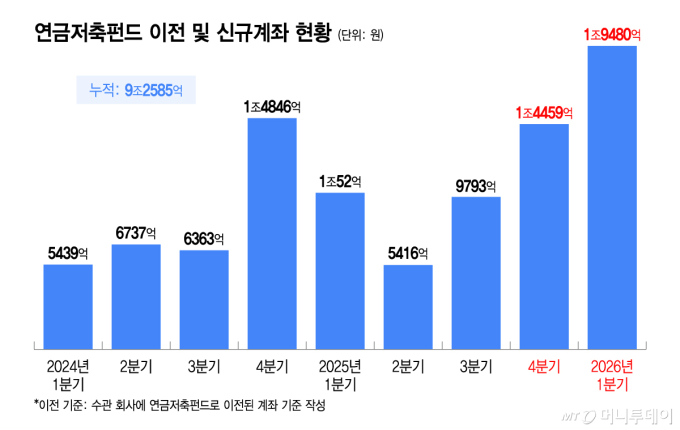
A wave of pension money moving to securities firms was also strong in pension savings products. Pension savings, which allow individuals to receive a tax credit of up to 6 million won when withdrawing funds in the form of a pension after making separate contributions over a certain period apart from corporate pensions, is represented by three main product types: insurance, trust, and funds. According to data submitted by the Financial Supervisory Service to Park Hong-bae (Rep.), the amount transferred from pension savings insurance and trusts to pension savings funds in the first quarter of this year reached 1.948 trillion won. The total amount transferred from 2024 through the first quarter of this year was 9.2585 trillion won, with particularly 3.3939 trillion won moved to pension savings funds in the last six months alone.
Amid strong prospects for legislative amendments to introduce fund-type defined contribution pension plans in the second half of this year, competition among various industries to attract pension customers is expected to intensify. Not only banks and insurance companies, which are already experiencing significant outflows of pension funds, but also securities firms are worried about customer attrition due to the emergence of large-scale trustees such as the National Pension Service (NPS).
Securities firms with competitive ETF (exchange-traded fund) products and trading capabilities have achieved a sweeping victory in the market for transferring retirement pension assets in kind, while contributions to pension savings funds are also approaching 70 trillion won. This indicates a steep money move of funds from both corporate retirement pensions and individual pension savings accounts toward securities firms. However, securities firms are maintaining their position as "uneasy number ones" by analyzing the impact ahead of the introduction of fund-type retirement pensions next year.
According to data submitted by the Financial Supervisory Service on the 18th to Park Hong-bae, a member of the Democratic Party of Korea serving on the National Assembly's Political Affairs Committee, securities firms emerged as the biggest beneficiaries of the system allowing the transfer of retirement pension assets in kind and the transfer of pension savings. Following the implementation of the system for transferring retirement pension assets in kind, securities firms saw a cumulative net inflow of 4.1513 trillion won over one year and eight months, whereas banks experienced a net outflow of 3.9714 trillion won.
Unlike retirement pension plans, which are mandatory under relevant laws, the individual voluntary pension savings market—chosen by individuals for tax benefits and other reasons—has continued to be dominated by securities firms. Consumers who held pension savings trusts offered by banks or pension savings insurance with principal guarantees have transferred approximately 9 trillion won into pension savings funds over the past two years.
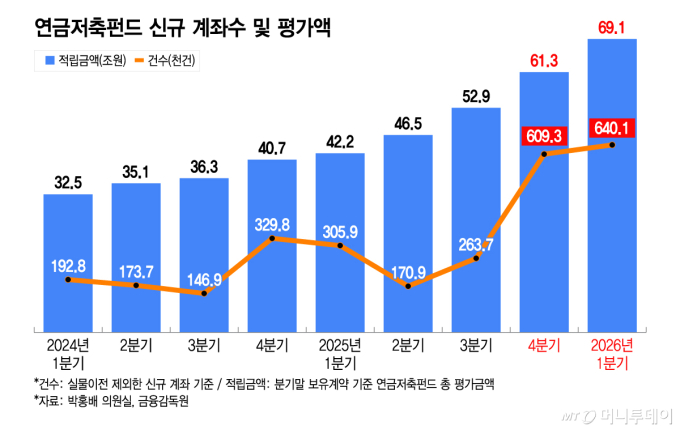
New accounts and total accumulated funds in pension savings funds also surged sharply. In the fourth quarter of last year, approximately 610,000 new pension savings fund accounts were opened, reaching 1.85 times the number from the fourth quarter of 2024 (approximately 330,000). In the first quarter of this year, 640,000 new accounts were established, and the total assessed value of pension savings funds was recorded at 69.1 trillion won.
Pension savings and individual pension plans are products individuals subscribe to for retirement preparation, possessing both popular appeal and a social security character. While there has been a strong tendency to prefer pension products that are unconditionally safe with principal protection, the atmosphere has shifted with the introduction of default options for defined contribution pensions and a boom in the stock market.
Analysts suggest that the reason brokerage firms achieved a decisive victory in the pension transfer market lies in their "ETF competitiveness." When looking solely at returns, the difference between brokerages and banks is not significant. For instance, Mirae Asset Securities' DC (defined contribution) principal-and-interest-guaranteed product recorded a second-quarter return of 50.41%, while Shinhan Bank posted 53.62%. Thus, when comparing the top profit-making companies in each sector, bank returns were actually higher. In the case of individual IRP principal-and-interest-guaranteed products, KB Securities achieved a second-quarter return of 52.98%, and KB Kookmin Bank recorded 52.96%, showing nearly equal performance.
This analysis gains credibility as customers have chosen securities firms that offer a wider range of ETF product options and enable real-time ETF trading. Although banks are significantly expanding their ETF lineup available for retirement pension accounts, the perception remains that they still lag behind securities firms. Furthermore, while ETF real-time price inquiries and trading are not possible through bank apps, they are available via securities firm MTS (Mobile Trading Systems), making transaction convenience higher at securities firms.
In the banking sector, while the industry collectively requested permission for real-time ETF trading, financial authorities are expected to overturn their 2021 official interpretation, making realization unlikely. In response, Hana Bank and others are preparing self-help measures, such as enabling real-time ETF price inquiries through partnerships with other companies.
The lock-in effect of retail investors on securities apps due to the KOSPI rally is also being discussed. The KOSPI index rose 101 percent, from a closing price of 4,214.17 points on December 30 last year to 8,476.48 points on June 30 this year. As retail investors who newly entered the stock market or activated their stock trading frequently used securities apps, they even transferred their pension accounts, including defined contribution pension plans and pension savings funds, to these platforms. Each securities firm launched large-scale events targeting customers for the physical transfer of pensions and new account openings.
A notable point is that transfers within the same industry have also become frequent. Since the implementation of the system allowing in-kind transfers of retirement funds, transfers from bank to bank reached 4.4817 trillion won, and transfers from securities firm to securities firm amounted to 2.6061 trillion won. Even within the same industry, a fierce battle for attracting pension customers was underway.
Securities firms that have gained the upper hand in the pension money move competition are not smiling all the way. This is because if the fund-type defined contribution retirement system is implemented as early as next year, they will have to compete with large funds. Competition has already been fierce under the current contract-based structure, and if large-scale funds enter the asset management market, intensified competition and inevitable customer attrition are expected.
Pensions must be maintained until the age of receipt, and additional contracts are often concluded during this period; consequently, each company is making all-out efforts to attract pension customers in order to secure loyal clients.
There are also opinions that the negative side effects of overheated competition in the pension market must be actively prevented. Park Hong-bae (Rep.) said, "While expanding consumer choice through the physical transfer of defined contribution pensions and making pension fund management more convenient is positive," he pointed out that "pension assets are directly linked to citizens' retirement lives and should not be swayed by excessive customer acquisition competition among financial institutions or short-term capital concentration. Financial institutions must strengthen internal controls, and financial authorities must closely monitor sales practices to continue institutional improvements."

 in STOCK


