

1. Launch of joint social contribution initiatives centered on the Korea Investment Association
The securities industry, which posted record-breaking results in the first half of this year, has launched a joint initiative for social contribution. Led by the Korea Financial Investment Association, securities firms have begun discussing industry-wide measures to enhance investor protection and other forms of social contribution. This move comes amid growing demands that the securities sector fulfill its corresponding social role, driven by soaring profits from the stock market boom and the rising stature of the capital markets.
According to the financial investment industry on the 18th, the Korea Financial Investment Association and securities firms are currently discussing a joint social contribution plan for the industry. While specific details such as the scale of support, target recipients, and funding allocation have not yet been finalized, it is reported that various measures, including strengthening financial investment education, are being considered. A senior official at a securities firm stated, "Discussions are underway on multiple initiatives, including investor education and fund creation, centered around the Korea Financial Investment Association," adding, "As the importance of capital markets grows and the status of securities firms responsible for them changes, we share the need for joint industry social contribution from a perspective of social responsibility."
Financial authorities also share the view that it is necessary to expand the social role of the securities industry. A financial authority official stated, "While securities firms have posted record-breaking results, there are also many individual investors who have suffered losses, so demands for social contribution will likely grow even further," adding, "Securities firms need to take the lead in strengthening investor protection education and investing in related infrastructure."
The banking sector's expansion of mutual prosperity and inclusive finance through interest refunds, rate cuts, and debt restructuring has also influenced discussions on social contribution within the securities industry. However, given that securities firms have a different revenue structure from banks, voices are calling for so-called "capital market-type mutual prosperity finance" that leverages the functions and expertise of capital markets rather than simple donations or cash support.
Industry insiders and outsiders alike have suggested measures such as financial investment education and investor protection, support for asset formation among youth and vulnerable groups, funding supply to small and medium-sized enterprises and venture companies, and the establishment of public interest and mutual benefit funds. The specific methods are expected to be determined through discussions between the Financial Investment Association and securities firms.
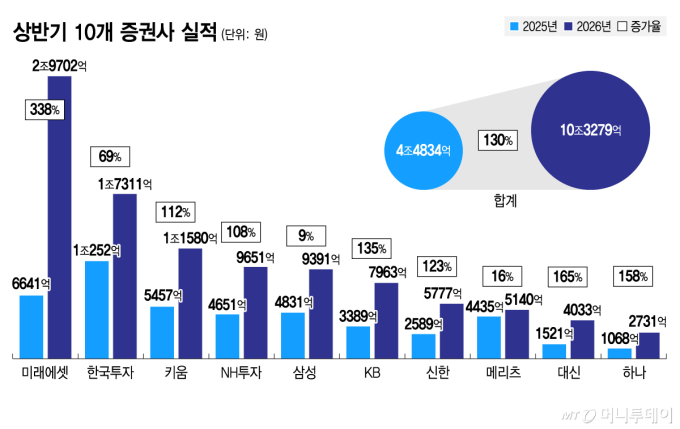
The background of the discussion on social contribution lies in the steep performance growth of the securities industry. The consolidated net profit for the first half of this year for the top 10 securities firms by capital stood at a total of 1.027 trillion won, surpassing the 1st trillion won mark for the first time. This represents more than double the figure from the same period last year and also exceeded last year's full-year net profit of 900 billion won in just six months.
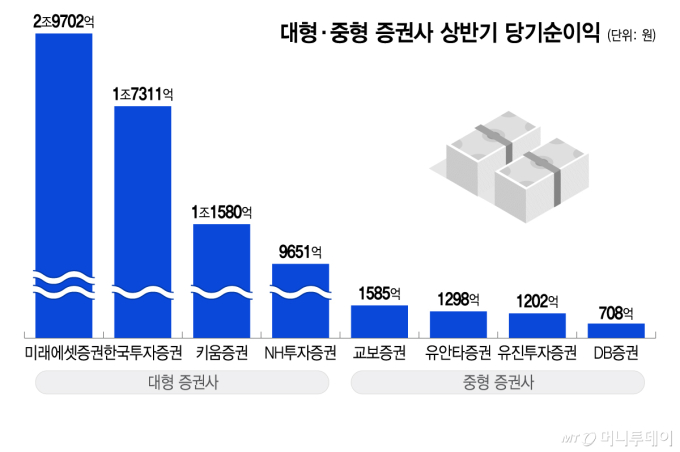
There are also hurdles to overcome in the process of fleshing out a joint plan. The securities industry experiences significant earnings volatility depending on market conditions, and there are differences in capital strength and profit scale between large firms and small-to-medium-sized firms. Issues such as the scale of social contribution, allocation criteria for each securities firm, and creating a sustainable structure that allows operations to continue even when business conditions deteriorate are expected to become key points of future discussion.
Park Hong-bae, a member of the Democratic Party of Korea serving on the National Assembly's Political Affairs Committee, stated, "Given that securities firms have achieved record-breaking performance levels, they must also expand their social responsibilities and roles accordingly." He added, "The industry should jointly develop sustainable social contribution plans that leverage the unique characteristics and expertise of the securities sector, including financial investment education, investor protection, and support for asset formation among youth and vulnerable groups."
② Expanding and strengthening financial investment education, etc., to "contribute to society by revitalizing the core business of securities firms"
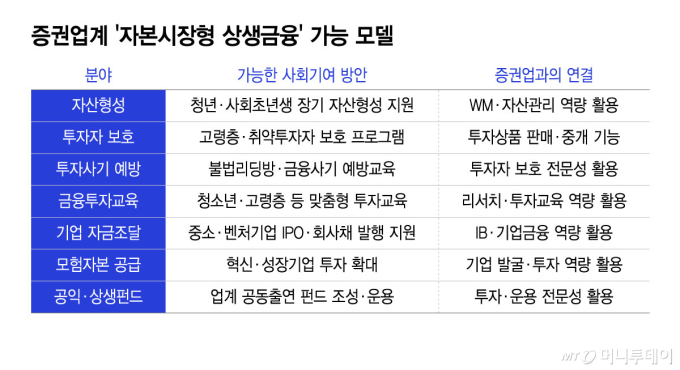
With record-breaking profits driven by a booming stock market, the securities industry is contemplating social contribution measures, with attention focused on "what to give back and how." The banking sector has expanded mutually beneficial and inclusive finance by directly alleviating financial consumers' burdens through interest refunds, rate cuts, and debt restructuring. However, securities firms with different revenue structures find it difficult to simply follow suit. As an alternative, "capital market-based mutual benefit finance" leveraging the core business of the securities industry—ranging from asset formation for youth, investor education, to funding for venture startups—is being discussed.
◇ Youth and Investor Support for 'Mutual Prosperity'... Expanding and Strengthening Investment Education
"Capital market-based mutual prosperity finance" is a method that provides tangible benefits to investors and companies by leveraging functions already possessed by securities firms, such as asset management, investment intermediation, and corporate finance. In particular, financial investment education is highlighted as a field where the securities industry can utilize its expertise in investment and asset management, offering significant potential for expanding social contribution.
Currently, the donations and contributions that securities firms are investing in financial investment education remain negligible compared to their performance or total scale of social contribution. According to data submitted by the Financial Supervisory Service to the National Assembly's Public Affairs Committee Park Hong-bae (Rep.), the donations and contributions related to financial investment education by the top 10 securities firms based on capital amounted to only 202 million won last year. In the first half of this year, it reached 269 million won, surpassing last year's level, but the absolute scale remains small. This indicates that there is room for the securities industry to make additional contributions.
With a shared infrastructure already in place, including the National Investor Education Council, it is possible to consider measures for the industry to expand its funding and participation to strengthen financial investment education for teenagers and young people, covering high-risk areas such as credit trading, margin trading, and leveraged products. Given the recent spread of "margin investing (investing with debt)" and the fact that there are numerous transactions that can increase investors' loss risks, the need for education that goes beyond simply conveying investment knowledge to properly instill an awareness of risk is growing. Lee Hyo-seop, a senior research fellow at the Korea Capital Market Institute, stated, "Providing financial investment education in a more meaningful way than today would be positive from the perspective of securities firms' trust," and added, "It will also help to curb margin investing (investing with debt) and guide investors toward asset management on a medium- to long-term basis."
Increasing the effectiveness of education, rather than just its quantity, is also a challenge. While pre-education is required for some high-risk products such as single-stock leverage and inverse products, there is a risk that such education may be completed in a purely formal manner. Yoo Eun-jeong of Chung-Ang University Gyeong Yeong-hak-bu (Prof.) stated, "To strengthen financial investment education, we could consider mechanisms to verify whether investors truly understand the content, but this is not an easy issue as it may lead to side effects and backlash." She added, "Basic education on finance and investing should be made available as a general subject starting from a younger age."
Supporting asset formation for young people and those newly entering society is also cited as one of the ways to contribute to society. This involves waiving or reducing transaction fees for a certain period for young people opening their first securities accounts or job seekers, among others. Since securities firms have provided fee benefits to attract new customers, these can be applied to specific demographics in line with social purposes.
◇ Fulfilling its core role of 'supplying venture capital'... supporting growth funding for ventures and startups
For corporations, it is possible to provide funding through venture and startup channels. Securities firms can directly invest in growth companies using their own capital or facilitate fundraising by connecting them with the capital market. Unlike simple donations, this approach leverages securities firms' capabilities in identifying companies and their investment banking (IB) expertise, thereby contributing to productive finance as well.
Financial authorities are also urging securities firms to fulfill their core role of supplying venture capital. Kwon Dae-young, Deputy Commissioner of the Financial Services Commission, stated at a consultation body held in May titled "Strengthening Venture Capital Capabilities of Securities Firms," saying, "It is possible to question whether, during the process of dramatic growth in securities firms' own capital over the years, that capital served as a catalyst for growth or was instead utilized for easy profit generation." He added, "Selecting growth potential hidden behind risks and creating new value is the very reason for the existence of the securities industry and the first step toward productive finance."
The industry jointly raising funds to establish a public interest and mutual prosperity fund is also one of the options. The fund model can be designed to operate over a long period, unlike donations that exhaust resources in a one-time manner, and utilize investment performance for social purposes again. If promoted as an industry-wide joint project, it could evolve beyond individual companies' corporate social responsibility into a mutual prosperity model for the entire securities industry.
A securities industry official said, "While we agree with the discussion on social contribution measures, we hope the conclusion will not simply be a matter of securities firms collecting money and donating a certain amount. We would like to see a plan that can be genuinely felt by those who receive help and also leverages the unique characteristics of the securities industry."
3. Performance volatility poses a challenge due to the disparity in physical strength between large and small companies... Reasonable burden-sharing and sustainability are key.
The securities industry, which posted record-breaking performance in the first half of this year, is seeking to expand its social contributions, but there are still significant challenges to address. The securities sector experiences high earnings volatility depending on market conditions, and there are also wide gaps in profits and capital strength among companies. Experts point out that it is crucial not only to provide one-time resources during boom periods but also to establish a system for social contributions that can be sustained even when market conditions change.
Particularly, concerns over earnings due to stock market volatility are slowing the pace of discussions on joint social contribution measures within the industry. Securities firms' revenues from key businesses such as brokerage, investment banking (IB), and trading are sensitive to market conditions including stock prices, transaction volumes, and interest rates. The securities industry is raising the possibility that stock market volatility may expand due to fatigue from the sharp rise in the first half of the year and macroeconomic uncertainties.
Smaller and mid-sized securities firms have more limited business portfolios than large firms and many rely heavily on performance in specific businesses, making them relatively more burdened by market fluctuations. Recently, forecasts emerged that declining transaction volumes and expanding stock market volatility could weigh on the second-half results of smaller and mid-sized firms.
Such disparities in financial strength among securities firms can become a variable when the industry develops a joint social contribution plan. If all securities firms are required to contribute the same amount to social contribution projects, it would inevitably place a relatively heavier burden on smaller and mid-sized firms. A securities firm official stated, "If the industry pursues this jointly, rather than imposing a uniform contribution amount across the board, consideration should be given to each company's capacity."
The scale and sharing method of social contribution support by securities firms have not yet been determined. It is expected that how to secure future funding and how to distribute the burden among securities firms will become major issues. A method of differentiating the burden based on each company's net profit, capital, or business scale could be devised. However, since net profit fluctuates significantly depending on market conditions and capital does not fully reflect current-year earnings, careful consideration is needed regarding which indicators to use as a basis.
Simply collecting one-time donations in proportion to profits earned this year can create another problem. When the stock market performs well, as it has this year, social contribution efforts are significantly expanded, only to be scaled back again when the market enters a downturn. A structure where the scale of social contributions fluctuates with stock market movements makes it difficult to ensure sustainability.
Some also point out that this discussion needs to go beyond one-off donations and evolve into a shared industry social contribution system with established principles. It is necessary to create a structure that reflects each securities firm's capacity to bear costs rather than basing contributions solely on profits in a specific year, and that allows the initiative to continue even amid changes in market conditions.
Whether the securities industry's social contributions will remain a fleeting act of "sharing" only during boom times or establish itself as a permanent role regardless of market conditions depends on the joint measures that will be developed in the future. The key lies in creating a sustainable structure that reflects each company's strength and the volatility of the securities industry's performance.
Experts are proposing alternatives such as differentiating the scale of contributions based on each securities firm's performance and capital strength, and utilizing funds secured during boom periods over several years. If the basis for contributions were set to average profits over recent years instead of net income in a specific year, it could mitigate the unique volatility of performance in the securities industry. Another option discussed is increasing contribution amounts when market conditions are favorable and reducing them when they deteriorate, while maintaining a certain level of social contribution projects by utilizing accumulated funds.
Rather than creating a new organization from scratch, utilizing existing industry infrastructure is also a path toward a sustainable model. Expanding the operations of existing organizations, such as the National Investor Education Council where the Korea Financial Investment Association serves as the secretariat, can reduce the costs associated with establishing a new body while ensuring continuity of operations.

 in STOCK


