

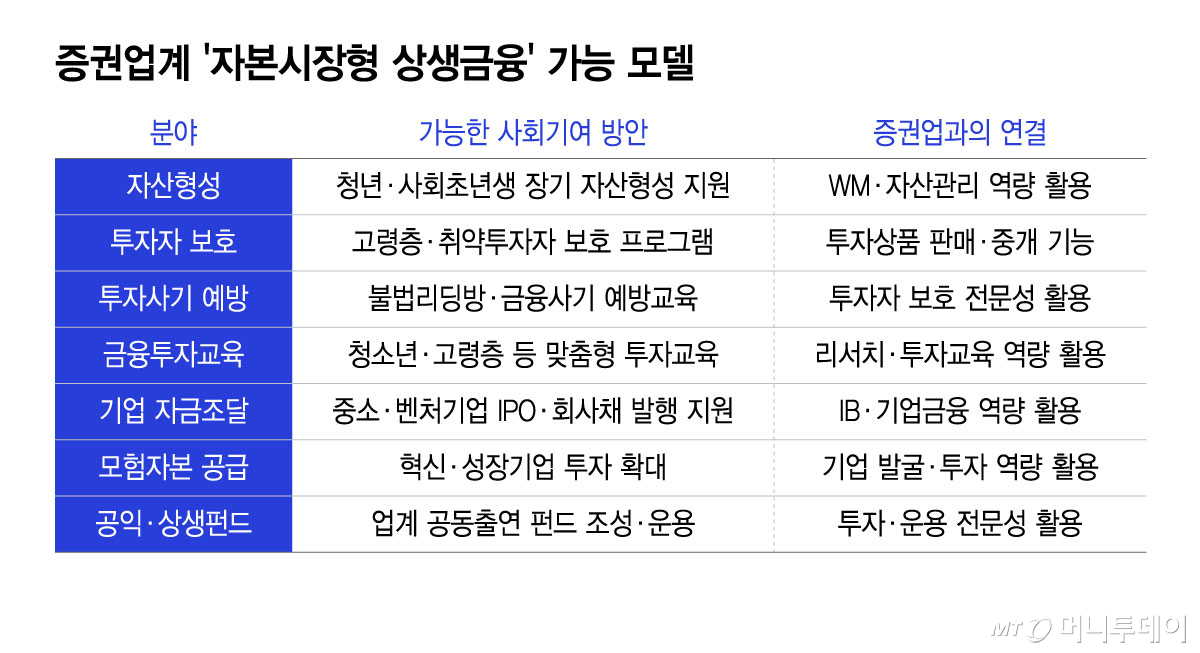
As the securities industry reaps record-breaking profits amid a booming stock market, it is contemplating ways to contribute to society. Attention is focused on "what and how to give back." The banking sector has expanded mutual prosperity and inclusive finance by directly reducing financial consumers' burdens through interest refunds, rate cuts, and debt restructuring. However, securities firms with different revenue structures find it difficult to simply follow suit. As an alternative, 'capital market-based mutual prosperity finance'—leveraging the core business of securities firms from youth asset formation to investor education and venture/startup funding—is being discussed.
'Capital market-based mutual prosperity finance' is a method that provides tangible benefits to investors and companies by utilizing functions already possessed by securities firms, such as asset management, investment intermediation, and corporate finance. In particular, financial investment education is highlighted as a field where the securities industry can leverage its expertise in investment and asset management while significantly expanding social contributions.
Currently, donations and contributions made by securities firms for financial investment education are negligible compared to their performance or overall scale of social contribution. According to data submitted by the Financial Supervisory Service to the National Assembly's Political Affairs Committee Park Hong-bae (Rep.), donations and contributions related to financial investment education by the top 10 securities firms based on capital amounted to only 202 million won last year. In the first half of this year, it reached 269 million won, surpassing last year's level, but the absolute scale remains small. This indicates ample room for the securities industry to provide additional support.
Since a shared infrastructure already exists through organizations such as the National Investment Education Council, the industry could consider expanding its resources and participation to strengthen risk education on high-risk investments like credit trading, margin trading, and leverage products for teenagers and youth. With the recent spread of 'margin investing (investing with debt)' and numerous transactions that increase investors' loss risks, there is a growing need for education that goes beyond simply conveying investment knowledge to properly instill awareness of risks. Lee Hyo-seop, senior researcher at the Capital Market Research Institute, stated, "Providing financial investment education more meaningfully than today would be positive in terms of securities firms' credibility," and added, "It would also help suppress margin investing (investing with debt) and guide investors toward asset management in the medium to long term."
Increasing the effectiveness of education rather than just its quantity is also a challenge. While pre-education is required for some high-risk products such as single-stock leverage and inverse products, it may end up being completed merely as a formality. Yeo Eun-jeong from Chung-Ang University Gyeong Yeong-hak-bu (Prof.) remarked, "To strengthen financial investment education, we could consider mechanisms to verify whether investors truly understand the content, but this is not an easy issue as it may lead to side effects and backlash." She further added, "Basic education on finance and investment should be introduced as a general subject starting from a younger age."
Supporting asset formation for youth and young professionals entering society is also considered one of the social contribution measures. This involves waiving or reducing transaction fees for a certain period for young people opening their first securities accounts or job seekers. Since securities firms have historically offered fee benefits to attract new customers, these incentives can be tailored to serve social purposes by applying them to specific groups.
For companies, it is possible to provide funding to venture/startup firms. Securities firms can directly invest in growth companies using their own capital or facilitate fundraising by connecting them with the capital market. Unlike simple donations, this approach leverages the securities industry's capabilities in company discovery and investment banking (IB), contributing to productive finance as well.
Financial authorities are also urging securities firms to fulfill their inherent role of providing venture capital. Kwon Dae-young, Deputy Commissioner of the Financial Services Commission, stated at a consultation body on strengthening the venture capital capabilities of the financial investment industry in May: "As securities firms' own capital has increased dramatically over the years, questions have been raised as to whether this capital served as a catalyst for growth or was merely used for easy profit generation. Selecting growth potential hidden behind risks and creating new value is the very reason for the existence of the securities industry and the first step toward productive finance."
Another option is for the industry to jointly raise funds to establish public interest and mutual prosperity funds. Unlike donations that deplete resources in a one-time manner, fund-based approaches can be designed to operate over the long term and reinvest management performance back into social purposes. If promoted as an industry-wide joint project, this could evolve beyond individual companies' social contributions into a mutual prosperity model for the entire securities sector.
A securities industry official said, "While we agree with discussions on social contribution measures, we hope the conclusion does not simply amount to securities firms collecting money and donating a certain amount." The official added, "We would like to see measures that can be genuinely felt by those who receive help while also leveraging the unique characteristics of the securities industry."

 in STOCK
