

The fourth week of August (24th–28th) was a "Big Week" filled with major events affecting the stock market, including Nvidia's earnings report, the Bank of Korea Monetary Policy Board meeting, and the U.S. Jackson Hole Symposium. As a result, the KOSPI faltered amid heightened caution throughout the week. Experts in the financial investment industry analyzed that with growing anxiety and the disappearance of earnings momentum, the KOSPI has entered a stock-specific trend phase.
According to data from Korea Exchange on the 29th, the KOSPI closed at 6,788.88 points for the fourth week of August, down 124.07 points (1.79%) compared to Jeonju. Selling pressure emerged early in the week due to disappointment over Samsung Electronics' shareholder return policy, pushing the KOSPI lower. Despite positive news on Nvidia's earnings surprise, caution surrounding major market events caused the KOSPI to decline for the entire week.
Lee Sang-yeon, a researcher at Shinhan Securities, stated, "Anxiety has spread across the broader stock market, and with the end of the earnings season, market momentum has vanished. While indices may fall, safe-haven sectors such as cosmetics and banking remain resilient. The market is gradually shifting toward a stock-specific trend."
During this period, top rising and falling stocks moved more in response to company-specific news—such as corporate splits, mergers, and shareholder return policies—rather than macroeconomic issues.
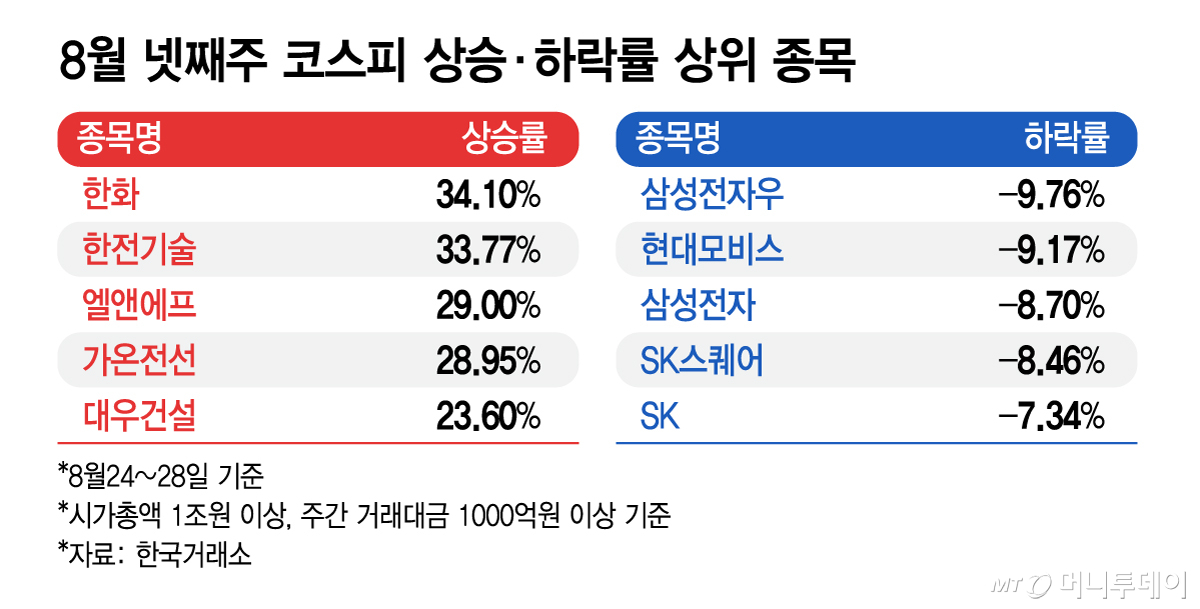
In particular, companies that announced shareholder return policies below market expectations saw significant declines during this period. Among KOSPI stocks (with a market capitalization of at least 1 trillion won and trading volume exceeding 100 billion won), the most declined stock was Samsung Electronics Preferred Stock, which fell by 9.79%. Samsung Electronics also slipped 8.7%, ranking third among the top decliners.
Samsung Electronics announced a shareholder return policy worth up to 110 trillion won immediately after market close on the 21st. However, this fell short of market expectations for large-scale share buybacks and other measures.
Hyundai Mobis, which dropped 9.17%, also declined amid disappointment over Hyundai Motor Group's shareholder return policy. Alongside Hyundai Mobis, Hyundai AutoEver (-7.14%), Hyundai Motor (-3.73%), and Kia (-2.22%) also fell together. Earlier, on the 24th, Hyundai Motor held its "2026 CEO Investor Day (CID)" and confirmed it would maintain its existing shareholder return policy.
SK Square and SK declined following news that SK Innovation would absorb SK i-Net Technology (SKIET) through a merger. SK Square fell 8.46%, and SK dropped 7.14%. SK Innovation also slipped 6.33%, driven by concerns that it would inherit the loss-making SKIET. However, securities industry experts analyzed that this merger would have limited impact on SK Innovation's fundamentals. During the same period, SK i-Net Technology surged 19.57%.
In contrast, Hanwha soared starting from its first day of relisting on the 25th following a corporate split. Hanwha rose 34.1% during the fourth week of August, recording the highest gain among all KOSPI stocks. On the 15th of last month, at an extraordinary shareholders' meeting, Hanwha decided to split into two entities: a company (surviving corporation) encompassing defense, shipbuilding, marine, energy, and financial sectors, and a newly established company, Hanwha Machinery & Service Holdings, which would hold the technology and life science divisions.
During the trading suspension period, the share value of Hanwha's major subsidiaries increased, while Hanwha's stock price traded at 69% below its net asset value (NAV). Consequently, Hanwha began surging from its first day of relisting.
△Korea Electric Power Corporation Technology (+33.77%), △L&F (+29.00%), △Gaon Cable (+28.95%), and △Daewoo E&C (+23.60%) also ranked among the top gainers.
Nuclear-related stocks, including Korea Electric Power Corporation Technology and Daewoo E&C, surged together amid expectations of new power plant orders. This followed media reports suggesting that the U.S. government proposed jointly acquiring shares in Westinghouse (WEC), a Korean nuclear company. However, the Ministry of Trade, Industry and Energy denied these reports as inaccurate.
Secondary battery stocks such as L&F also rose following news that Samsung SDI plans to sell its stake in Samsung Display to secure funds totaling 4.4 trillion won. Although Samsung SDI has not disclosed specific plans for fund utilization, industry observers expect the capital to be invested in projects such as Synergy Cells' facility construction at a battery plant under development in New Carlisle, Indiana, U.S. As a result, Samsung SDI surged 19.46%.
Power equipment stocks, including Gaon Cable, rose following news that U.S. President Donald Trump signed an executive order prohibiting the import and entry of certain foreign-made power equipment. Since this measure effectively targets Chinese-made power equipment, expectations grew that domestic power equipment manufacturers would benefit from the shift.


 in STOCK

