

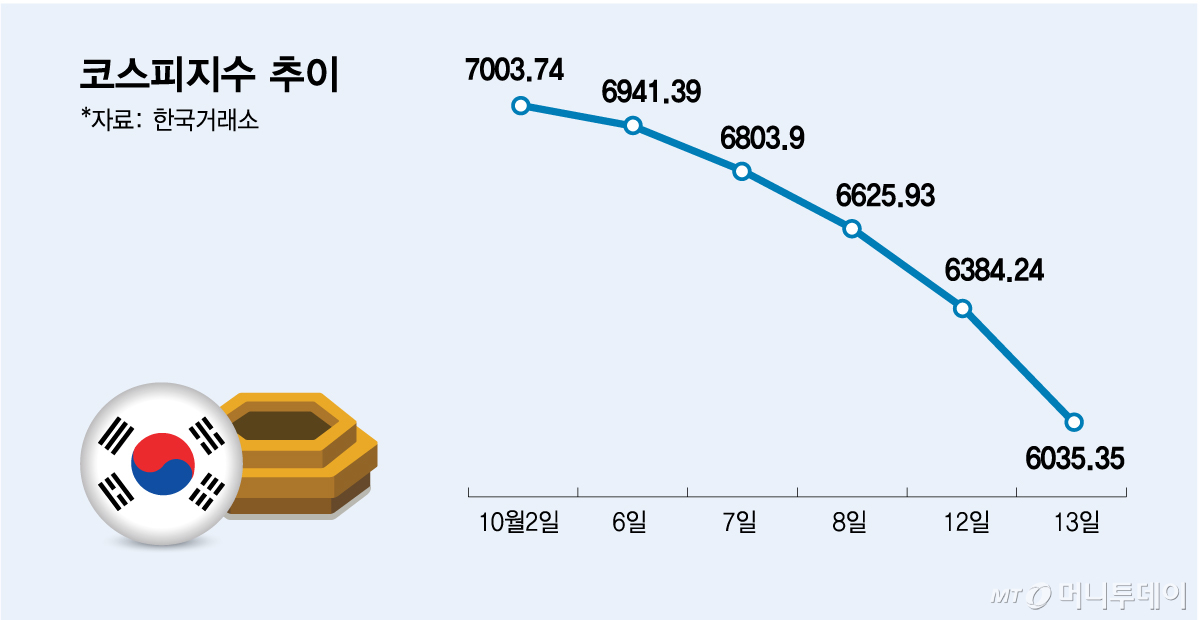
The KOSPI slid more than 5%, falling to the 6,030 level amid concerns over China-driven semiconductor supply, controversy over AI (artificial intelligence) profitability, and a selling offensive by foreign investors. The sell-side sidecar (futures market circuit breaker) was triggered for the first time in 35 trading days, and the index briefly dipped below the 6,000 mark during the session. Samsung Electronics and SK Hynix fell 7.29% and 10.09%, respectively.
On the 13th, the KOSPI closed at 6,035.35, down 348.89 points (5.46%) from the previous day. The KOSPI opened more than 3% lower and widened its decline, with the sell-side sidecar (futures market circuit breaker) activated early in trading.
During the session, it fell below the 6,000 mark to reach 5,911.11. This marked the first time since July 31 that the KOSPI dropped below 6,000 intraday, a span of 74 days.
Although it barely recovered above the 6,000 line just before the close, it could not avoid a fifth consecutive trading day of declines. The KOSPI, which stood at 7,003.74 on the 2nd, has now fallen to the low 6,000s.
What dragged down the KOSPI on this day was news that Chinese memory semiconductor firm ChangXin Memory Technologies (CXMT) plans to launch server-grade semiconductors within the year. As concerns over China-driven memory supply grew, the Philadelphia Semiconductor Index fell 2.67% in U.S. stock markets on the 12th (local time), and this impact also pushed down the share prices of Samsung Electronics and SK Hynix.
The controversy over OpenAI's annualized recurring revenue (ARR) has been revealed to stem from differences in calculation methods, yet it continues to act as a negative factor. The external environment is also unfavorable. With international oil prices rising and heightened caution ahead of the U.S. September CPI (consumer price index) release on the 14th (local time), foreign investors' risk appetite has weakened.
Kim Min-gyu, a researcher at KB Securities, said, "The causes are deteriorating investment sentiment in the semiconductor sector, a supply-demand gap in the stock market, and the persistence of an unstable macro environment," adding, "Net selling by foreign investors continues, centered on the semiconductor industry."
In the KOSPI market, foreign investors made net sales of 4.533 trillion won. Retail investors and institutional investors made net purchases of 2.2361 trillion won and 1.6884 trillion won, respectively. Most of the institutional investor net buying was by financial investment firms, with the bulk of their purchases related to ETFs (exchange-traded funds). As share buybacks by Samsung Electronics and SK Hynix enter their final stages, a supply-demand gap is emerging.
Among KOSPI sectors, electrical and electronics, which includes semiconductor stocks, fell 7.61%. Manufacturing dropped 6.28%, while finance and machinery/equipment slid more than 3%. Insurance, distribution, securities, and chemicals showed declines in the 2nd% range. In contrast, entertainment/culture rose 2.11%. Medical/precision instruments and electricity/gas gained more than 1%.
Most of the top market capitalization stocks on the KOSPI declined. Samsung Electronics fell 7.29%, and SK Hynix plunged 10.09%. Investor sentiment appears to have been dampened by news of CXMT's plan to launch server memory. 'S7' stocks also fell across the board. SK Square plunged 12.91%, and Samsung Electro-Mechanics dropped 8.34%.
Among the top 20 market capitalization stocks, LG Energy Solution jumped 3.02%. Samsung Biologics, Kia, and HD Hyundai Heavy Industries closed slightly higher.
The KOSDAQ closed at 837.03, down 12.16 points (1.43%) from the previous day.
In the KOSDAQ market, retail investors made net sales of 190.9 billion won. Foreign investors and institutional investors made net purchases of 139.9 billion won and 42.9 billion won, respectively.
Among KOSDAQ sectors, technology growth companies fell 4.03%. Non-metals and general services showed declines in the 3rd% range. Distribution, pharmaceuticals, and electrical/electronics dropped more than 2%. In contrast, publishing/media reproduction rose 2.78%. Entertainment/culture, finance, and machinery/equipment closed slightly higher.
Among top KOSDAQ market capitalization stocks, Fadu showed weakness of 7.15%. ISC fell in the 4th% range, while Alteogen and Iotech dropped in the 3rd% range. In contrast, PSK Holdings rose 7.2%, and Jusung Engineering jumped 3.56%.
On this day, the won/dollar exchange rate closed daily trading at 1,345.1 won, up 10.0 won from the previous close.

 in STOCK
