

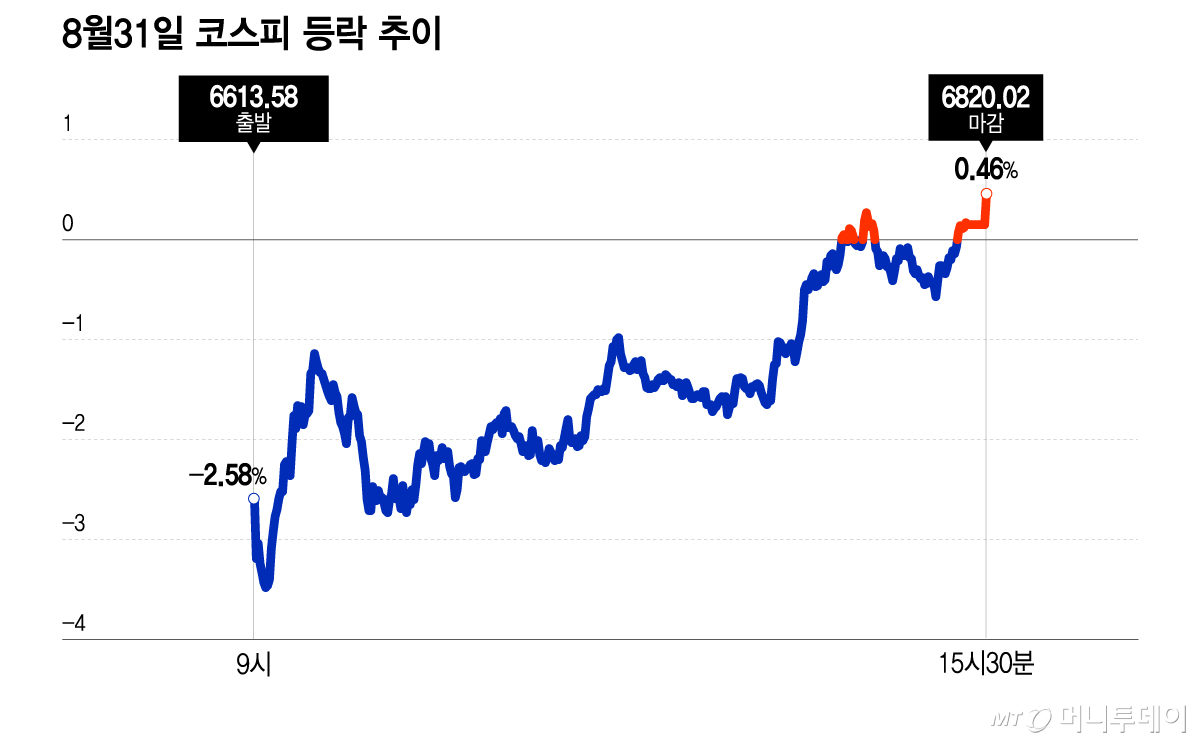
The KOSPI index recovered the 6,800 level. Share buybacks by the twin leaders of the semiconductor sector pushed the end-of-month market slightly higher. Amid rising U.S. interest rates that repeatedly triggered selling sentiment, market attention focused on whether Broadcom's upcoming earnings report and U.S. employment data could alleviate concerns.
On the 31st, the KOSPI index closed at 6,820.02, up 31.14 points (0.46%) from the previous trading day. The index initially slid to 6,547.76, down 241.12 points (3.55%), just six minutes after the market opened, before rebounding and shifting to an upward trend in the latter half of the session.
Among the top market capitalization stocks, Samsung Electronics closed at 260,000 won, up 3,000 won (1.17%), and SK Hynix closed at 1,674,000 won, up 21,000 won (1.27%) during regular trading hours, contributing approximately 37 points to the index rise.
Samsung Electronics, LG Energy Solution, and Samsung Biologics showed gains in the 2nd% range, while Hyundai Motor posted strength in the 1st% range. KB Financial Group, SK Square, and Samsung C&T closed with a slightly positive trend, whereas Samsung Life Insurance ended the session in the 1st% negative range.
By sector, KOSPI's electrical and electronics and chemical sectors closed with gains in the 1st% range. Conversely, construction, machinery and equipment, and metals sectors fell by around 3%, while telecommunications, general services, and insurance sectors declined by about 2%, and electricity/gas and securities sectors dropped by approximately 1%.
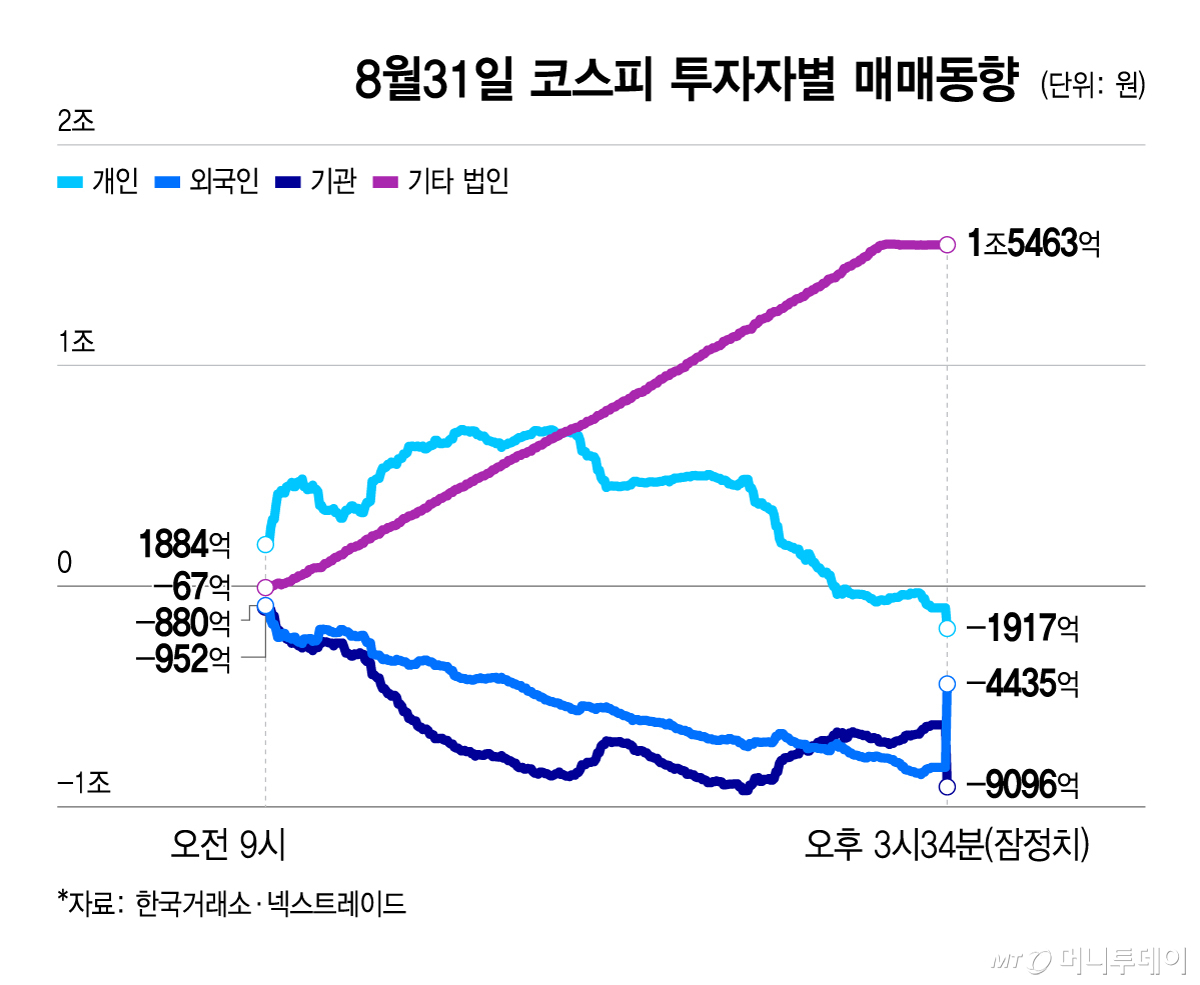
Looking at supply and demand, based on the provisional figures at 3:34 p.m., Korea Exchange and NextTrade recorded net purchases totaling 1.5433 trillion won by other corporations, offsetting net selling by institutional investors (909.6 billion won), foreign investors (443.5 billion won), and retail investors (191.7 billion won). Other corporations include accounts where direct corporate stock transactions such as share buybacks are recorded.
On this day, it is interpreted that the KOSPI market saw a rebound in the index as Samsung Electronics and SK Hynix, which had previously announced purchases of 20 thousand won shares and 650,000 shares respectively before the market opened, supported the downside through split purchases during trading hours, while institutional investors reduced their net selling volume.
Im Jeong-eun and Tae Yun-seon, researchers at KB Securities, stated, "Kevin Warsh's remarks at the Jackson Hole meeting on the 28th (local time) were interpreted as hawkish, strengthening expectations for interest rate hikes." They added, "After U.S. semiconductor stocks such as Nvidia, which surged sharply in the New York market on the previous day, closed weakly, the domestic market initially fell sharply but recovered its losses with the rebound of the two major semiconductor stocks today."
They further noted, "This week, U.S. August non-farm employment and unemployment rate data, as well as earnings reports from technology companies such as Dell and Broadcom, are scheduled for release." They added, "The Federal Reserve's September interest rate policy direction and the differentiation of technology stocks based on AI (artificial intelligence) related earnings are expected to determine the market's direction."
Lee Jae-won, a researcher at Yuanta Securities, stated, "With interest rate concerns not fully resolved and geopolitical tensions between the U.S. and Iran intensifying, the KOSPI index recovered primarily driven by large-cap stocks with concentrated share buyback supply and second-generation battery and energy storage system (ESS) stocks confirmed to have policy and order momentum."
The researcher added, "Today was the day when the structure of interest rates capping the upside and shareholder returns supporting the downside was most clearly confirmed." He also noted, "Considering trends in the KOSDAQ market, small- and mid-cap stocks, and the number of rising stocks, the market has not yet reached a stage of full recovery in risk asset preference sentiment."
The KOSDAQ index closed at 834.29, down 4.12 points (0.49%) from the previous trading day. Retail investors made net purchases totaling 293 billion won, while institutional investors and foreign investors recorded net sales of 207.7 billion won and 88 billion won, respectively.
Among market capitalization top stocks, Simtek rose in the 5th% range, EcoPro BM gained in the 2nd% range, and IOTech and EcoPro showed strength in the 1st% range. Conversely, Alteozen fell by around 3%, and HLB dropped by approximately 1%, accelerating weakness in biotech stocks.
By sector, KOSDAQ's non-metallic minerals rose in the 2nd% range, and paper/wood products gained in the 1st% range. Conversely, pharmaceuticals and general services fell by about 2%, while IT services, textiles/apparel, and construction sectors declined by approximately 1%.
The won/dollar exchange rate closed Seoul's foreign exchange market weekly trading at 1,368.6 won, down 3.9 won from the previous day as of 3:30 p.m., marking its lowest level in 13 months.

 in STOCK

